Phase Transition Without Symmetry Breaking express
A crowd of people moves freely across a square, but suddenly freezes in place without changing their positions. Everyone stays where they were, but motion stops. This is exactly what a symmetric mass generation transition looks like: the system gains rigidity, yet its symmetry remains untouched.
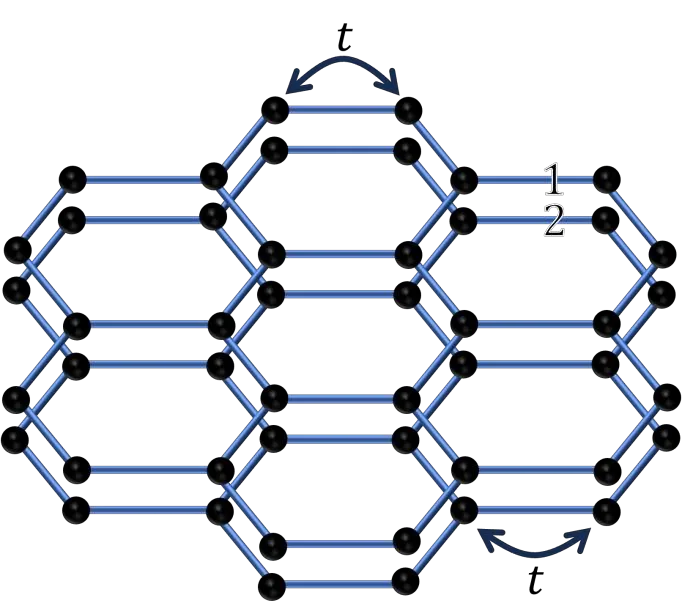
In the paper, physicists simulated such a transition in a bilayer honeycomb lattice — a structure resembling honeycomb but made of two layers of atoms. They used the quantum Monte Carlo method, which allows an honest account of all quantum fluctuations, and found the critical point at an interaction parameter value of 2.584. Below this point, the system behaves as a Dirac semimetal, where electrons move like massless particles, and above it, as an insulator with an energy gap, but without symmetry breaking.
Then the scientists drove the system out of equilibrium by slowly changing the parameter and found that even without the usual conditions for the Kibble–Zurek mechanism, the dynamics follow generalized finite-time scaling. This means that the out-of-equilibrium properties are also universal and do not depend on the model's details.
Such a transition is important for understanding how matter can acquire mass without the Higgs mechanism and could help in the search for new states in materials and even in particle physics.
The symmetric mass generation transition is similar to how a liquid turns into glass: atoms freeze, but their arrangement does not become ordered.
In science fiction, such transitions could explain how matter suddenly becomes impenetrable without changing its structure.