Gold breathes in liquid express
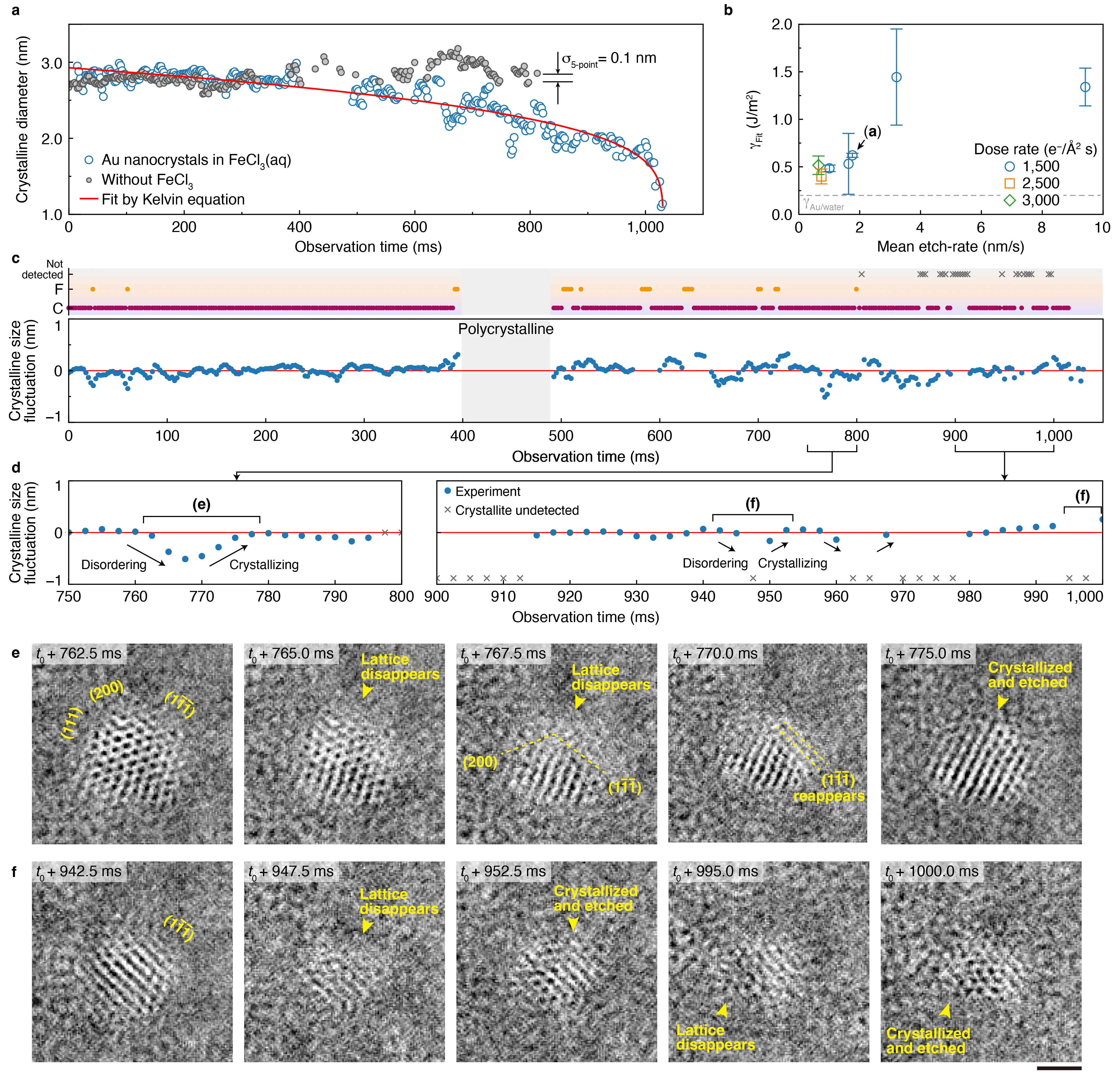
Gold nanoparticles in liquid are like tiny living creatures: they constantly change their internal structure, as if breathing. Scientists managed to peek into this process using an electron microscope that takes snapshots every millisecond, and a neural network that cleans the images from noise. It turned out that the crystal lattice of the particles sometimes becomes as strict as rows of soldiers on parade, and sometimes falls into disorder, like a crowd after a concert.
These changes are not random. They depend on what surrounds the particle: which molecules float in the liquid, which ions stick to the surface. When the environment changes, the particle rearranges instantly. This "nervousness" affects how fast gold dissolves and how neighboring crystal grains fuse. Previously, these processes were too fast to see, but now they are in the lens.
Understanding such dynamics will help create more stable catalysts, sensors, and other devices where nanoparticles work in liquid. If you know how a particle reacts to its environment, you can choose conditions under which it will last longer and work more reliably.
A single gold nanoparticle contains only a few thousand atoms, and each of them can move within milliseconds — for comparison, in an ordinary gold ring, atoms are practically immobile.
In Michael Crichton's novel "Prey," nanorobots capable of rearranging in response to their environment spiral out of control — research into such dynamic nanoparticles brings us closer to understanding similar scenarios.