Mass loss rate is the average speed at which a nanoparticle sheds its material, typically measured in atoms per second or grams per second. In the context of the provided research, this concept is central to understanding how gold nanoparticles on a hot substrate gradually shrink — a process that affects their optical and electronic properties. The rate depends on temperature, particle size, and the surrounding environment, and it is a key parameter in nanofabrication and sensor design.
History
The systematic study of nanoparticlemass loss dates back to the mid-20th century with the development of thermogravimetric analysis, but the specific application to gold nanoparticles on substrates gained prominence in the 1990s with advances in in-situ electron microscopy.
How it works
At elevated temperatures, surface atoms gain enough energy to overcome the binding forces that hold them in the nanoparticle lattice. These atoms then evaporate or diffuse away, reducing the particle's mass over time. The rate is governed by an Arrhenius-type relationship, where the activation energy for desorption and the temperature exponentially influence how quickly mass is lost. For gold on a hot substrate, the process can be accelerated by surface diffusion and interactions with the substrate material.
In practice
This concept is used to predict the stability of nanoparticles in high-temperature catalytic converters and to design nanoscale sensors that must maintain their size over time.
Fun fact
A single gold nanoparticle can lose thousands of atoms per second at temperatures just a few hundred degrees Celsius, yet remain visible under an electron microscope for hours.
Units by system: SI: kgs · CGS: gs · Planck: m pt p · natural: evc2
A lake in a drought doesn't dry up all at once. First, islands of dry land appear on the water's surface, they expand and merge, and only then does the water recede from the exposed bed. A mirabilite crystal behaves similarly when it loses water: round patches of anhydrous salt appear on its surface, growing outward and then beginning to deepen.
A stone thrown into water quickly loses speed. A meteor entering the atmosphere should behave the same way: air slows it down, and friction burns up its material. But cameras of the Global Fireball Observatory network have captured hundreds of bright fireballs over ten years that streak across the sky with almost no deceleration.
A perovskite solar cell is like a young athlete: it performs brilliantly at first, but tires with age. Over eight hours, its performance drops noticeably, with no visible cause like cracks or dust. Scientists took one cell and recorded its performance at 0, 90, 280, and 480 minutes of its life.
A cosmic "caliper" will soon measure a neutron star to within a hundred meters. For an object a couple dozen kilometers across, that's like measuring the thickness of a human hair from a kilometer away.
A neutron star is the remnant of an exploded supernova.
A hunter sets snares in the woods. They know the animal's habits but not whether it will ever show up. In much the same way, physicists set up detectors in hopes of catching particles of dark matter — the invisible substance thought to make up most of the Universe's mass.
A new study offers hunters an unusual tool: not a trap, but a measuring tape.
A laser is like a tuning fork that rings at a single note. But even in complete silence, its sound trembles slightly. Previously, it was thought that this tremor, random kicks from spontaneous emission of light by atoms inside the laser, was the main limit to precision.
In diamond quantum devices, there's a tiny defect — the nitrogen-vacancy center (a nitrogen atom plus a vacancy where a carbon atom should be). It acts as a switch that spontaneously flips back and forth: it can carry an extra electron or not, and this determines whether it emits light or not.
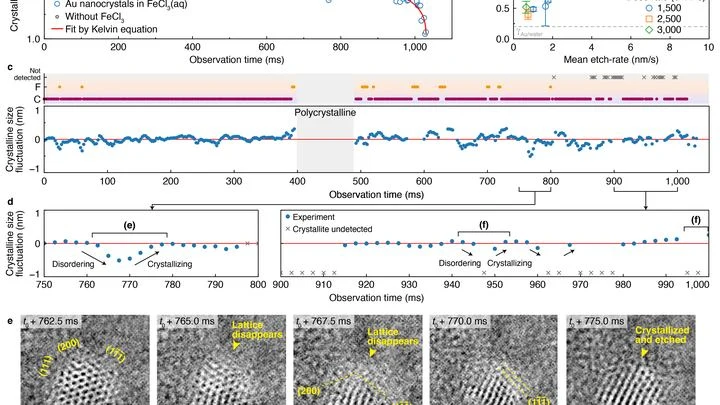
Gold nanoparticles in liquid are like tiny living creatures: they constantly change their internal structure, as if breathing. Scientists managed to peek into this process using an electron microscope that takes snapshots every millisecond, and a neural network that cleans the images from noise.
Drop tiny gold spheres onto a scorching skillet: each smaller than a hundredth of a hair's width. Under an electron microscope, you can watch them slowly evaporate. It seems simple: each sphere should shrink evenly, like an ice cube in warm water. But instead of a steady shrinkage, the particles behave like drunk pedestrians: one step forward, two to the side.
A lithium battery is like a house with a storage room: during charging, lithium goes inside; during discharging, it comes out. But if the storage room gets cluttered, some lithium stays inside forever. How much lithium returns depends on the metal the walls are made of.
The authors of the study took four metals: aluminum, magnesium, silver, and copper.