A Light Vortex That Keeps Its Shape express
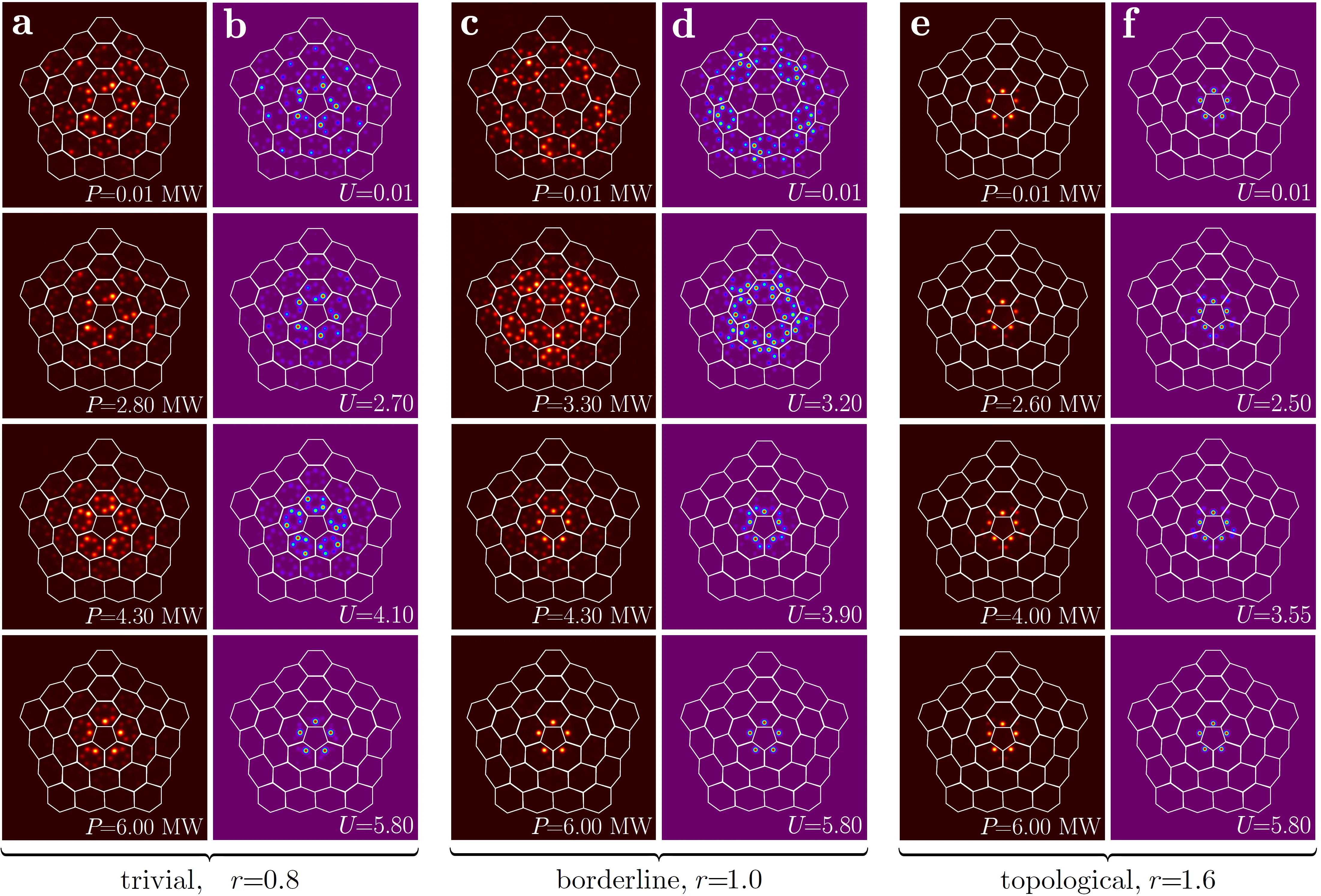
A laser beam twisted into a spiral looks like a drain vortex in a sink: light moves not only forward but also in circles. Such vortex beams already help move tiny particles and transmit more data. But once they pass through an inhomogeneous medium, the vortex falls apart, like water from a leaky bucket.
Photonics — the science of light in microchips — has found a way to hold the vortex. In glass, laser-written waveguide tracks were burned, but not in straight rows; instead, they included a defect — like a missing strand in a woven basket. This defect creates a protected channel through which light travels, ignoring scratches and dust.
The researchers superimposed two protected light streams and obtained a vortex that doesn't disintegrate. Its shape doesn't occur in ordinary lattices — because ordinary lattices are too regular. Here, the defect helps rather than hinders.
This discovery bridges two ideas: light that carries rotation and a material that shields light from disturbances. In the future, such vortices could serve as couriers in optical computers or as tweezers for assembling micromachines.
Original abstract
as written by the authors arXiv:2603.27219
Vortex-carrying wave fields play a crucial role in photonics due to unusual propagation properties and interactions with matter, which enable numerous practical applications ranging from optical tweezers and imaging to information encoding and transmission. Localized vortex-carrying beams propagating in nonlinear optical media may form self-sustained excited states-vortex solitons-which are, however, usually prone to instabilities and require high powers for their stabilization in non-topological materials. Using fs-laser written aperiodic waveguide arrays, we demonstrate that photonic topological insulators with disclinations admit the formation of stable and thresholdless vortex solitons with tunable shapes. These unique materials belong to a class of higher-order topological insulators and allow the propagation of localized, topologically protected excitations at the disclination core, enabling disorder-resistant transmission of signals and energy. We show that vortex solitons bifurcate from the superposition of topologically protected linear edge states at the disclination core and remain stable in the entire forbidden topological gap. Realized topological vortex solitons with symmetries that are inaccessible in periodic lattices are the first example of excited soliton states with non-trivial phase structure in a topological insulator. Our findings shine a light on the interplay between nonlinearity, the angular momentum degree of freedom of light, and the material topology.
The laser used to burn tracks in the glass fires pulses lasting femtoseconds — that's one millionth of a billionth of a second. In that time, light travels less than the thickness of a human hair.
In the TV series "Stargate," portals transport characters through swirling rings of light — similar to those studied in this work.