Why Gatemon Qubits Lag Behind Regular Qubits express
Two identical cars roll off the same assembly line. Body, wheels, steering — everything matches. Only one has a regular gasoline engine, while the other has a hybrid engine that can be tuned to the road. And the hybrid stalls after a couple of kilometers, while the gasoline one runs for tens. That's roughly the situation with two types of superconducting qubits — the building blocks of a quantum computer.
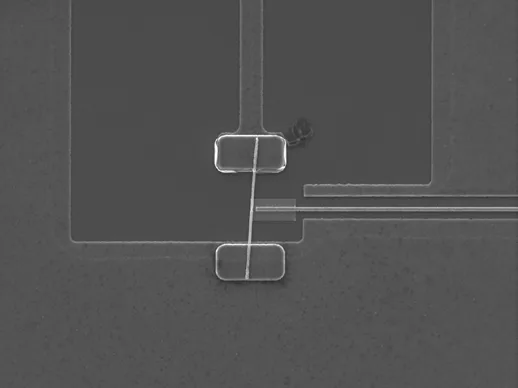
In a new study, physicists fabricated two kinds of qubits on a single chip: regular ones with a tunnel junction between superconductors, and gatemons — with a junction that has a piece of semiconductor embedded in it. Everything else (wiring, dielectrics, control lines) was identical. The only difference lies in the heart of the qubit: the Josephson junction, which determines its quantum properties. And here's the result: regular qubits live for tens of microseconds, while gatemons last only a few. Moreover, the gap cannot be explained by radiation losses or circuit leakage — all these channels were calculated and subtracted. What remains is the junction itself.
Measurements at different temperatures showed that quasiparticles, excitations that destroy quantum information, behave identically in both types of junctions. So they are not the culprit. The difference lies in something else, something that does not depend on temperature and sits deep within the junction itself. Perhaps it's material defects or uncontrolled processes at the superconductor-semiconductor interface. It's as if the hybrid engine had an invisible crack — not visible on the blueprint, but constantly siphoning off power.
Until gatemons catch up with regular qubits in lifetime, quantum computers based on them will lose in reliability. But at least now it's clear where to look: not at external noise, but inside the junction itself. Perhaps engineers will find a way to patch that crack, and then flexible qubits will become not only convenient but also long-lived.
A Josephson junction consists of two superconductors separated by a thin layer of insulator or semiconductor. Through such a barrier, Cooper pairs, bound pairs of electrons that create superconductivity, tunnel. The barrier is only a few nanometers thick, thousands of times thinner than a human hair.
In the TV series 'Devs', a quantum computer is built on superconducting qubits, and the characters fight for every percentage point of accuracy — much like physicists today fight for microseconds of gatemon lifetime.