Dust Grains Like Shuttlecocks: How Patterns Emerge in Protoplanetary Disks express
Around young stars, disks of gas and dust swirl — the building blocks for future planets. Inside these disks, dust grains don't just fly randomly: they align along invisible lines of gas flow. Recently, astronomers noticed that dust grains in such disks behave like badminton shuttlecocks — always turning their long side into the wind.
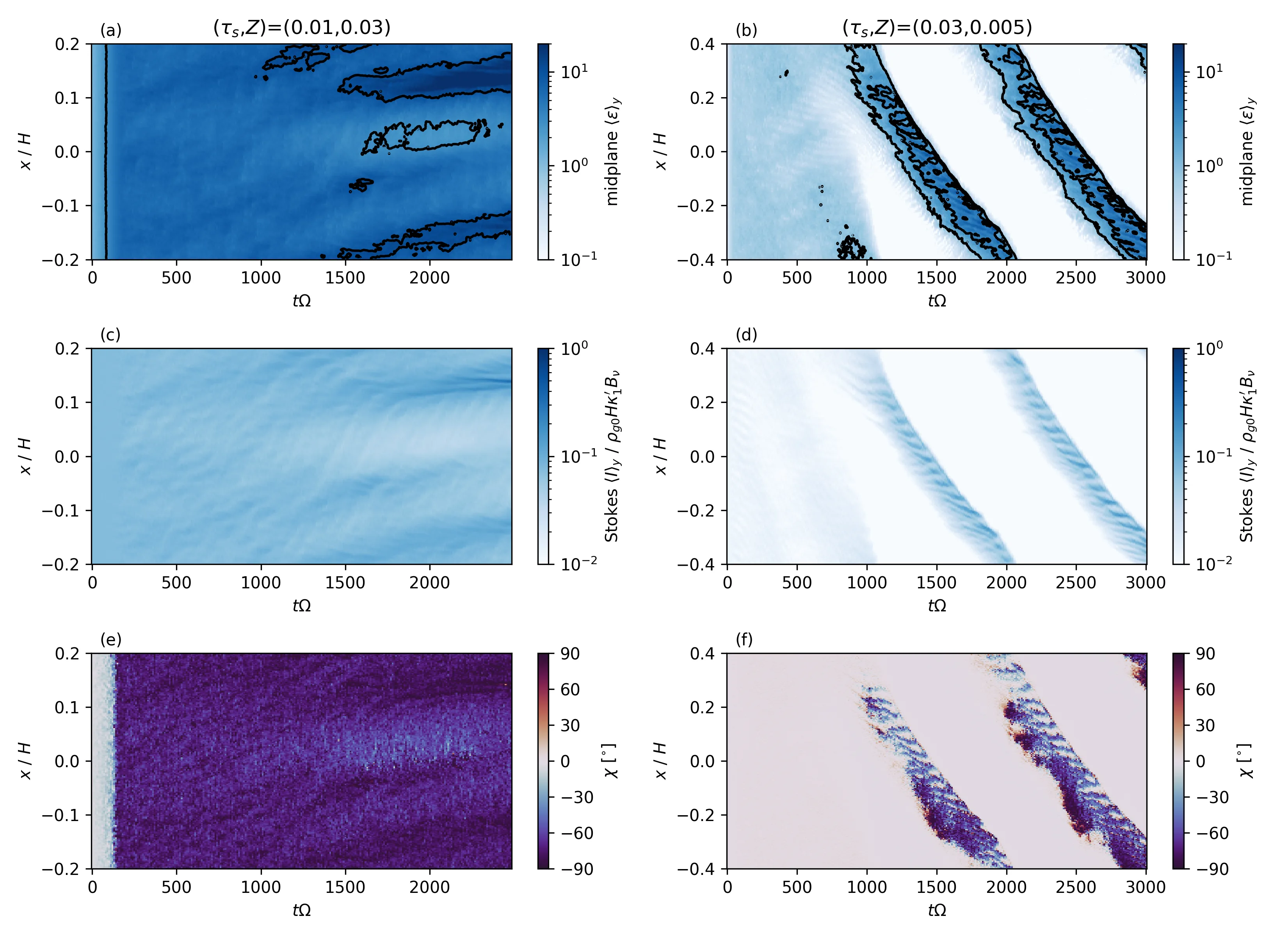
Polarized light from these disks revealed that large grains, about a hundredth of a millimeter in size, are aligned along the disk's circumference. But why? In a new study, scientists modeled how gas and dust mix in the disk. It turns out that in regions with little dust, gas flows outward from the star, and grains align along this flow, like weather vanes. But where dust is abundant, it starts to 'push' the gas, and the flow curls into circular motion. Grains follow suit and align along the circumference.
This is how the pattern seen by telescopes is born: in dense clumps, grains lie across the line of sight, and their polarized glow is oriented along the disk's circle. This means that active mixing is happening in the disks — dust gathers into clumps that could become planet seeds. By observing polarization, astronomers can peek into this process without waiting for a planet to form.
Original abstract
as written by the authors arXiv:2604.05122
(Sub)millimeter dust polarization in protoplanetary disks has revealed the presence of large (~ 100 um) dust grains that are aligned along their long axis following the azimuthal direction of the disk. The novel badminton birdie-like aerodynamic alignment predicts large grains to align with their long axes following the direction of gas flow experienced by the dust, denoted as the A-field. With 3D streaming instability (SI) simulations, we find that the A-field is predominantly in the radial direction in regions of low dust-to-gas ratio, but in the azimuthal direction in regions of high dust-to-gas ratio. Through polarized radiation transfer, we find that the resulting polarization angle indeed follows the disk azimuthal direction in the high dust density regions. Therefore, ongoing SI is an attractive candidate for producing the azimuthal dust polarization pattern as observed in an increasing number of disks.
Dust grains in disks are a thousand times thinner than a human hair, yet their collective alignment is visible from hundreds of light-years away.
In Stanisław Lem's novel 'Solaris', the planet's ocean creates ordered structures from particles — somewhat similar to how dust grains in disks align into patterns.