Astrophysical polarimetry is the measurement and interpretation of the polarization of light coming from celestial objects. Unlike a simple intensity or spectrum, polarization carries information about the geometry and physical conditions of the source: the orientation of magnetic fields, the shape and alignment of dust grains, and the processes that generate the light itself. By analyzing how the electric field of light waves is oriented, astronomers can probe environments that are otherwise invisible, from the magnetic fields around black holes to the turbulent regions where stars are born.
History
The first astronomical polarimetric observations were made in the early 20th century, but the field grew significantly in the 1940s–1950s when the polarization of starlight was discovered and linked to interstellar dust. Modern high-precision polarimetry became a standard tool with the advent of CCD cameras and space telescopes.
How it works
Light becomes polarized when it interacts with matter or magnetic fields in a way that favors certain orientations of the electric field. For example, scattering by electrons or dust grains, or emission from charged particles spiraling in magnetic fields (synchrotron radiation), produces characteristic polarization patterns. Instruments called polarimeters, often mounted on telescopes, measure the fraction of light polarized and its position angle. Comparing these measurements across wavelengths and over time reveals the structure of magnetic fields and the distribution of scattering material along the line of sight.
In practice
Polarimetry is used to map magnetic fields in the solar corona, study the geometry of supernova explosions, and characterize the atmospheres of exoplanets. It is also a key technique in cosmic microwave background research, where the polarization pattern encodes the early universe's history.
Fun fact
The polarization of light from a gamma-ray burst can reveal whether the burst's magnetic field is ordered or chaotic, providing a direct probe of the most extreme accelerators in the universe.
The night sky looks calm, but in reality, invisible particles, cosmic rays, are constantly flying through us. Among them are electrons and their antimatter counterparts, positrons. When they collide with detectors on satellites or balloons, the instruments record their energy.
On the wall: light and dark fringes. That’s what light looks like when it cancels itself out.
Way back in the 17th century, Christiaan Huygens suggested that light is a wave.
Light from the very beginning of the cosmos has been traveling toward us for 13.8 billion years. During that time, its polarization, the direction of its oscillations, might have been twisted, like a compass needle that someone quietly nudged. Physicists call this phenomenon cosmic birefringence.
An ordinary flashlight emits light whose waves oscillate in all directions at once. But pass that light through a special filter, and you get a beam that oscillates strictly in one plane: that's polarized light. When such a beam travels through biological tissue, the tissue's internal structure slightly alters the orientation of the oscillations.
At the hearts of many galaxies, cosmic tops of incredible power spin — supermassive black holes. Their nature was first described by Schwarzschild right after Einstein gifted the world with general relativity.
The universe sounds with silence. The lion's share of matter — about 85%—remains invisible, manifesting only through gravity. Back when Vera Rubin Vera Rubin showed that galaxies spin as if wrapped in unseen mass.
A black hole is not just a dark silhouette against the stars. Its shadow is surrounded by a thin glowing ring of photons that loop around the event horizon before escaping to an observer.
In a close binary system, the hot star, like a searchlight, illuminates its cooler companion. Some of the light scatters off free electrons in its atmosphere — this is Thomson scattering — and acquires linear polarization. As the stars orbit each other, this polarization rotates, like the hand of a peculiar cosmic metronome.
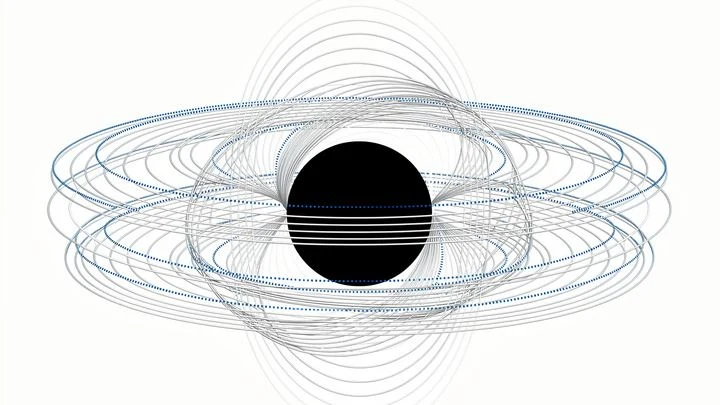
A spinning top whirling so fast that it forces light around it into spirals: that's a fitting image for what happens near a black hole's horizon. Hot plasma falls in and emits radio waves. Their polarization (the plane in which the wave oscillates) becomes an arrow pointing in the direction of energy flow.
Red giants are swollen, aging stars. Deep inside, an ocean of plasma churns: heat forces its way from the core to the surface, generating waves like a mighty surf. The star's magnetic field acts like an invisible seabed – it steers these waves, changing their height and speed.
Gravitational waves are the trembling of spacetime itself. Usually we only catch their overall hum, but each wave also has a direction of oscillation – polarization. Old maps were built only from signal loudness, which led to errors. It's like trying to see the bottom of a pond through sun glare.
A flashlight beam glides over uneven glass. The glass is massive galaxy clusters, and the flashlight is ancient light born shortly after the big bang. Passing by such clusters, light doesn't just bend around them like water around a rock. Its path shifts slightly sideways, and the amount of shift depends on how the light is 'twisted'—right or left.
When two black holes merge, they shake the very fabric of spacetime. The newborn giant doesn't settle instantly (it rings like a cosmic bell, emitting a characteristic pattern of damped gravitational waves) the so-called ringdown.
A stellar river winds around the center of a distant galaxy like a glowing ribbon on an invisible frame. That frame is the dark halo: a vast cloud of invisible dark matter whose gravity holds stars and gas in place. If the halo is squashed like a pumpkin or stretched like a melon, the stellar stream will bend differently.
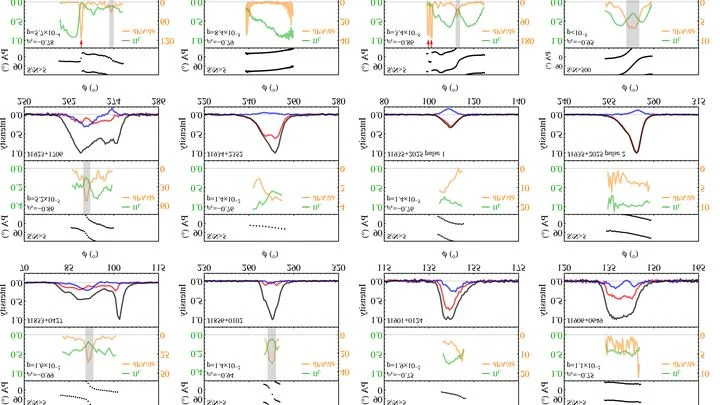
The neutron star 4U 1735-44 is gobbling up matter from a companion star. The matter spirals into a flat disk, like water going down a bathtub drain. But this disk shines in X-rays, and astronomers have for the first time measured how "combed" those rays are: that is, how polarized.
When particles collide at enormous speeds, they produce a shower of new particles. Among them are antiprotons — twins of ordinary protons but with the opposite charge. Each of these particles has its own spin, like a tennis ball sent with a twist. But whether antiprotons are actually spun up at birth has never been checked.
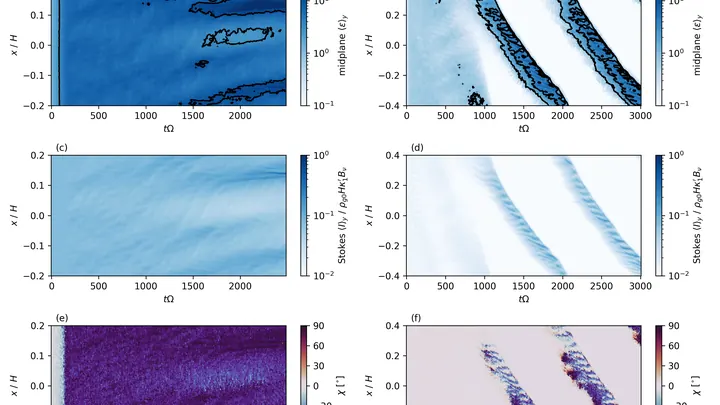
Around young stars, disks of gas and dust swirl — the building blocks for future planets. Inside these disks, dust grains don't just fly randomly: they align along invisible lines of gas flow. Recently, astronomers noticed that dust grains in such disks behave like badminton shuttlecocks — always turning their long side into the wind.
You can make a light beam look like a flower with several petals. If you send such a beam through a cloud of cold rubidium atoms and switch on a magnetic field, the petals start to rotate. The angle of rotation is directly linked to the field's strength.
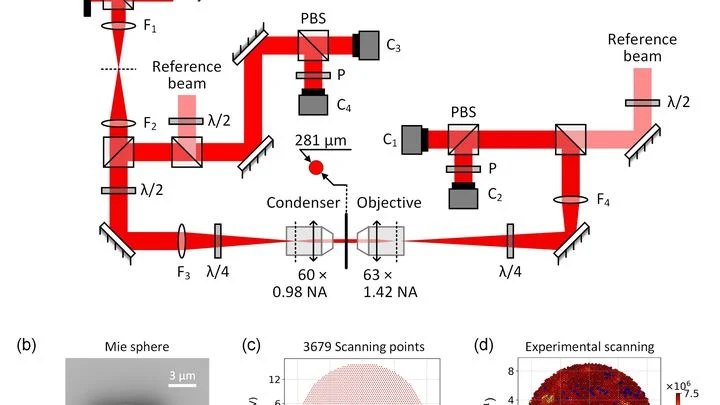
A flashlight beam in fog breaks into thousands of faint specks. Each speck is light that has bounced off countless water droplets before reaching your eye. To make sense of this mess, physicists construct a special table — the scattering matrix. It records how each incoming ray turns into a set of outgoing ones.
Laser light is like a perfectly aligned row of soldiers on parade: all waves oscillate in the same plane. Such light is called polarized. In a new study, physicists have for the first time produced polarized gamma rays by colliding electrons with a powerful laser pulse.
A neutron star the size of a city spins faster than a kitchen blender, flinging particles around itself. A glowing cloud forms around it — called a pulsar halo. The shape of this cloud depends on invisible magnetic fields that, like ocean currents, steer the particles.
The Sun is not a calm sphere. Waves constantly ripple through its interior, like a bell after being struck. These oscillations reach the surface and reveal what's happening on the far, invisible side. Astronomers have long been able to 'listen' to this ringing and find large sunspot groups there.
According to Einstein's theory, massive objects cause spacetime curvature, like a heavy ball warping a rubber sheet. As they accelerate, they create ripples — gravitational waves, akin to the circles from a stone dropped in a pond.
Toss a handful of pebbles into a pond, and the spreading ripples intersect, creating splashes and calms. That’s roughly how gravitational waves, predicted by Einstein, behave. Except it’s not water that’s oscillating, but spacetime itself.
In a giant particle accelerator, where protons traveling at nearly the speed of light smash into a neon target, charmed baryons are born — particles that live for less than a billionth of a second.
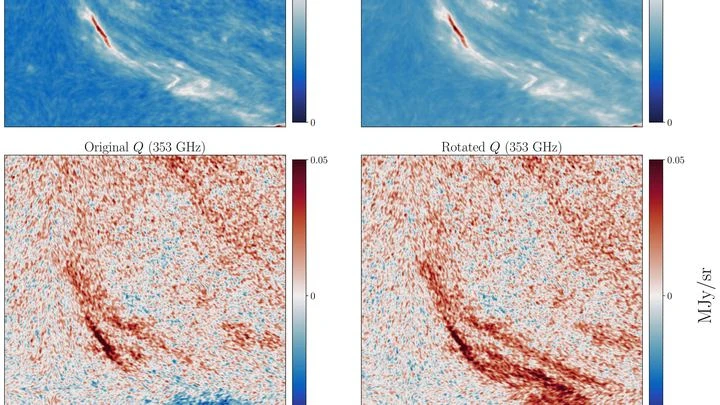
In the dark cloud L43, where stars are born, dust grains twirl like tiny compasses. Light from a young star pushes them, while the magnetic field lines them up in a specific direction. When a grain is turned sideways to us, its heat reaches us polarized, like light passing through a narrow slit.
Light from the star HD 163296 passes through the surrounding gas-and-dust disk like a flashlight beam through murky water. The disk's particles scatter the light, giving it a special property — polarization: the waves begin to oscillate in a single plane, like a rope shaken strictly up and down.
Terahertz radiation sits between microwaves and infrared light. It passes through clothing, paper, and plastic but is blocked by water and metal. That's why these waves are used in security scanners and for quality control of materials.
The cosmic microwave background is a faint glow left over from the Big Bang, like the cooling embers of a campfire. It encodes gravitational waves that may have arisen in the first fractions of a second, when the universe inflated faster than light.
Light from distant galaxies passes through telescope lenses like through a stack of window panes. Each pane is coated with a thin film to reduce glare. But this film acts as a polarizing filter: one component of the light wave passes a bit more freely, the other a bit worse. As a result, the wave rotates slightly, and the telescope sees a different picture than what is in the sky.
Throw pebbles along a tight row of posts: they ricochet into a dense spray. Throw at an angle, and they scatter. Gamma rays in a crystal do the same: they spawn particle cascades that spread out unless the crystal’s atomic rows are perfectly aligned. Align them within a hair’s width, and the cascade sharpens into a tight beam. A small crystal then outperforms a large one.
The Sun is not just a ball — it's a magnetic mansion. Its invisible force lines, like electrical wiring, thread through space and control space weather. But until now, we've only seen this wiring from the landing — the plane of Earth's orbit. The attic and basement, the magnetic poles, remained a mystery.
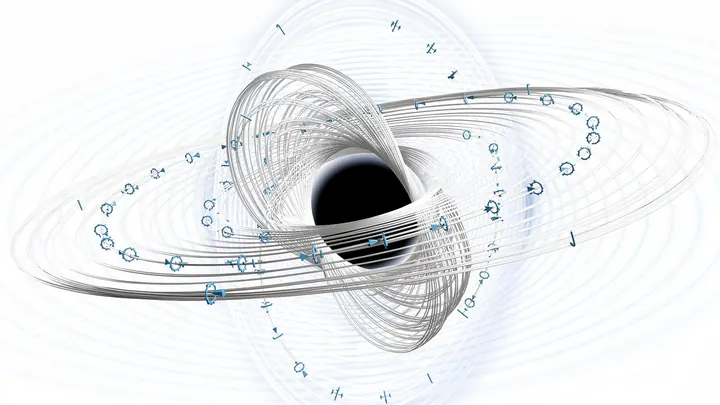
A black hole doesn't just suck in matter — like a giant cosmic whirlpool, it warps the very fabric of reality and bends light rays around itself, focusing them. The effect is even stronger for black holes that spin at nearly the speed of light: their rotation twists space into a tight spiral.
The Universe is filled with invisible mass, dark matter, which reveals itself only through gravity. One hypothesis suggests that dark matter consists of primordial black holes — objects formed in the extreme conditions just after the Big Bang.
In a typical magnet, all spins of electrons (internal ‘arrows’-magnets, discovered by Pauli) point one way. Altermagnets, like MnTe, are trickier: these arrows alternate direction, like ripples spreading from a pebble tossed into water. But here’s the twist — the ripple arises from the electrons’ own motion.
On the night of March 9–10, 2024, a cloud of plasma ejected by the Sun raced away from the star. It had already passed a distance of five solar radii when a ground-based array of 352 antennas in California's Owens Valley caught a brief radio signal from it.
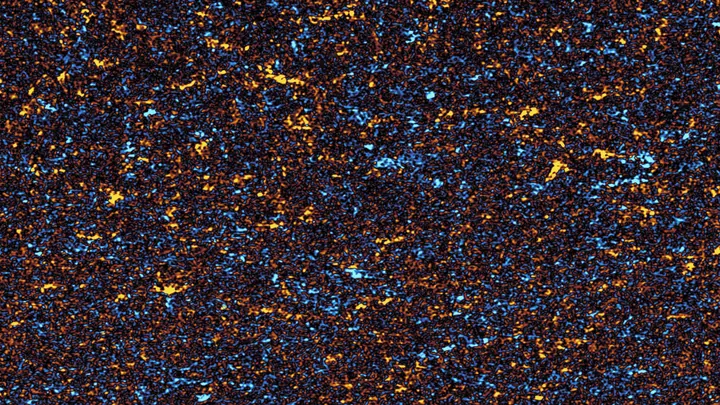
The ACT telescope in Chile's Atacama Desert stared at the sky from 2007 to 2022. Its target: the cosmic microwave background, light that has been traveling toward us for 13.8 billion years. This light is polarized: its waves oscillate in specific planes, like strings stretched in different directions.
The cosmic electron spectrum is like fingerprints at a crime scene. Particles arriving from the depths of the Galaxy carry in their energies the traces of those that produced them. For a long time, the picture was blurred: instruments with wide energy bins, like out-of-focus photographs, did not reveal details.