The Universe’s Brightest Flash Set the Tempo for the Alien Hunt express
The method is like a game in a dark theater: you and your friends agree that after a common flash, each will turn on a flashlight after ten seconds, adjusting for light delay. In a similar way, a cosmic gamma-ray burst, a colossal explosion visible across the Universe, can serve as a starting signal for aliens. Astronomers have put this into practice for the first time.
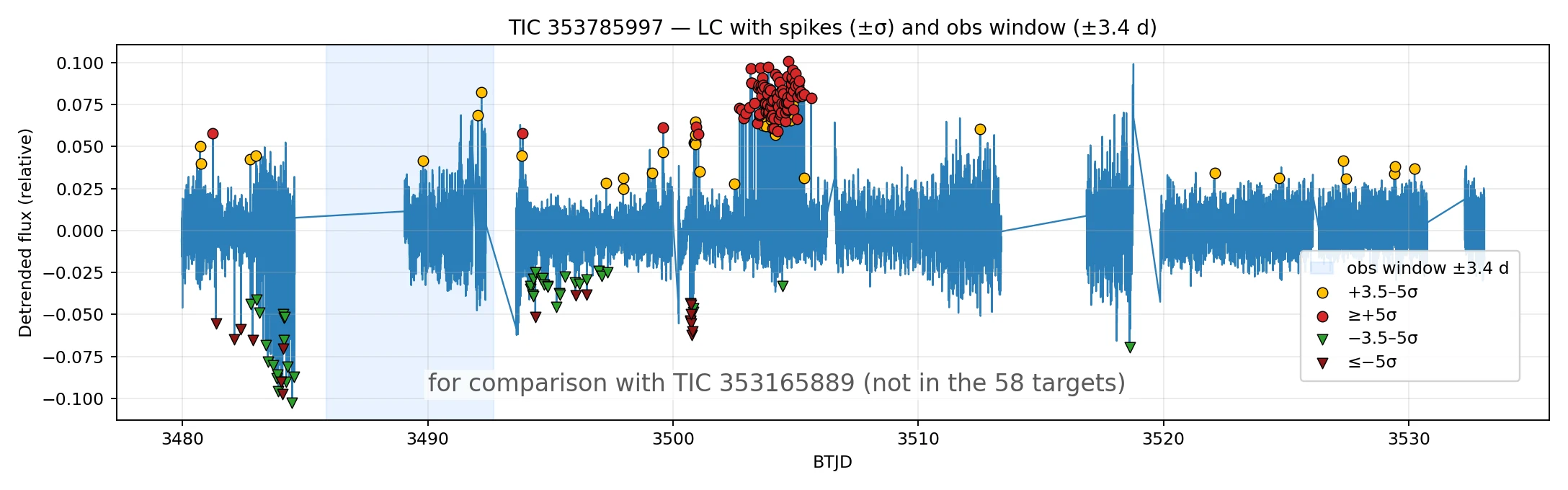
They took the brightest gamma-ray burst in history, GRB 221009A, and data from the TESS satellite, which usually hunts for exoplanets — distant worlds. For 50 days, the satellite measured the brightness of 58 stars near the burst’s direction. According to calculations, if an alien civilization wanted to reply, its signal, a brief brightening of a star, would fall into a precisely calculated three-day “window,” based on the distance to the Galactic center and the speed of light.
Two suspicious spikes in brightness were found. But nearby stars changed their light simultaneously too — a sure sign of instrument jitter, not an intelligent signal. The method, however, worked perfectly. And here’s a twist: the gamma-ray burst itself turned out to be so powerful that, had it been ten times closer, it would have stripped off Earth’s ozone layer. So the search for extraterrestrial contacts inadvertently reminded us of the fragility of our home.
Original abstract
as written by the authors arXiv:2604.06807
We present the first observational test of the hybrid ring strategy, a general coordinated signaling scheme proposed by Seto (2025), which provides a practical Schelling-point realization for interstellar signaling. We use the exceptionally bright GRB 221009A as the anchoring flash for the scheme, together with the accurately measured distance to the Galactic center. This combination provides a high-precision relation linking sky position to a tightly constrained arrival-time window. TESS observed the region around the GRB nearly continuously for ~50 days in 2024, providing survey light curves that enable a direct test of this scheme with sharply predicted arrival-time windows of $$\sim$$3.4 days. Among 58 carefully selected stars, we identify two that show noticeable single-time-bin brightenings inside their predicted windows (where each time bin corresponds to a 200 s integrated TESS exposure). In both cases the brightenings coincide with excursions in at least one nearby star and are therefore most consistent with instrumental origins. This test demonstrates that the hybrid ring strategy is practical with existing survey data and could serve as a promising basis for future technosignature searches.
At its peak, GRB 221009A emitted as much energy as the entire Sun over 10 billion years.