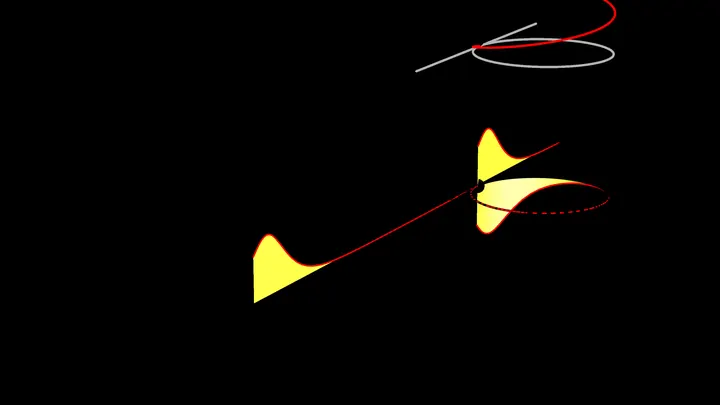
Light delay, also known as the Shapiro effect, is the gravitational time delay of light passing near a massive object. According to general relativity, a strong gravitational field slows the passage of time, and since light travels at a fixed speed, the slowing of time effectively increases the light's travel time along its path. This is not a mere technicality but a direct consequence of spacetime curvature: the light follows a geodesic through curved spacetime, and the coordinate time it takes is longer than it would be in flat space.
History
The effect was predicted by Irwin Shapiro in 1964 and first confirmed in 1967 by radar ranging to the planet Mercury, using the Arecibo radio telescope.
How it works
When a light signal passes near a massive body (like the Sun), the gravitational potential φ causes a delay Δt = −(2GM/c³) ln(1 − R/r), where M is the mass, R is the impact parameter, and r is the distance to the observer. The effect is strongest when the light grazes the surface of the body. In practice, this is measured by bouncing radar signals off planets or spacecraft and comparing the round-trip time with predictions from Newtonian gravity. The delay is tiny — for the Sun, it's at most about 250 microseconds — but it is measurable with modern clocks.
In practice
The Shapiro delay is used to test general relativity in the solar system, to calibrate timing in pulsar timing arrays for gravitational wave detection, and to measure the masses of distant galaxies throughgravitational lensing time delays.
Fun fact
The Shapiro delay is so sensitive that it has been measured to a precision of one part in a thousand in the Cassini spacecraft experiment, confirming Einstein's theory to within 0.001%.
Two runners start a race on a course with changing incline. One starts earlier, the other later, and the judge measures their speeds without knowing about the staggered starts. So it is with virus variants: data arrive with delays, and if those delays are unequal, estimates of competitive advantage can be badly wrong.
A light ray passing by a massive body slightly changes its direction, like a stream of water bending around a rock in a creek. In the solar system, there are many such "rocks": planets, their moons, asteroids. And each one, with its own gravity, bends the path of light coming from distant stars.
A scale that weighs not a body, but the very space around it. That's how Einstein's equations work in general relativity: they link the curvature of spacetime to what resides within it.
A globular cluster, a dense swarm of hundreds of thousands of stars, plows through a galaxy like a bullet through water. In ordinary dark matter (the invisible mass that holds galaxies together), it should quickly lose speed due to dynamical friction.
Two balls dropped from different heights fall to the ground with different accelerations. In space, things are more complicated: even emptiness makes bodies move differently.
General relativity, which describes the structure of the universe, does not forbid closed timelike curves. But Stephen Hawking put forward the 'chronology protection' conjecture: quantum effects should destroy such curves, making time travel to the past impossible.
Moments before totality, swift shadow bands glide across the ground, like ripples from pebbles tossed into water. For centuries, this phenomenon baffled scientists. It turns out the key is that light is a wave.
The Sun isn't a pinpoint lamp but a vast disk. When the Moon nearly covers it, a thin glowing crescent remains.
Light cones are not about light; they are boundaries in spacetime that separate causes from effects. These cones are not rigid: a massive object curves them, like a heavy ball pressing into a stretched sheet.
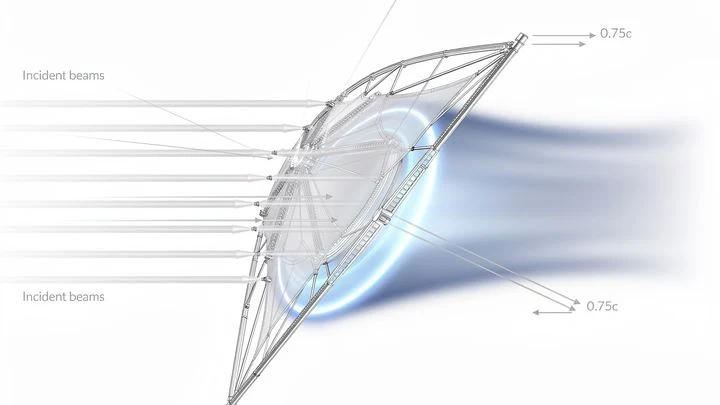
Imagine a three-faced dancer on the crest of a light wave. One face is a catcher, absorbing incoming photons. The second is a perfect mirror, throwing light back. The third is frosted glass, scattering rays in all directions. As long as speed is low, the dance is harmonious. But at near-light speeds, the choreography breaks.
This is like a surfer chasing a wave.
Place two identical alarm clocks on a table and set them off at the same time. If one is on a slippery surface and starts to slowly slide, its timing will be thrown off, and within a minute they'll ring out of sync. That's roughly how the new method proposed by astrophysicists for supermassive black holes works.
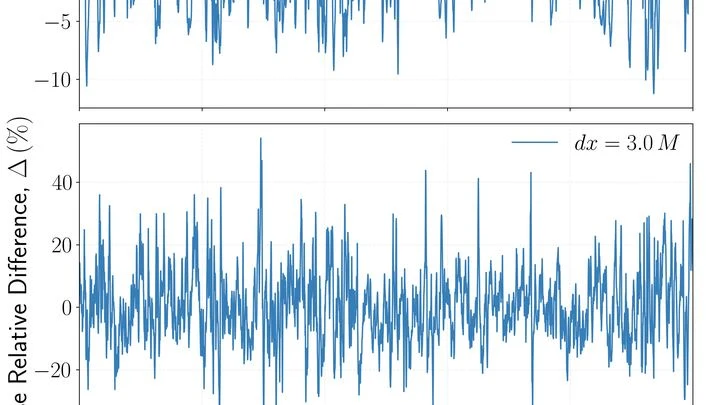
Photographing the vicinity of a black hole is like shooting a fountain: a short exposure freezes the droplets, a long one blends everything into blurry streaks. Light from the superheated gas swirling around the hole reaches us along different paths. Some rays curve around it in an arc, others make multiple loops due to spacetime curvature.
A pair of neutron stars is like two heavy bowling balls slowly spiraling toward each other. They are born together from a binary system of massive stars, but it can take hundreds of millions of years before they finally collide. When they do, a short gamma-ray burst erupts — a brilliant explosion visible across half the universe.
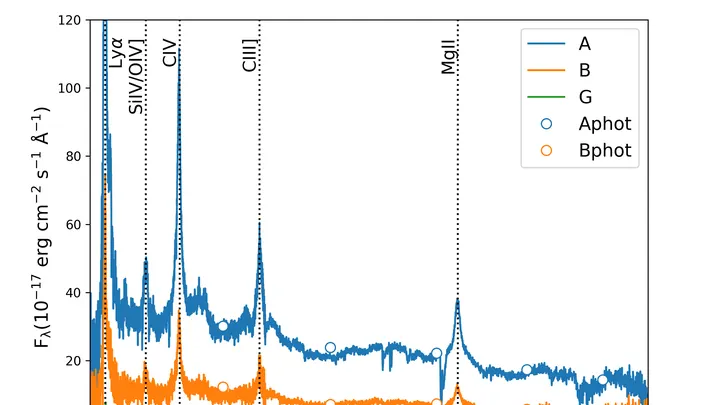
Light from quasar PS J2305+3714 has been traveling toward us for more than eleven billion years. On its way, it passes near a massive galaxy whose gravity bends its path, like a heavy ball denting a stretched sheet. Through a telescope, we see not one quasar but two images — two points of light that are actually the same distant object.
Mass curves spacetime like a heavy stone pressing into an asphalt road. Light passing by skirts around this dent, its path lengthens, and it arrives late. Astronomers have observed this Shapiro effect many times near the Sun and planets.
A new plan proposes to recreate this delay on a lab bench.