The Brightest Flash in the Universe as a Starting Signal for the Search for Extraterrestrial Civilizations express
Imagine you and your friends are in a dark room. You agree that after a common flash, each of you will turn on a flashlight ten seconds later, but with a correction for the light delay — since the light from the flash reaches each of you with a slight lag. In a similar way, astronomers have proposed using a cosmic gamma-ray burst, a colossal explosion visible across the entire universe, as a starting signal for alien civilizations. And for the first time, they have tested this idea in practice.
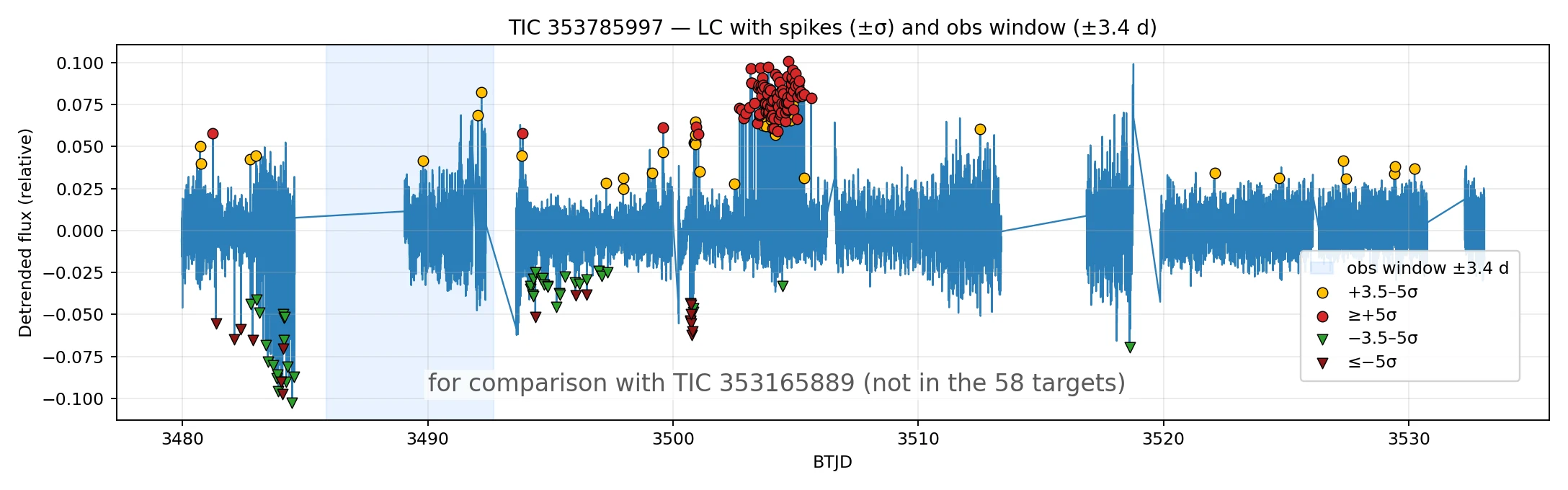
The target was the brightest gamma-ray burst ever observed, GRB 221009A — an event that releases so much energy that it can briefly outshine an entire galaxy. The data were collected by the TESS satellite, whose primary mission is to search for exoplanets (distant worlds around other stars) using the transit photometry method, that is, by recording tiny changes in stellar brightness. Over 50 days, the satellite measured the brightness of 58 stars located near the direction of the burst.
The logic of the search is this: if an extraterrestrial civilization wants to respond to a signal that is common to all, it might use its own 'flashlight'—briefly enhancing the radiation of its home star, for example, with a powerful laser. But when should such a reply be expected? The calculations rely on the distance from the center of the Galaxy to Earth and a fundamental constant — the speed of light. Since the gamma-ray burst does not reach different points in the Galaxy simultaneously, an expected signal should fall within a precisely calculated three-day 'window.' This resembles our analogy with friends: each turns on a flashlight with a correction for the time it takes light to reach them.
During the analysis, two suspicious brightness jumps were found. However, the same increase in brightness was simultaneously shown by neighboring stars — a sure sign that this was instrument jitter or another instrumental effect, not an intelligent signal. Although no aliens were found, the method itself worked perfectly: it allowed a systematic scan of the sky for anomalies.
And here is an unexpected twist: along the way, it turned out that the gamma-ray burst GRB 221009A was so powerful that, had it been ten times closer to Earth, its radiation would have stripped away the planet's ozone layer. Thus, the search for extraterrestrial contacts inadvertently reminded us of the fragility of our home, and that even distant cosmic cataclysms can have consequences for life on Earth.
At its peak, GRB 221009A emitted as much energy as the Sun does in 10 billion years.