The Universe’s Brightest Flash Set the Tempo for the Alien Hunt express
The method is like a game in a dark theater: you and your friends agree that after a common flash, each will turn on a flashlight after ten seconds, adjusting for light delay. In a similar way, a cosmic gamma-ray burst, a colossal explosion visible across the Universe, can serve as a starting signal for aliens. Astronomers have put this into practice for the first time.
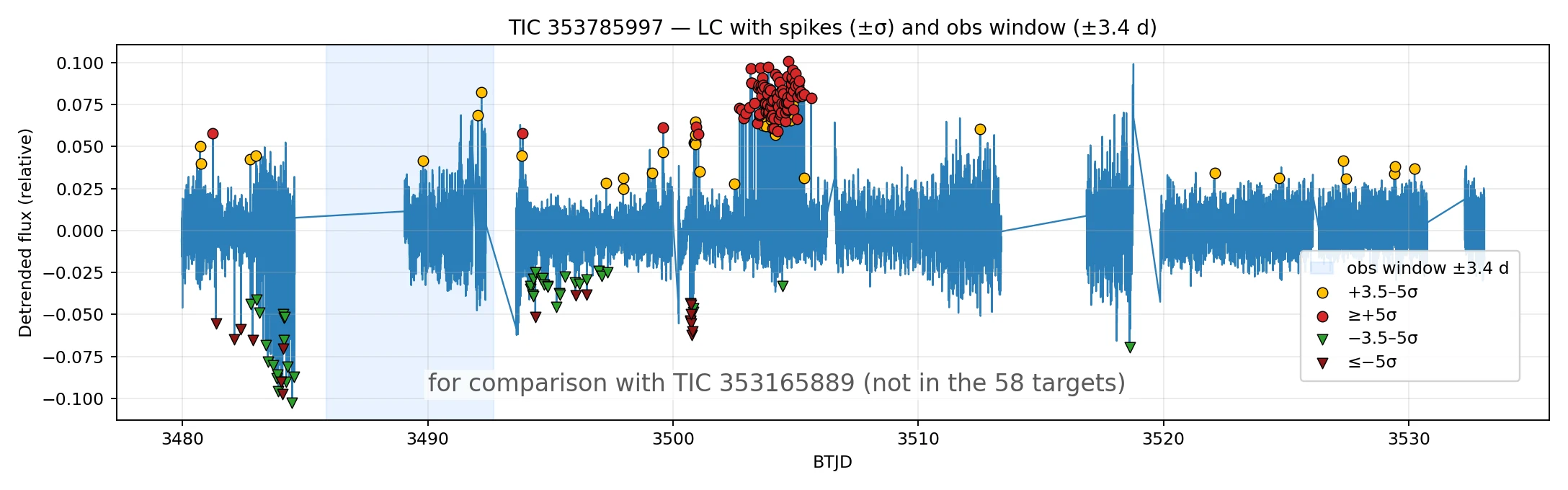
They took the brightest gamma-ray burst in history, GRB 221009A, and data from the TESS satellite, which usually hunts for exoplanets — distant worlds. For 50 days, the satellite measured the brightness of 58 stars near the burst’s direction. According to calculations, if an alien civilization wanted to reply, its signal, a brief brightening of a star, would fall into a precisely calculated three-day “window,” based on the distance to the Galactic center and the speed of light.
Two suspicious spikes in brightness were found. But nearby stars changed their light simultaneously too — a sure sign of instrument jitter, not an intelligent signal. The method, however, worked perfectly. And here’s a twist: the gamma-ray burst itself turned out to be so powerful that, had it been ten times closer, it would have stripped off Earth’s ozone layer. So the search for extraterrestrial contacts inadvertently reminded us of the fragility of our home.
At its peak, GRB 221009A emitted as much energy as the entire Sun over 10 billion years.