A Dance of Two Stars 57 Light-Years Away express
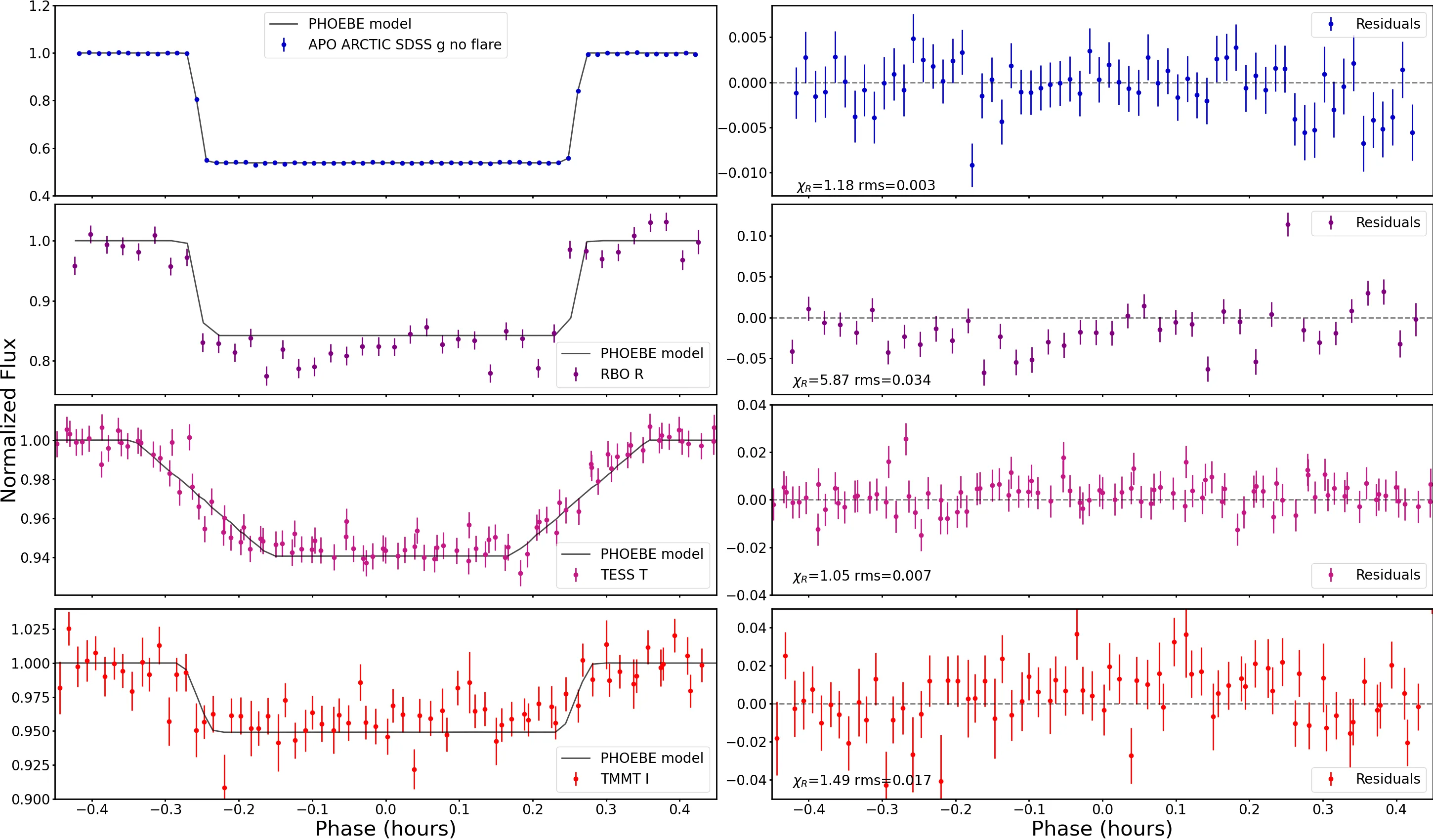
Every 15 hours, in a constellation 57 light-years away, a miniature solar eclipse takes place. A tiny white dwarf — a star the size of Earth but heavier than the Sun — ducks behind the disk of a red dwarf. For astronomers, this is not just a pretty coincidence but a way to peek into the pair's past.
Once, the primary star in this system swelled into a red giant and engulfed its neighbor. The neighbor, braking against the gas, spiraled inward, and the giant's envelope was stripped away. What remains is what we see: a dense core — the white dwarf — and a surviving red dwarf on a tight orbit. Such pairs are called post-common-envelope systems.
The new pair, TIC-460388167, was found using data from the TESS space telescope and ground-based spectrographs. The eclipses allowed astronomers to pin down the orbital inclination — 89 degrees, meaning we see the system almost edge-on. The orbital period is 0.636 days. The red dwarf turns out to be synchronized: it always shows the same face to the white dwarf, just like the Moon to Earth. This was confirmed — for the first time for such a pair — from the profile of spectral lines.
Such systems are natural laboratories. They show how stars survive a common envelope and what is left afterward. The more such pairs we measure, the clearer one of the most violent stages in the lives of binary stars becomes.
The orbital period of the pair is 15 hours and 16 minutes. In that time, the white dwarf manages to completely hide behind the red dwarf and reappear.