Binary neutron star systems are pairs of neutron stars that orbit a common center of mass. Their formation is a complex process that typically begins with two massive stars in a binary system, which evolve and eventually explode as supernovae, leaving behind neutron stars. The survival of the binary through these explosions is a delicate balance of mass loss, orbital dynamics, and kicks imparted by asymmetric supernova explosions. Understanding this formation pathway is crucial for interpreting gravitational wave signals, such as those from the merger GW170817, and for explaining the production of heavy elements like gold and platinum in the universe.
History
The first binary neutron star system, PSR B1913+16, was discovered in 1974 by Russell Hulse and Joseph Taylor, who used it to indirectly confirm gravitational waves. The formation theory was developed in the 1980s and 1990s, with key contributions from theorists like V. Kalogera and E. van den Heuvel.
How it works
The formation proceeds through several stages. Initially, two massive stars (each >8 solar masses) form in a binary. The more massive star evolves faster, expands, and may transfer mass to its companion, potentially leading to a common envelope phase that shrinks the orbit. The first supernova explosion can disrupt the binary if too much mass is ejected, but if it survives, a neutron star is left. The second star then evolves, and if it also explodes as a supernova, the system may remain bound if the kick velocity and mass loss are not too large. The result is a tight binary of two neutron stars that will eventually merge due to gravitational wave emission over billions of years.
In practice
Understanding binary neutronstar formation is essential for predicting merger rates for gravitational wave observatories like LIGO and Virgo, and for interpreting the electromagnetic counterparts of such mergers, including kilonovae and gamma-ray bursts.
Fun fact
The merger of two neutron stars in 2017 (GW170817) was observed in both gravitational waves and light, confirming that such events are the primary site of r-process nucleosynthesis, producing elements heavier than iron like gold and platinum.
Twenty thousand years ago, the star that would become supernova 1987A put on a ring. Not one — three. The two outer ones, like lampshades, tilted relative to the equatorial ring, and the star's light, struggling through them, barely reached an observer who happened to be in the plane of the equatorial ring.
Imagine two spinning tops set on a table. If they spin in the same direction, their combined rotation is large; if they spin toward each other, the total rotation can be zero even though each top spins rapidly on its own. In a pair of neutron stars approaching merger, their individual rotations, spins, play the role of such tops.
A neutron star is the remnant of an exploded star, compressed so tightly that a teaspoon of its material would weigh as much as a mountain. Inside such an object, protons and neutrons are packed tightly together, and under enormous pressure, hyperons, particles containing a strange quark, can appear.
The collapse of a star's core is like compressing a spring: matter falls inward, and a neutron star is born at the center. But the fall is never perfectly smooth. In the boiling outer layers, random eddies transfer angular momentum to the infalling gas, and a disk swirls around the central object.
This disk is no calm river. It pulses, strengthening and fading.
Three milliseconds before the merger. A gargantuan black hole spinning at breakneck speed drags in a neutron star — a ball the size of a city but with 1.5 times the Sun's mass. Tidal forces stretch the star into a thread as thin as a needle and fling its matter outward.
A billiard ball clicks against another in complete darkness. The sound of the impact and the clatter of balls dropping into pockets: that's all you hear. This is roughly how physicists study the interactions of elementary particles at energies that no terrestrial accelerator can reproduce.
A neutron star is the collapsed core of a massive star, squeezed to the size of a city. A teaspoon of its material weighs as much as a mountain. But inside this superdense sphere, a surprise may lurk: under unimaginable pressure, neutrons break apart into quarks, giving the star a new, more compact core.
The mystery of antimatter in space has long puzzled astrophysicists: where do positrons come from, settling like snowflakes into our detectors? The answer might lurk in the most ubiquitous gamma-ray background. The Universe is soaked in diffuse light — the cosmic photon background (CPB).
LIGO and Virgo detectors catch ripples in spacetime, but some signals force us to rewrite the scripts of stellar death. GW190814 — the merger of a black hole of 23 solar masses with a compact object of 2.6 solar masses — is a discordant chord in the symphony of standard models.
Detectors pick up the “ripples” of gravitational waves from mergers of black holes or neutron stars — like an echo from the kitchen where a cosmic dish was being prepared. Astronomers are trying to reconstruct the recipe: how two massive stars turned into an exotic pair and collided.
Two neutron stars whirl in their final dance. If their spin aligns with their orbital motion, the partners merge neatly, launching a narrow jet of superheated matter. If they spin in opposite directions, the dance breaks apart, scattering a thick shroud of debris.
Two burned-out stars, each about the size of Earth but heavier than the Sun, spiral ever closer until one crashes into the other. The impact triggers a thermonuclear explosion, giving birth to a type Ia supernova. Such flashes serve as cosmic beacons for measuring distances across the universe. Yet the details of their origin remain hotly debated.
A light bulb that doesn't burn out but flares brighter and brighter until it blows the whole fixture apart. That's roughly how the most massive stars in the universe die. When a star's core heats up to billions of degrees, pairs of particles (electrons and their antimatter counterparts, positrons) begin to form.
A spinning top whirls at great speed and, instead of a steady hum, emits a quiet buzz — because it is slightly dented. Neutron stars work much the same way: city-sized spheres compressed to such density that a teaspoon of their material weighs as much as a mountain.
In 2017, detectors picked up a tremor in space — gravitational waves from the merger of two neutron stars. At the same moment, telescopes saw a flash. For the first time, one event spoke in two languages at once: light and gravity.
When two neutron stars collide, they produce a flare that shines like a million Suns. In 2017, astronomers saw such a flare for the first time — event AT2017gfo. Now scientists have built computer models to understand exactly how this light arises.
Be stars are rapidly rotating luminaries with bright gas disks. Usually, a companion star spins them up: mass flowing from the neighbor whirls the star like a bullet in a rifled barrel. But there are also lone Be stars without a partner: their origin long remained a mystery.
New research shows that solitaries can be born from a supernova explosion.
Every 15 hours, in a constellation 57 light-years away, a miniature solar eclipse takes place. A tiny white dwarf — a star the size of Earth but heavier than the Sun — ducks behind the disk of a red dwarf. For astronomers, this is not just a pretty coincidence but a way to peek into the pair's past.
A spinning top that whirls so fast it completes 220 rotations in a single second: that's exactly what China's FAST radio telescope has caught. This is the pulsar PSR J1810-0623, a neutron star the size of a city but with more mass than the Sun.
A cosmic neon sign lit up in an incredibly distant galaxy: almost all its light comes from hot gas, and the stars are lost in this glow. The James Webb telescope recorded that the gas, a mix of hydrogen and helium, is so heated that it glows on its own.
Double neutron stars are pairs of ultra-dense remnants of exploded massive stars. They orbit each other and gradually spiral closer until they merge in a powerful flash — a source of gravitational waves. But where do such pairs actually form? One possibility is inside star clusters, where stars are plentiful and interact closely.
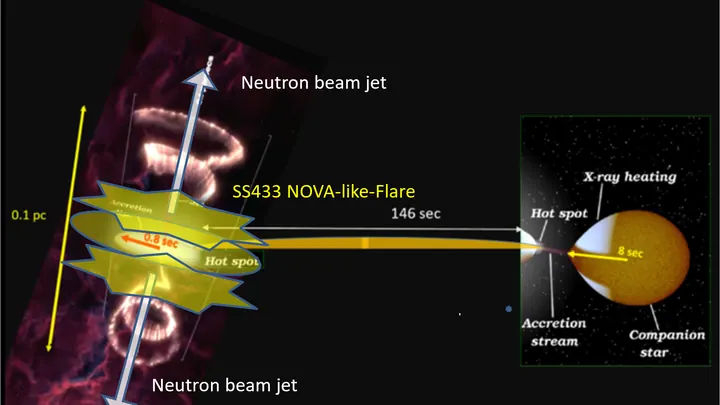
The binary system SS433 is known for its black hole stripping matter from a neighboring star. Some of the gas falls into the hole, while the rest is ejected in two narrow jets that wobble like a spinning top. These jets are visible in radio and X-rays.
In the dense core of the globular cluster NGC 6397, where stars jostle like commuters at rush hour, astronomers have spotted a peculiar pair. One star is a white dwarf with a surface temperature of 16,000 K, the scorched remnant of a star that has been cooling for billions of years, and circling it is an unseen companion.
Wide binary stars are like two dancers holding hands but standing at opposite ends of the hall. Their bond is weak, and any passerby can break them apart. Astronomers found 26 such pairs and tested how tightly they hold on.
It turned out that 12 pairs dance by Newton's rules: their orbits can be calculated like those of planets around the Sun. But three pairs move too fast.
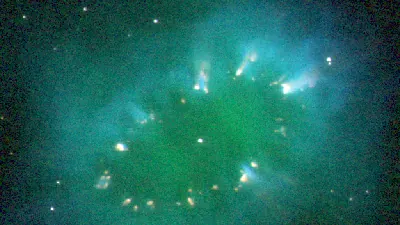
Deep in space, there's a cloud of gas that looks like a necklace with bright beads. This is the Necklace Nebula — the remains of a star that once swelled up and swallowed its neighbor. At the center, a pair remains: a small, hot star and its bloated companion, rich in carbon.
Massive stars end their lives in a grand explosion — a supernova. Their cores collapse into a neutron star (a super-dense ball where a teaspoon of matter weighs a billion tons) or a black hole. For a long time, the most common type of such outbursts was thought to be the domain of solitary stars.
However, supernova SN 2018gj broke the rule.
In a star cluster, like on a crowded dance floor, massive stars rarely stay single. More often they whirl in pairs or triples, and the distance between them can be less than from Earth to the Sun. But how do they manage to get so close to each other?
Simulations showed: it's all about the disk of gas and dust that envelops the pair. This disk, like a drain funnel, swirls the stars and slowly pulls them inward.
Two stars whirl in a tight dance. One is a neutron star — an ultra-dense sphere the size of a city but with a mass of one and a half Suns. The other is an ordinary star that swells and spills its matter onto its neighbor. Sometimes this transfer happens too fast, and the stars become enveloped in a shared gas shell, like two spoons in one pot of boiling soup.
Imagine a bridge with its middle ripped out: cars on the other side would be a surprise. That's how astronomers long viewed black holes with masses from 50 to 130 solar masses: the stars that could produce them explode as pair-instability supernovae.