Light as a Fingerprint: How to Read Quantum States express
A light pulse can be compared to a musical chord: several notes sound simultaneously, each with its own loudness and phase. In quantum optics, such 'chords' are called multimode squeezed states. They are important for secure communication and ultra-precise measurements, but to use them, you need to know the shape of each 'note'.
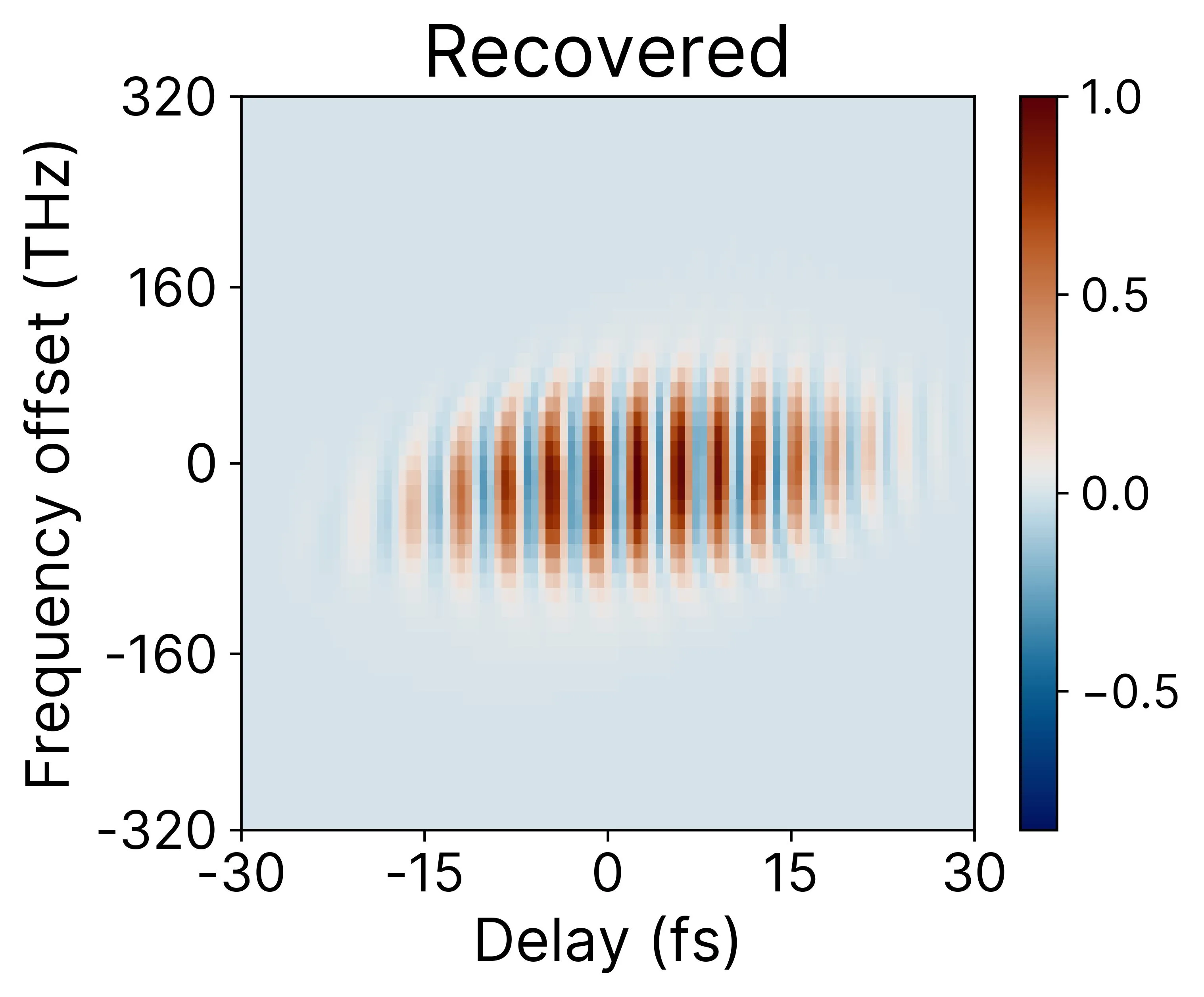
Conventional measurement methods are either too complex or assume that the pulse shape is known in advance. The new approach uses an optical parametric amplifier, a device that amplifies a weak signal without destroying its quantum properties, and the FROG method (frequency-resolved optical gating). FROG works like a stroboscope: a short reference pulse 'illuminates' a slice of the signal, and a spectrometer captures the instantaneous picture. This allows simultaneous reconstruction of both the pulse shape and the degree of squeezing — a quantity showing how strongly quantum noise is suppressed in one quadrature and amplified in another.
Simulations showed that the method works for ultrashort pulses and complex shapes. This paves the way for practical analysis of large quantum systems where many modes are intertwined. Instead of bulky setups — a single compact device that reads the quantum 'chord' in its entirety without drowning out the quiet notes.
Original abstract
as written by the authors arXiv:2604.08717
Temporally multimode squeezed states have been a topic of recent interest due to their applications in quantum communication, information processing, and sensing. Characterizing the mode shapes is crucial for effectively manipulating these states, but current mode shape and state characterization techniques necessitate constraining assumptions and complicated experimental setups. Here, we propose a characterization technique that simultaneously recovers the complex temporal mode shapes and quadrature variances of ultrafast multimode squeezed states based on frequency resolved optical gating (FROG) using an optical parametric amplifier (OPA). FROG is a promising tool for quantum state characterization due to its flexibility of implementation and high temporal resolution. Using an OPA as the nonlinear process in FROG has the benefit of amplifying weak quantum states to a detectable level while preserving quantum information. Numerical simulations demonstrate the recovery of the mode shapes and levels of squeezing and anti-squeezing of ultrafast multimode squeezed states. This scheme offers a practical experimental approach to measuring arbitrary temporal mode shapes and characterizing large-scale multimode ultrafast Gaussian quantum states.
Squeezed light is already used in the LIGO and Virgo interferometers to detect gravitational waves — quantum noise is reduced to hear the ripples of spacetime.
In the series 'The Expanse', quantum communication allows instant transmission of messages across the Solar System; precise characterization of light states is a step toward such technologies.