Magnetic Fields in the Cores of Red Giants express
Eight red giants — bloated old stars like the future Sun — are not behaving by the book. Their surfaces oscillate steadily, like a bell, but within this chime there are glitches: some tones are missing, and the rhythm breaks. Scientists suspected an invisible hand inside — a magnetic field — and tried to calculate its strength.
To explain the observations, they had to assume the field is very strong — from 100 to 700 kilogauss. For comparison, a refrigerator magnet's field is about 0.001 kilogauss. Such a powerful field could not have arisen just by chance. Most likely, it was born in the star's youth, when its hot core churned like boiling water in a pot, mixing matter and generating a magnetic dynamo.
These eight stars turned out to be not very massive — roughly like the Sun. The size of their magnetic field matches the size of the core the star had in its youth. This means the field is a memory of a turbulent youth, frozen deep inside. Now astronomers can use such stars as natural laboratories to understand how magnetic fields live and die within stars.
Original abstract
as written by the authors arXiv:2604.09901
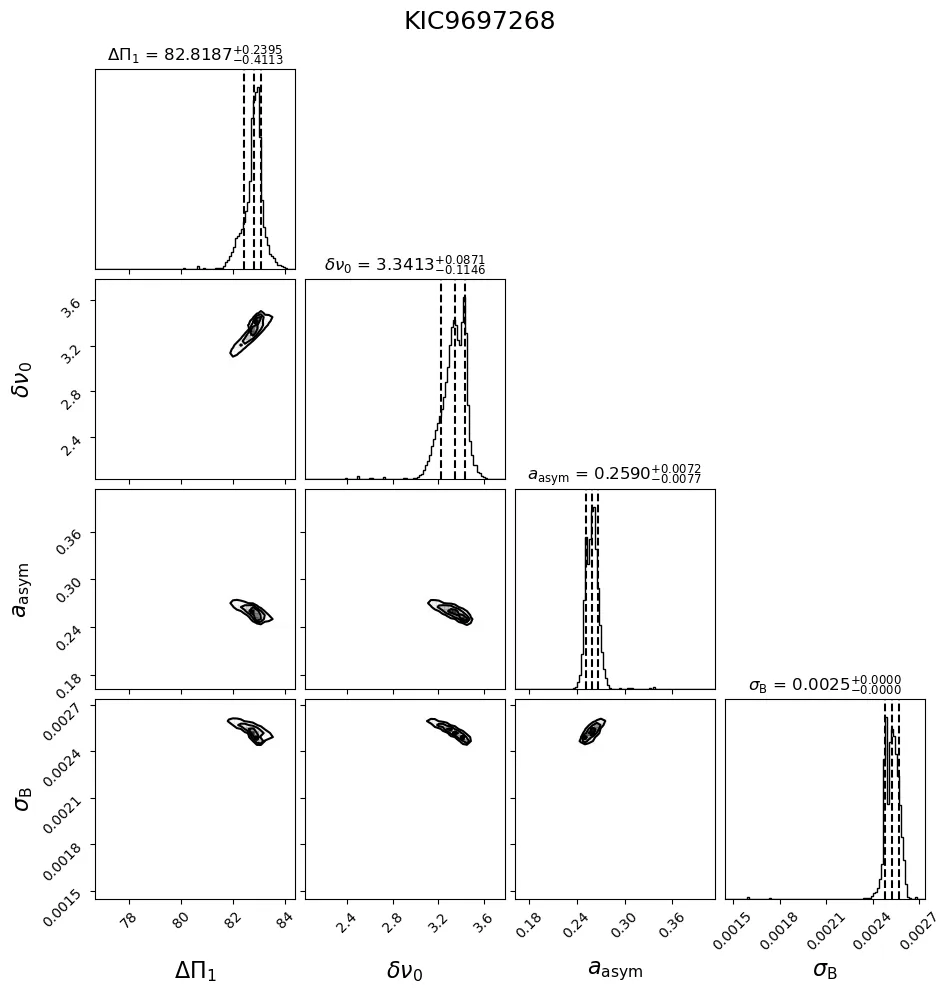
The recent seismic detection of magnetic fields in red giants cores has given the opportunity to characterize these fields, potentially giving information about their origin and their role in the internal transport of angular momentum. We detect strong deviations from the regular pattern of g-mode periods in eight Kepler red giants showing $$l=1$$ doublets. In three of these stars, the modes show partial suppression. We investigate the magnetic origin of these features and determine the characteristics of the core fields that can produce such signatures. We need to invoke strong, near-critical fields. Assessing the effects of such fields on the mixed mode frequencies requires a non-perturbative approach. We use and adapt a formalism that was recently proposed following a similar development as the traditional approximation for rotation (TAR). We then compute asymptotic expressions of mixed mode frequencies including magnetic effects and attempt to reproduce the observed oscillation spectra. We show that for near-critical fields, information can be obtained about the radial profile of the radial field $$B_r$$, as opposed to weaker fields for which only a weighted average of $$B_r^2$$ can be measured. For the eight targets, we find that the $$l=1$$ doublets cannot be identified as the $$m=\pm1$$ components. Instead, we show that very good fits to all the observations can be obtained by identifying the two components as $$m=0$$ and $$m=1$$. These solutions correspond to fields with intensities ranging from 100 to 700 kG that are confined well below the H-burning shell. Our best-fit models for the eight stars have low masses (1.1-1.2 $$M_\odot$$) and the maximal size of their convective core during the main sequence approximately corresponds to the radial extent of the measured magnetic fields. The detected fields could thus have been generated by dynamo action in the main-sequence convective core.
The magnetic field in a red giant's core is millions of times stronger than a refrigerator magnet's field, but it is hidden deep beneath the star's surface.
In Stanisław Lem's novel 'Solaris', the planet's ocean behaves as if alive; here, the star itself stores a 'memory' of its youth in the form of a magnetic field.