In 1933, Walter Meissner and Robert Ochsenfeld discovered that cold tin completely expels a magnetic field from its interior. This contradicted the ordinary equations of electrodynamics. Two years later, brothers Fritz and Heinz London proposed two simple amendments to Maxwell's equations that mathematically described this phenomenon. They introduced the concept of superconducting electron density and a characteristic field penetration depth. Today, these equations are the foundation of the theory of type I superconductivity. The penetration depth varies among materials: for aluminum it is 50 nm, for lead it is 37 nm. This property is used to create the most sensitive magnetic field detectors — SQUIDs.
History
After the discovery by Meissner and Ochsenfeld in 1933 of the complete expulsion of a magnetic field from a superconductor, a theoretical description became necessary. In 1935, brothers Fritz and Heinz London, working in Oxford, published two papers proposing a modification of electrodynamics for superconductors. Their idea was to treat superconducting electrons as a resistance-free fluid accelerated by an electric field. The Londons introduced two main constants: the concentration of superconducting carriers nₛ and the penetration depth λ. Later, their approach was generalized in the Ginzburg–Landau theory and in the microscopic BCS theory.
How it works
The London equations are used to calculate the distribution of magnetic field and current in type I superconductors, as well as near the surface of any superconductors. They describe the Meissner effect and current behavior in weak fields well. However, their applicability is limited: they do not explain behavior in strong fields that destroy superconductivity, and they do not distinguish between type I and type II superconductors. Also, the London theory does not account for quantum effects such as the formation of Cooper pairs.
In practice
This is the basis for MRI magnets, superfast maglev trains, and cables that don't heat up.
Fun fact
The penetration depth varies among materials: for aluminum it is 50 nm, for lead it is 37 nm. This property is used to create the most sensitive magnetic field detectors — SQUIDs.
Current in an ordinary metal flows like a crowd of people down a straight street: each electron is on its own, and if you turn on a magnetic field, the whole crowd shifts slightly sideways. This shift is called the Hall effect.
A superconductor pushes out a magnetic field like a sponge squeezing out water. This Meissner effect has been known for nearly a century, but it's usually calculated in a flat world — without gravity. In the strong field of a black hole or at enormous speeds, the picture changes.
A superconductor pushes out a magnetic field like a sponge squeezing out water. This Meissner effect has been known for nearly a century, but it's usually calculated in a flat world — without gravity. In the strong field of a black hole or at enormous speeds, the picture changes.
Many materials behave like finicky ice: at one pressure they melt, at another they turn harder. Superconductors in the cuprate family are no exception. Their ability to carry current without loss depends on how tightly the crystal lattice is squeezed. In a new study, physicists traced this dependence for the compound Bi-2223.
Many materials behave like finicky ice: at one pressure they melt, at another they turn harder. Superconductors in the cuprate family are no exception. Their ability to carry current without loss depends on how tightly the crystal lattice is squeezed. In a new study, physicists traced this dependence for the compound Bi-2223.
An inflatable balloon with magnetic field lines drawn on it with a marker is a simple model of how a weak magnetic field behaves in an expanding universe. While the balloon is small, the lines lie obediently on the rubber and don't hinder its stretching. That's roughly how a field fills ready-made space without arguing with its geometry.
A thin film of a special crystal (for instance, molybdenum disulfide) sits on a microscope stage. The temperature is just above the point where the material becomes a superconductor.
Superconductivity and magnetic field are age-old foes: the field barges in like a whirlwind, tearing apart the delicate pairing of Cooper pairs, destroying order.
Usually, superconductivity is a story about cold. The lower the temperature, the easier it is for electrons to pair up and flow without resistance. But in a new study, physicists grew thin films of nickelates doped with europium and saw the opposite picture.
Imagine a slide with three dips: the deepest one is a stable position for a ball, the middle one is precarious. A slight push and the ball rolls down. Yet, constant vibration of the right strength can hold it in the middle hollow for a long time.
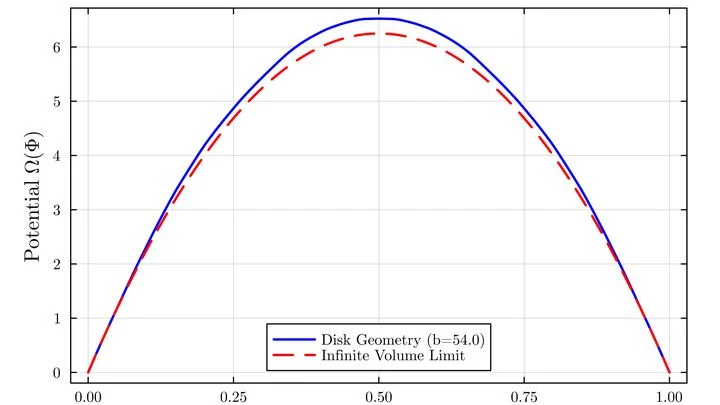
In the 1950s, physicists Lee and Yang discovered that all states of matter are separated by invisible points in the world of imaginary numbers.
Superconductors conduct current without loss, but usually require extreme cold. Hg1223 — a mixture of mercury, barium, calcium, copper and oxygen — breaks the rule: it stops resisting current already at –139°C. The secret is that the strong electrical repulsion between electrons forces them to pair up.
A long, narrow pan, and a thin pancake sets in uneven stripes. For decades, scientists saw a similar picture when modeling the behavior of electrons in superconductors — materials that conduct electricity without loss. They used elongated "cylinders," and the result was always the same: rigid magnetic "stripes" that were thought to hinder superconductivity.
A superconductor is like a perfect electron dance: electrons move in pairs without losing energy, like dancers who never miss a beat. But add a few magnetic impurities, and strangers crash into the dance, disrupting the synchronized motion. The temperature at which this dance begins drops.
A copper wire under current is a familiar sight, but inside it something unexpected is happening. A strong electric current doesn't just heat the metal: it knocks atoms out of their rightful places, leaving behind tiny voids, as if a few balls were suddenly removed from a tightly packed arrangement.
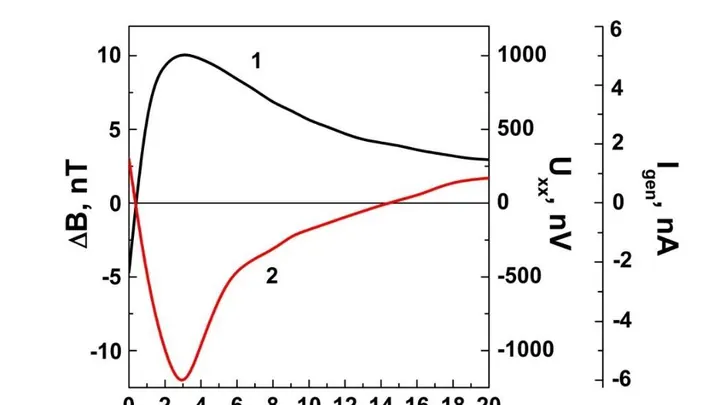
Ordinary magnetic measurements only see the surface of a superconductor, where barriers and viscous flows of magnetic field get in the way. Inside, in the so-called intermediate state, superconducting and normal domains coexist, separated by thin walls. These walls can oscillate, but hearing them directly has been difficult.
Deep inside Earth lies a solid iron core about the size of the Moon. It floats in liquid metal and sways slightly, like a pit in a peach when you shake the fruit. Such oscillations are called Slichter modes: the core shifts both along the planet's axis and perpendicular to it.
Three forces act together to damp this motion.
Inside copper-based superconductors, materials that carry current without loss at unexpectedly high temperatures, there is a hidden phase. It behaves like an ordinary metal, but it's invisible in standard measurements.
Eight red giants — bloated old stars like the future Sun — are not behaving by the book. Their surfaces oscillate steadily, like a bell, but within this chime there are glitches: some tones are missing, and the rhythm breaks. Scientists suspected an invisible hand inside — a magnetic field — and tried to calculate its strength.
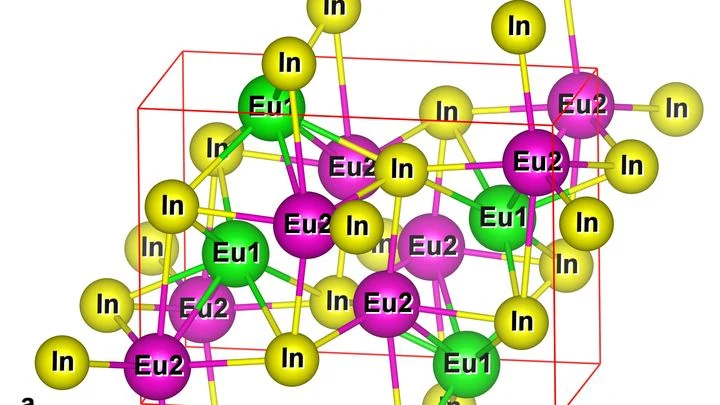
A piece of europium-indium alloy, when cooled in a magnetic field, behaves like water that does not freeze all at once but first in one corner of the glass, then in another.
A thin sheet of graphene, just a few micrometers thick, was placed in a weak magnetic field, and it began to push the field out of itself, like a sponge squeezing out water. This effect, known as the Meissner effect, is the hallmark of a superconductor: a material that conducts electricity without loss.
Superconductivity is the ability of a material to conduct electricity without losses. Ordinary wires heat up, and some energy is lost as heat, but a superconductor carries current with zero resistance.
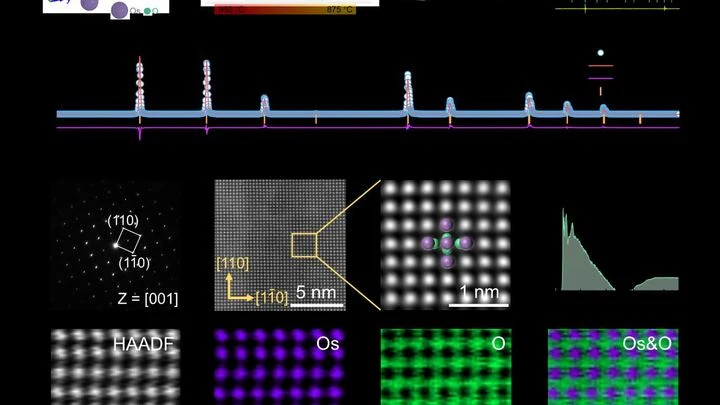
A crystal of osmium dioxide, OsO₂, is like a stubborn teenager: under ordinary conditions it behaves like a typical metal, but press hard enough and its character changes.
An ordinary superconductor loses resistance when cooled, and current flows through it without loss. But in ultrathin films, things are different: the material fluctuates between normal and superconducting states, and in this transition zone, strange resistance waves emerge. Resistance rises and falls as if someone were turning a volume knob.
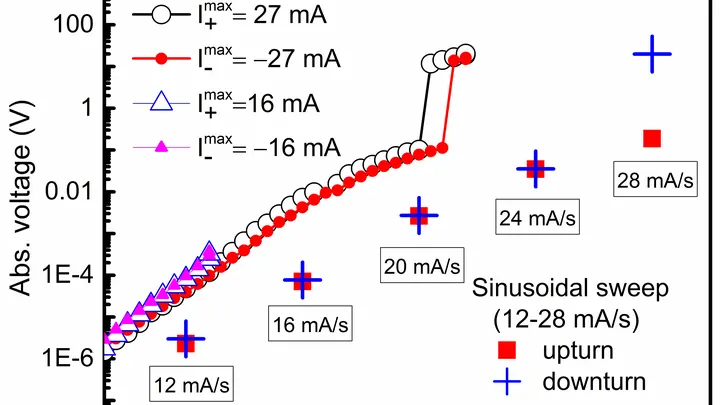
An ordinary conductor carries current equally in both directions, like a door that swings both inward and outward. A diode, by contrast, is a door with a self-closing hinge: it opens easily one way but pushes back the other.
A magnet doesn't like its field penetrating a superconductor. An ordinary piece of lead, cooled to cryogenic temperatures, pushes out magnetic field lines, and levitates above a magnet. This is the Meissner–Ochsenfeld effect, discovered in 1933.
In a thick metal, electrons are like a discordant orchestra: each instrument plays on its own, the overall sound is noise. But roll the metal into a film just a couple of atoms thick, and electrons suddenly begin to "play" in harmony, conducting current without dissonance. Even John Bardeen explained that in superconductors, electrons form pairs — duets that move unimpeded.
The classic BCS theory of superconductivity, developed by John Bardeen, Leon Cooper, and Robert Schrieffer, describes the mechanism by which electrons pair up into Cooper pairs and move without resistance.
A magnetic field is invisible, but you can make it 'glow'. To do that, take a tiny diamond with defects — places where a carbon atom is replaced by nitrogen and a neighboring lattice site is vacant. These defects, like sensitive compass needles, respond to the slightest changes in the magnetic field and emit light of varying brightness.
Metals are full of free electrons: they dart between atoms like a swarm of bees around a hive. If you poke such a metal with a thin magnetic filament, the electrons start to feel its field. A new calculation shows they don't just go around the field; they trap it inside, like a cork sealing water in a bottle.
Matter is like a house. In some rooms, there is the strict order of a crystal, where every atom is in its place. In others, the chaos of superfluid helium, where atoms forget about their neighbors.
The Universe after the Big Bang was almost perfectly homogeneous. Almost, because tiny density perturbations stretched by inflation became the seeds of galaxies. But what if these same perturbations could give birth not only to stars but also to black holes?