How Helper Cells Keep a Thought in Mind express
Holding a phone number in your head while you dial it: that's working memory. In the brain, a group of cells is responsible for this, sending signals to each other like people passing a bucket along a chain. But every transfer has a cost: it requires messenger substances that get used up. If they aren't replenished, the chain stops and the thought is lost.
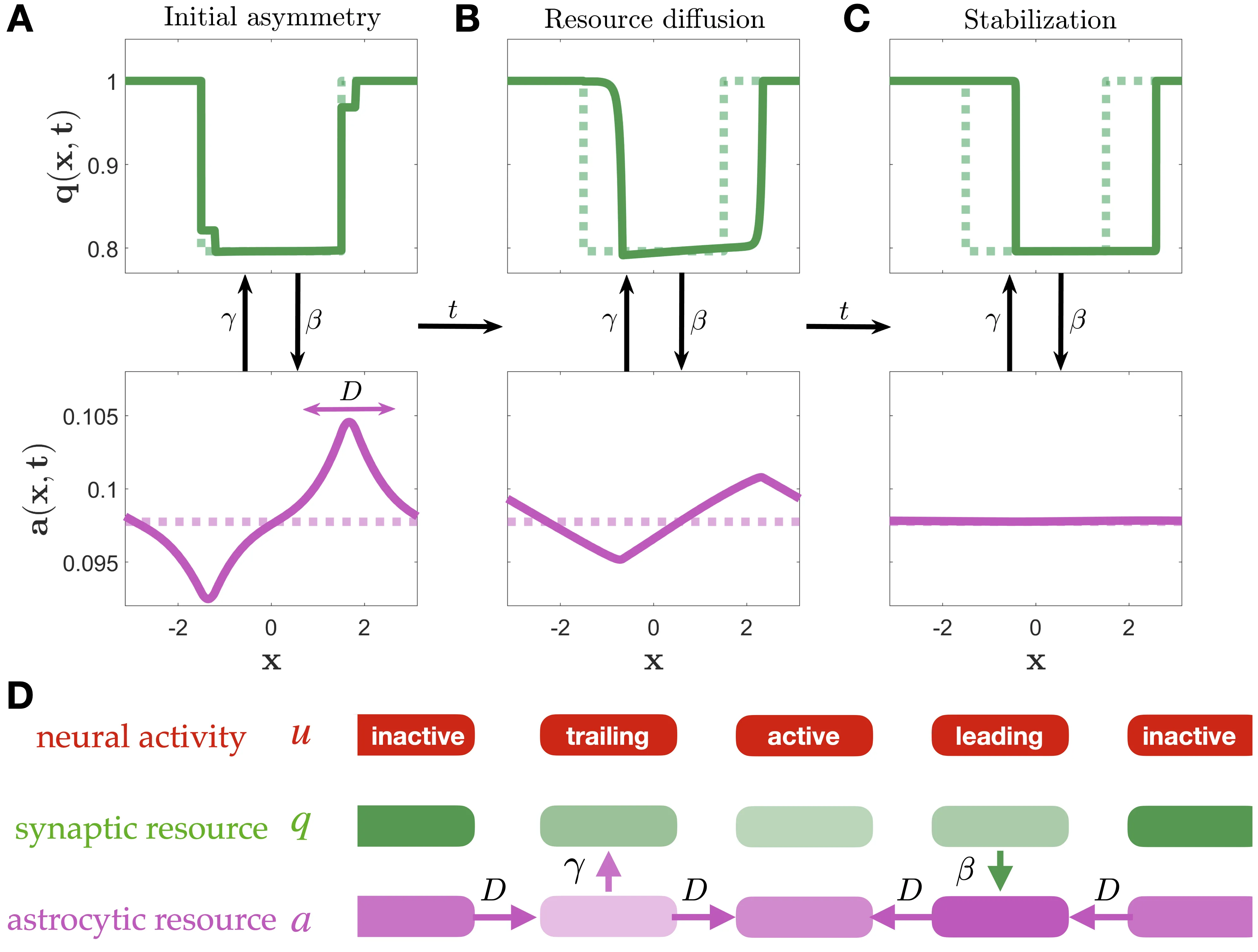
In this new study, helper cells, astrocytes, were added to the chain. They don't transmit signals themselves but ferry needed substances around, like a water delivery service for firefighters. It turns out that if the helpers quickly distribute resources and restock supplies, the active zone stays put even if nudged slightly. Without such support, the zone starts to drift and eventually fades out.
The scientists derived the conditions under which working memory is stable. It's like finding the right rhythm for the bucket brigade: if the water supply comes too slowly, the fire goes out. Understanding these mechanisms could help with diseases where memory weakens.
Original abstract
as written by the authors arXiv:2604.10036
Persistent neural activity underlying working memory requires sustained synaptic transmission, yet the metabolic and neurotransmitter support provided by astrocyte networks is largely absent from spatially extended neural circuit models. We introduce a coupled astrocyte-neural field model in which synaptic efficacy is regulated by depletion and recovery of a conserved resource pool recycled and spatially redistributed through diffusively coupled astrocytes. We obtain explicit stationary bump profiles and self-consistency conditions for bump width and amplitude on a canonical ring architecture. Linearizing about these solutions while carefully accounting for perturbations at bump boundaries, we analyze the resulting spectral problem governing stability. Our analysis, supported by numerical simulations and low-dimensional Fourier truncations, reveals a two-stage stabilization mechanism: astrocytic diffusion smooths resource asymmetries created by small bump displacements, and synaptic replenishment transfers this smoothing back to the synaptic pool. Together, sufficiently strong diffusion and replenishment suppress drift instabilities and enlarge the parameter regime in which stationary bumps persist.
Astrocytes can exchange substances through special channels, forming a network that spans large regions of the brain.