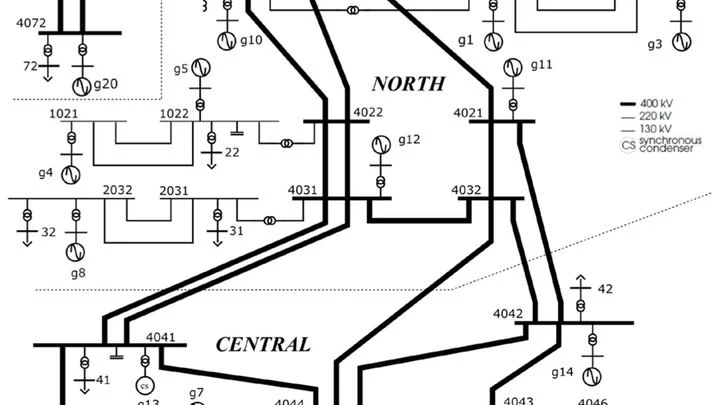
Power grid stabilization is the set of techniques used to keep voltage and frequency within safe limits across an electrical network. Modern grids face new challenges: renewable sources like solar and wind are intermittent, electric vehicles charge unpredictably, and large data centers draw sudden, massive loads. These fluctuations can trigger voltage oscillations — rhythmic swings in the electrical potential that, if left unchecked, can cascade into blackouts. The goal is to detect these oscillations early and damp them before they grow.
History
The physics of grid oscillations has been studied since the 1920s, but the term 'stabilization' became critical with the advent of wide-area monitoring in the 1990s. The use of machine learning for real-time oscillation damping is a development of the 2010s–2020s.
How it works
Oscillations in a power grid are often low-frequency (0.1–2 Hz) and arise from the interplay between generators, loads, and control systems. Detection involves monitoring voltage and current phasors across the network using sensors called PMUs (phasor measurement units). Once an oscillation is identified, suppression strategies include adjusting generator output, switching in capacitor banks, or using power electronics like static compensators to inject counteracting currents. In modern approaches, neural networks analyze the PMU data to predict instability and trigger corrective actions faster than traditional linear controllers.
In practice
Deployed in transmission system operator control rooms to prevent blackouts, and in electric vehicle charging algorithms that adjust charging rates to help regulate grid frequency.
Fun fact
A single large data center can cause measurable voltage oscillations in a regional grid, and researchers have proposed using its own cooling fans as dampers to stabilize the network.
In some crystals, electrons are not spread uniformly but arrange themselves into a strict checkerboard: one cell has more electrons, the neighboring cell has fewer. Such a pattern is called charge order, and for a long time it was considered something frozen, like a pattern on frosty glass.
Imagine a large orchestra without a conductor. Each musician hears everyone else and adjusts to the collective hum. If every instrument amplifies its neighbors, the sound builds to a screech; if some occasionally dampen it, the orchestra may fall into silence or break into cacophony.
A forest does not live in a static world. Between winter and summer, day and night, conditions shift, and each fluctuation is like a rhythm that all its inhabitants must keep pace with. Yet until now, ecologists have mostly studied how communities of living beings persist in an unchanging environment, like testing a bridge's strength only in calm weather.
One hundred milliseconds. In that time, after a lightning strike or a short circuit, the power system either returns to normal operation or loses stability. A new-generation Neural Network Oscillations learns to sense this moment, like an experienced tightrope walker anticipating a gust of wind.
You're standing in the shower: you turn the tap, and the water is either freezing or scalding. The pipes have a mind of their own — the pressure jumps unpredictably. The new controller learns on the go: it doesn't know the plumbing layout, but within minutes it adapts and gently guides the temperature to comfort, without breaching safety limits.
The power grid can be pictured as a water supply system: pipes are the lines, and pumps are the converters. When pressure (voltage) drops in some district, powerful pumps can send extra water (power) there. The trouble is, too strong a flow causes overload, and too weak a flow doesn't help. You need to know exactly how far to open the valve.
Engineers found the answer.
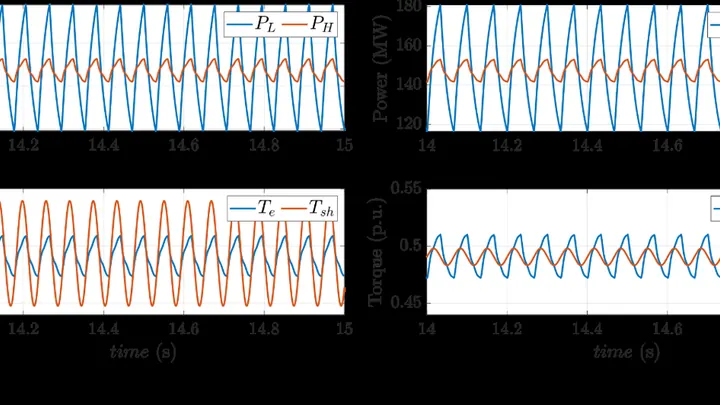
To swing a playground swing, push it in rhythm. That's how you use resonance — amplifying oscillations when the beat matches. A similar mechanism twists hydroturbine shafts when they receive electrical jolts from AI data centers. Modern AI servers consume energy unevenly: millions of processors suddenly kick into action, then go quiet.
The power grid is a galaxy, where massive generators, like stars, set the rhythm with their synchronous rotation. With the advent of green energy, "planets" appear — power converters. Some obediently circle in their orbits, while others try to become centers of attraction.
The railway overhead contact line resembles a galaxy: energy flows through it like gravity, with trains becoming planets. The more trains draw current simultaneously, the stronger the voltage fluctuations — gravitational waves ripple through the system, threatening blackouts.
The railway's electrical network is like an orchestra: trains are musicians whose systems respond differently to current. When their 'electric voices' fall out of tune, disorder arises — a cacophony that can escalate into dangerous voltage rocking.
In pursuit of gravitational waves, ripples in spacetime left by black holes and neutron stars, detectors like LIGO pump their arms with light of dazzling intensity.
In the world of atoms and particles, everything tends toward rest: particles lose energy, just as a swing slows down due to energy loss (friction). But many devices — from hydrogen masers to atomic clocks — live by repetitive cycles.
A child on a swing: too strong a push and they fly off. Roughly this is how powerful light tears electrons out of an atom. It would seem that the stronger the push, the more certain the destruction. But in the quantum world it is different: when the field strength crosses a certain threshold, the atom suddenly freezes.
Holding a phone number in your head while you dial it: that's working memory. In the brain, a group of cells is responsible for this, sending signals to each other like people passing a bucket along a chain. But every transfer has a cost: it requires messenger substances that get used up.
Light traveling through an optical fiber is like a runner in a narrow corridor: it can run straight, or it can weave from side to side. The direction of these "weaves" is polarization. Physicists have learned to keep the runner on a straight path: they constantly check its trajectory and gently correct it, not letting it veer off.
Tuning a string: higher harmonics help hold the pitch without drowning out the fundamental note. In an optical microcavity, a tiny resonator made of two mirrors, light bounces between the reflective surfaces, and any jitter in the spacing knocks it off resonance.