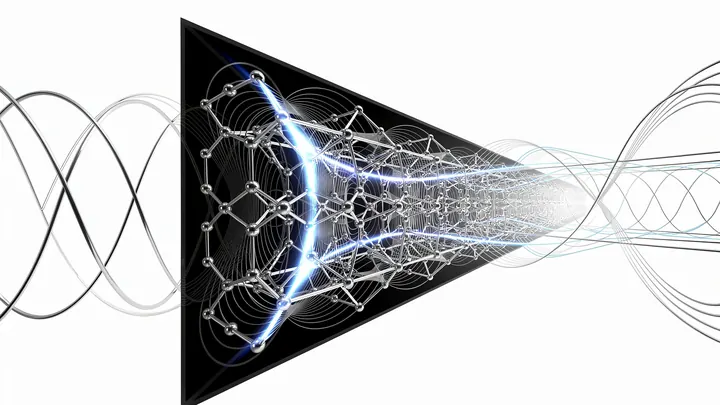
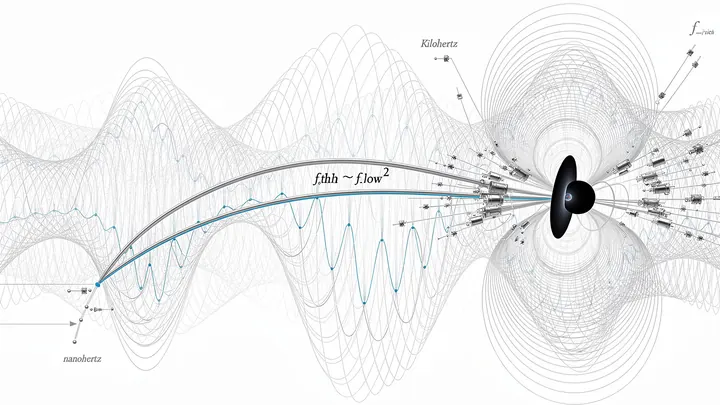
A stochastic background is a random, statistically uniform signal that arises from the superposition of many independent, unresolved sources. In gravitational-wave astronomy, for example, the stochastic background is the combined signal from countless distant mergers of black holes and neutron stars, or from processes in the early universe. Unlike a single event like a binary merger, which produces a distinct chirp, a stochastic background is a persistent, random 'noise' that looks like static.
History
The concept of a stochastic gravitational-wave background was first discussed in the 1970s, with early work by Misner, Thorne, and others. The first detection of a stochastic background was announced in 2023 by the NANOGrav collaboration, using pulsar timing arrays, which found evidence for a background likely from supermassive black hole mergers.
How it works
Each individual source emits a weak gravitational wave, but when you add up millions of them from all directions and at all times, the result is a random field. Because the sources are independent, the phases are random, so the total signal is a Gaussian random process. To detect it, you cross-correlate data from two or more detectors: the common signal shows up as a correlated component, while local noise is uncorrelated. The spectrum of the background (how its amplitude varies with frequency) encodes information about the sources that produced it.
In practice
It is used to probe the population of black hole mergers, to test models of the early universe (e.g., cosmic strings or inflation), and to measure the rate of events too faint to detect individually.
Fun fact
The stochastic background detected by NANOGrav in 2023 is so faint that it took 15 years of observations of 68 pulsars, each acting as a cosmic clock, to see the correlation pattern.
An architect reinforces the foundation but leaves a door open for remodeling: that's how living systems balance reliability against renewal. A cell copies hereditary information with a fidelity any scribe would envy, yet it can also allow changes that help it survive under new conditions.
Every winter, hospitals fill up, and by summer they seem to empty. Epidemics breathe like the tide. But why do waves of disease keep rolling in, even without new mutations? Mathematicians found an answer in a tug-of-war between two strains.
Within a single epidemic, two virus variants often coexist.
Imagine a lottery where instead of money, you win black holes. Each ticket is a random spot on the sky, and the prize is a gravitational wave from the merger of two giants. The chance of hitting the jackpot is minuscule, but if you do, the wave is heard across the entire universe.
When a star many times heavier than the Sun dies, it collapses and explodes as a supernova. This is not just a flash of light — the entire process, from core collapse to the ejection of the outer layers, makes space itself tremble. These ripples are called gravitational waves.
The Universe is humming, but our ears catch only the bass. LIGO hears the rumble of black hole mergers — the infrasound of space. Higher up, in the gigahertz range, the flutes and violins of primordial gravity ring out.
A low rumble coming from underground could be the noise of a distant construction site, or it could be the echo of an ancient earthquake. Astronomers faced a similar puzzle in 2023 when they detected ultra-low-frequency gravitational waves — the trembling of spacetime itself, rippling across the universe.
The mystery of dark matter has puzzled physicists for nearly a century. Among the candidates for its role are primordial black holes (PBHs), born in the fiery embrace of the first moment after the Big Bang.
A fundamental string plucked at the moment of the Big Bang doesn't just hum a single note — waves run along it, and occasionally tiny loops peel off. These loops, like tuning forks, begin to ring at their own frequency, producing a very high-pitched sound.
In a football stadium, the crowd's emotions arise from the chatter of individual fans. If mood could be both joyful and sorrowful at once, you'd have a quantum superposition. But the murmur of thousands of voices instantly forces that blend into a single definite state.
An orchestra of millions of instruments plays a single note, but each enters at its own moment and with its own volume. That's how the stochastic gravitational wave background sounds — a hum from black hole mergers that are individually indistinguishable.
A pot of water sits on the stove. When the water boils, it suddenly turns into steam: that's a phase transition. In the first moments after the Big Bang, the Universe underwent something similar, but it wasn't liquid and gas that changed, but fundamental fields.
Every isolated quantum system inevitably moves toward thermal equilibrium — a state where all details of the past are erased. It’s like an orchestra: instead of a symphony, it starts playing white noise — random but statistically predictable notes.
Gravitational wave detectors pick up a low-frequency hum, like the sound of a distant waterfall. The Webb telescope finds galaxies in the early universe with black holes that seem too massive for such a young age.
A figure skater glides across the ice, gradually approaching the center of the rink. A slight twist of the torso, and the smooth spiral breaks, the trajectory becomes unpredictable. Something similar happens when a small black hole with its own rotation (spin) falls toward a giant black hole.
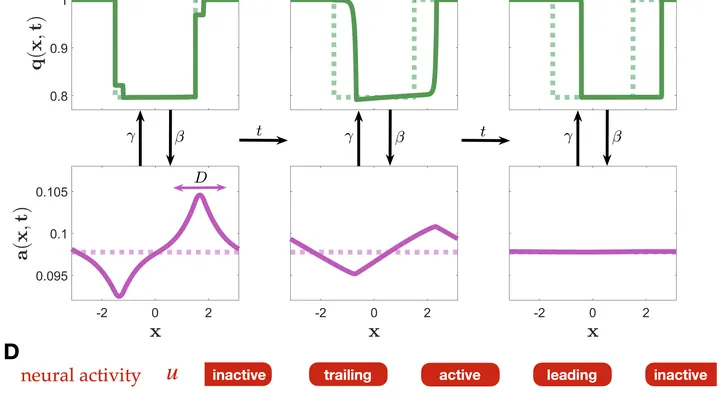
Holding a phone number in your head while you dial it: that's working memory. In the brain, a group of cells is responsible for this, sending signals to each other like people passing a bucket along a chain. But every transfer has a cost: it requires messenger substances that get used up.
The universe wasn't born in silence. Primordial gravitational waves — ripples in spacetime — still carry the echo of that event. Scientists try to hear it in two ways. Low 'notes' are captured in the Big Bang's afterglow — light emitted 380,000 years later.
Imagine the hum of a crowded square (that's what the gravitational wave background of the Universe sounds like, as detected by a network of pulsars) neutron stars that emit regular radio pulses with the precision of atomic clocks.
When a massive star dies and explodes, it releases not only light but also invisible lightweight particles. They fly out in all directions at nearly the speed of light. Only a small fraction reaches Earth, but each explosion sends its own clump. These clumps stretch along the way: fast particles overtake slow ones, and by the time they arrive, a clump can be spread over tens of thousands of years.