A Microwave for the Proton: How Automation Keeps the Spin express
At Fermilab's accelerator, a particle beam strikes a target of frozen ammonia. The hydrogen nuclei inside are like tiny tops, and physicists need them all spinning the same way. Then the collisions reveal how the proton's spin is put together. But getting billions of tops to point in one direction is like getting a stadium crowd to turn in unison at a whistle.
Microwaves at 140 gigahertz act as the conductor's baton. They flip the nuclear spins, and the nuclei gradually align. The trouble is that radiation from the beam messes up the tuning: the frequency drifts like an out-of-tune string. Previously, an operator had to turn a knob by hand, watching the signal. Now an automatic system does the job.
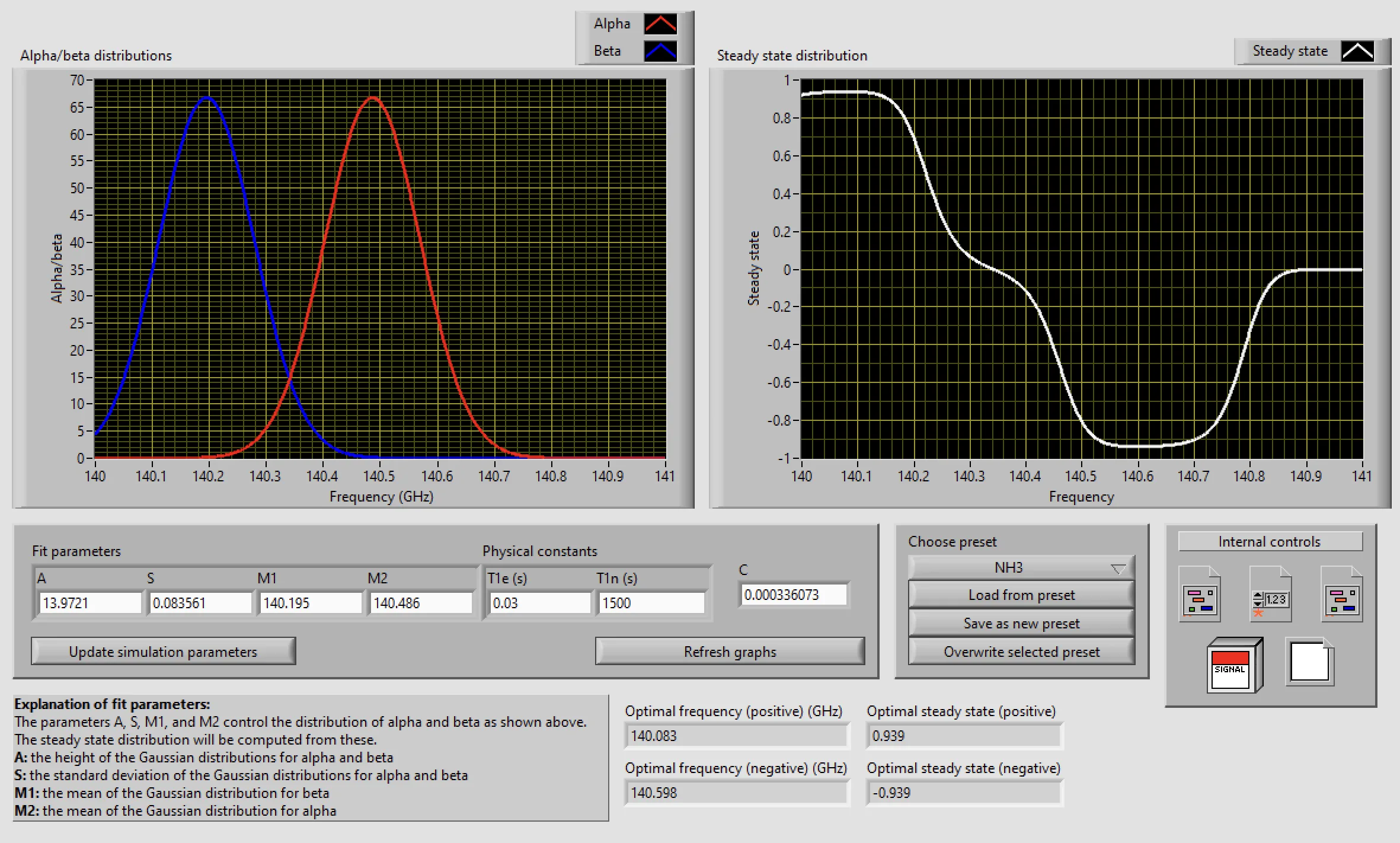
The engineers built a digital twin of the whole system — a computer model that mimics the real setup. It accounts for heating, radiation drift, and sensor noise. On this model, they trained several algorithms: one follows simple rules, another learns by trial and error, and a third finds patterns without hints. All of them can turn two knobs at once: the microwave frequency and their power.
The result: the target's polarization stays at its maximum even when the beam disrupts the tuning. The operator sits in a safe room watching plots, not turning knobs near radiation. The same approach will work for future spin experiments and for any cryogenic setup with finicky microwaves.
Original abstract
as written by the authors arXiv:2604.10447
The SpinQuest experiment at Fermilab employs a dynamically polarized solid ammonia target to probe the spin structure of the proton, requiring stable, optimized microwave-driven Dynamic Nuclear Polarization (DNP) under high radiation conditions. We present the design, operation, and automation of a 140 GHz microwave system based on an extended interaction oscillator (EIO), integrated with real-time polarization feedback from a continuous-wave NMR system and cryogenic diagnostics. The system enables fine frequency control through motorized cavity tuning and is operated remotely to mitigate radiation exposure. To continuously optimize target polarization, we develop an automation framework supported by a Monte Carlo (digital twin) of the DNP process. The simulation incorporates rate-equation dynamics, frequency-dependent steady-state behavior, dose-induced frequency drift, beam-induced depolarization, and realistic NMR noise. This framework is used to design and benchmark control strategies, including a heuristic feedback algorithm, reinforcement learning (RL), and unsupervised RL approaches. These methods enable autonomous frequency tuning, improve ramp-up efficiency, and maintain near-optimal polarization under evolving conditions. We also demonstrate integration of EIO power-supply control into the feedback loop via anode voltage modulation, providing an additional degree of freedom for simultaneous control of microwave frequency and RF power. This combined control of cavity tuning and anode voltage allows the system to avoid frequency-dependent power nonuniformities and to better match broad Larmor distributions in irradiated targets. The results establish a scalable framework for AI-driven control of complex microwave systems in polarized-target experiments, with implications for future spin-physics measurements and other cryogenic, high-field applications.
The ammonia target is cooled to about 1 kelvin — colder than the surface of Pluto.
In the series 'The Expanse,' ships use magnetic fields to shield against radiation — here, the polarized target also aligns particles, but for scientific measurements.