Cosmic Hazes: How Galaxies Are Wrapped in Gas express
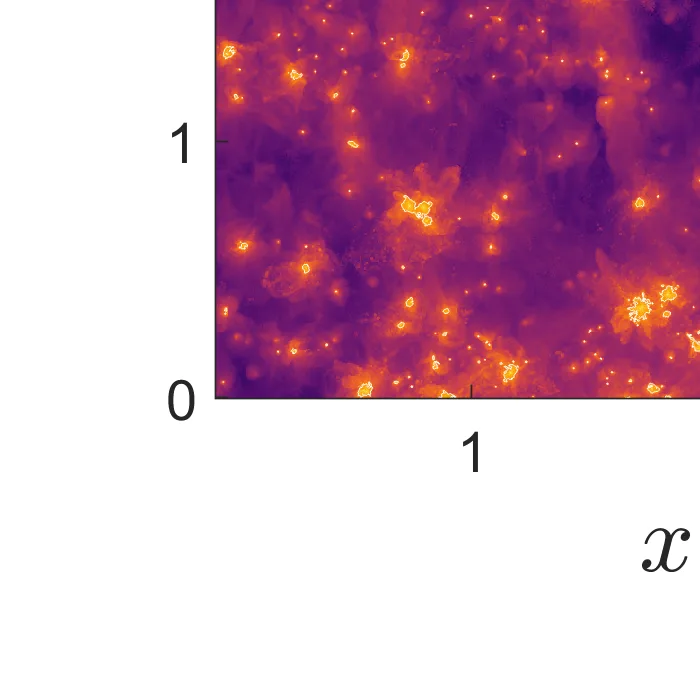
Every galaxy floats in an invisible cloud of gas, like fruit in syrup. This gas is the leftover building material from which stars were assembled, and it is constantly replenished by fresh supplies from intergalactic space. Seeing it directly is nearly impossible: it is too tenuous and too cold. But when light from a distant quasar passes through such a cloud, metal atoms in the gas absorb some of the light at specific wavelengths. From these 'dips' in the spectrum, astronomers calculate how much gas the light encountered along the way.
Scientists took one of the best computer models of the universe (IllustrisTNG, where millions of virtual galaxies live by the laws of physics) and compared its predictions with real observations. In the model, they considered two scenarios: gas heated only by particle collisions, or gas also illuminated by ultraviolet radiation from all stars and quasars. It turned out that the second scenario matches what telescopes see much better. The model describes particularly well the tenuous gas on the outskirts of galaxies: that very 'syrup' stretching for hundreds of thousands of light-years.
Why does the model fall short on dense clouds? Possibly it lacks some processes that compress gas: supernova explosions, outflows from black holes, or galaxy collisions. It's like a baker forgetting to add yeast to the dough — the pie turns out, but not as fluffy. The difference between model and reality points to which 'yeast' needs to be added to the next version of the simulation.
This approach, comparing model with observations, helps calibrate our understanding of how galaxies breathe: pulling in gas, processing it into stars, and ejecting it back out. The more accurately the model reproduces the pattern of quasar light absorption, the more confidently we can say we correctly understand the circulation of matter in the universe.
Original abstract
as written by the authors arXiv:2604.10595
Low-ionization metal absorption lines provide a primary probe of cool gas in and around galaxies. We confront observations of metal-line absorption in quasar spectra with predictions from the IllustrisTNG cosmological simulation in order to benchmark how well current galaxy formation models reproduce the observed circumgalactic medium (CGM) and intergalactic medium (IGM) absorption signatures. We implement two ionization prescriptions: a purely collisional model and a model including photo-ionization by a uniform ultraviolet background (UVB). Using a grid-based framework, we compute MgI, MgII and FeII column densities and construct column density probability distribution functions (PDFs) and equivalent width (EW) statistics for comparison with observations. The observational samples considered here are based on the High Resolution Echelle Spectrometer (HIRES), the Ultraviolet and Visual Echelle Spectrograph (UVES), the Sloan Digital Sky Survey (SDSS) and the Dark Energy Spectroscopic Instrument (DESI). The computed PDFs broadly reproduce the observed ones across the sampled column density range of $$10^{11.4}\lesssim \text{N}\lesssim 10^{16}\ \rm{cm^{-2}}$$, indicating that the simulation captures the dominant physical drivers of low-ionization absorption. We then compute the cosmic incidence of MgII systems, namely the evolution of their number with redshift $$d\mathcal{N}/{dz}$$. The model that includes UVB accurately produces $$d\mathcal{N}/{dz}$$ up to equivalent widths (EW) of $$\rm W_0^{2796} < 0.6\ \mathring{A}$$, consistent with low-density photo-ionized gas in the outer CGM. At high EWs of $$\rm W_0^{2796} > 1\ \mathring{A}$$ TNG underestimates $$d\mathcal{N}/{dz}$$ and fails to capture its rise toward $$z\sim2$$.
Light from a quasar passing through a gas cloud can reveal its composition: magnesium and iron atoms leave characteristic 'fingerprints' in the spectrum at strictly defined wavelengths.