Squeezing Chaos Into a Single Number
Try packing a suitcase for a trip when you have no idea what you will need. If there is a lot of stuff and it is all different, you will spend ages rearranging it and still have no clue how neatly everything fits. That is roughly how physicists long looked at entropy, the measure of disorder, in systems that never settle down: bacterial swarms, granular materials, swarms of active particles. For calm, equilibrium systems the recipes have been known for ages: heat it, measure the heat, do the math. But life does not wait for equilibrium, and here the old tools come up short.
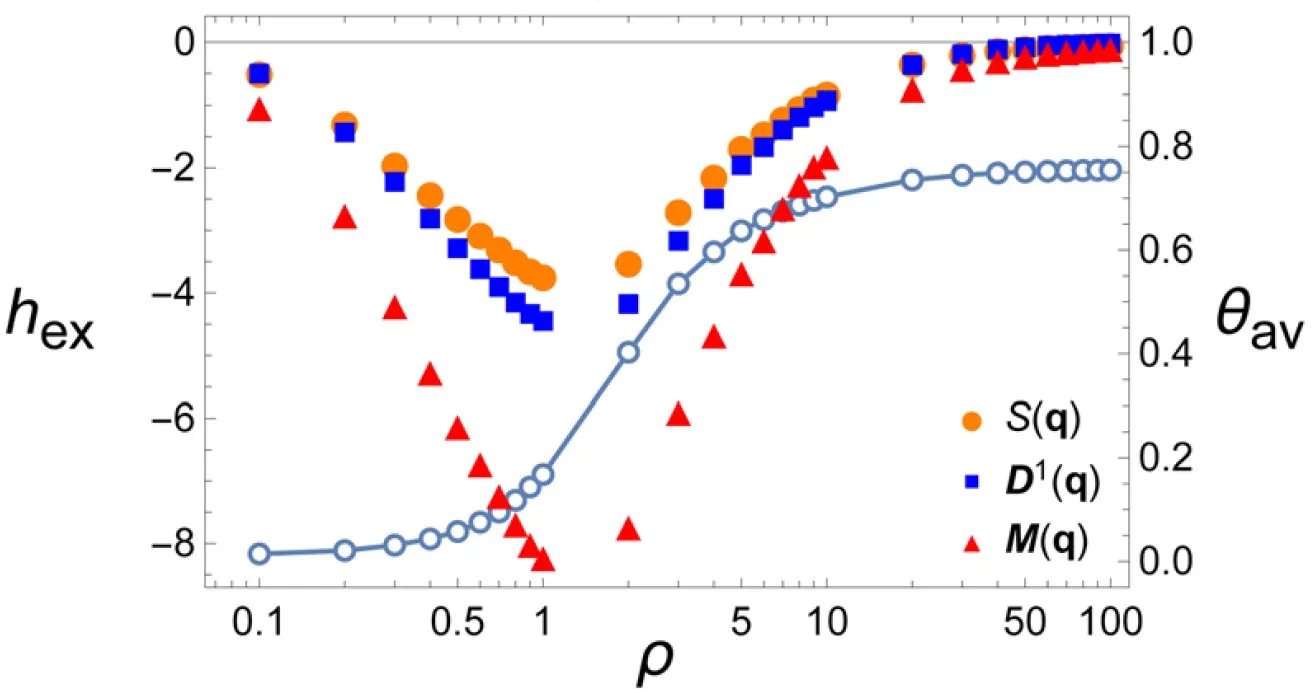
The main trouble is the curse of dimensionality. To estimate the entropy of a system of hundreds of particles, you have to fill in numbers for every possible position and velocity they might have. The number of such combinations snowballs: for a hundred-dimensional system you would need more samples than there are atoms in the Universe. So scientists took a detour. Instead of sifting through every state, they ask: what do we already know about the system? Pairwise correlations, that is, how much particles like to be near each other or far apart. The speed at which they wander off. Or even how well a data file compresses on a computer. A good archiver, like zip, spots repeating patterns, and the shorter the compressed file, the less disorder in the original data. This is not a trick but a direct consequence of information theory: entropy is the limit of compression.
These methods do more than spit out a number. They let you peer into the mechanism. In a jammed packing of two kinds of droplets, correlation boundaries revealed which type of contact governs the jam. In the Vicsek model, where particles align their direction with their neighbors, entropy analysis showed that orientational degrees of freedom freeze before positional ones. Previously this distinction was invisible: the order parameter showed only an overall transition, while entropy sorted it onto separate shelves.
Of course, every approach has its limits. Upper bounds from correlations can sit far from the true entropy if the system has long-range connections that pairwise interactions fail to capture. Machine learning demands careful tuning of the neural network. But even a rough estimate beats nothing: it lets you compare states, spot transitions and build phase diagrams where there used to be blindness.
Today these methods are already at work in labs: analyzing swarming bacteria, granular media, active colloids. Tomorrow they will step into the quantum world, where von Neumann entropy awaits its measurers. Instead of a suitcase with unknown contents, we get a luggage tag with the exact weight and a list of items, and we can finally see how neatly the world is packed.
The entropy of a continuous distribution can be negative, unlike the discrete case. You can see this with a narrow peak: the narrower the peak, the lower the entropy, and in the limit it goes to minus infinity.