Entropy Out of Equilibrium: How to Measure Chaos That Won't Settle Down
Context
Equilibrium thermodynamics offers clear recipes for entropy: through heat capacity, energy fluctuations or free energy. But living systems, granular media and active matter exist far from equilibrium, where those recipes fail. This work sits off to the side: nearby in the archive are studies of chaos without knowledge of the rules, phase diagrams and extracting laws from noise. They all wrestle with one problem: how to fish information out of a complex system without knowing its microscopic details.
Methods
The authors don't offer a single universal method; instead they assemble a palette of approaches. Data compression uses algorithms like LZ77: the length of the compressed file estimates entropy, because a good compressor approaches the theoretical Shannon limit. Upper bounds from correlation functions rely on the maximum entropy principle: knowing only pair correlations, you can compute the maximum possible entropy. Machine learning applies the Donsker-Varadhan variational formula, where a neural network searches for the optimal functional. Kinetic inequalities link entropy to the diffusion coefficient and relaxation time.
Results
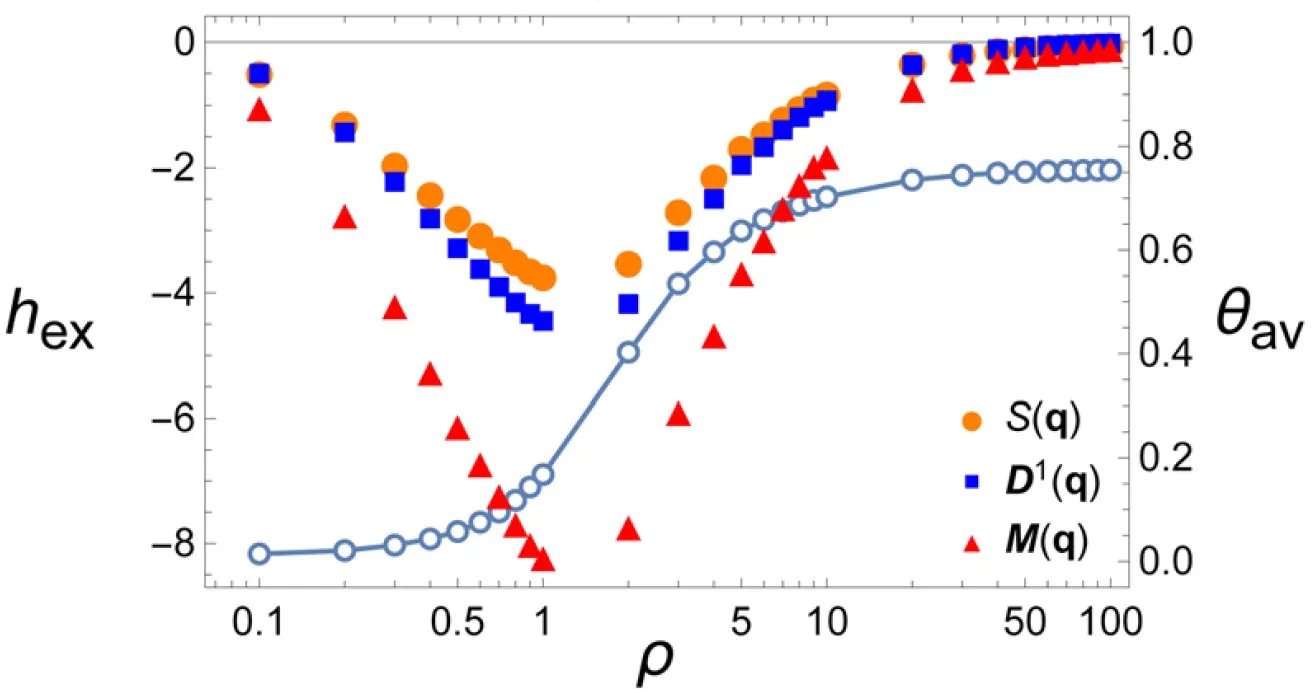
The methods were tested on model and experimental systems. In the Vicsek model, the transition from disorder to flocking is accompanied by a sharp drop in entropy, with the main contribution coming from orientational degrees of freedom rather than positional ones. For swarming bacteria, entropy analysis revealed a new transition that was invisible in the order parameter. In jammed packings of a binary droplet mixture, the upper-bound method distinguished regimes governed by different correlations. Key numbers: entropy drops by about 1-2 (in units of $k_B$ per particle) at the phase transition, and estimating the entropy of a continuous distribution in M-dimensional space requires on the order of $q^{-M}$ samples, where q is the fraction of rare events.
Implications
This work differs from its neighbors in that it focuses on physical systems with continuous degrees of freedom, where direct application of statistical estimators is impossible. Instead of a universal algorithm, it proposes using physically motivated constraints, which makes the approach suitable for experimental data. This is the first systematization of methods that not only estimate entropy but also reveal the dominant degrees of freedom at a transition.
Future development
The most promising directions are quantum von Neumann entropy and entropy production. For quantum systems, upper bounds analogous to the classical ones can be derived from correlation functions. Entropy production, tied to irreversibility, is harder to measure, but new methods based on neural networks and cross-parsing promise progress. Another path is combining bounds from different sources to isolate the dominant mechanism.
Impact
The methods are applicable to active matter, biological systems, granular media and quantum simulators. They give experimentalists a tool for detecting hidden transitions without knowing the microscopic model.
Next steps
Develop analytical expressions for upper bounds from kinetic coefficients such as viscosity or conductivity. Generalize the methods to quantum systems and test them on experimental data from cold atoms.
Key open problems
In statistical physics, the question of the link between static entropy and kinetics far from equilibrium remains open. This work proposes inequalities that may shed light on that link, but their accuracy and universality have yet to be tested. It is also unclear how close the upper bounds are to the true entropy in systems with long-range correlations.
The entropy of a continuous distribution can be negative, unlike the discrete case. You can see this with a narrow peak: the narrower the peak, the lower the entropy, and in the limit it goes to minus infinity.
Key numbers
- entropy drop at the transition: 1-2 k_B per particle
- required number of samples: q^{-M}, where q is the fraction of rare events, M is the dimension
- dimension of phase space: typically 102-103
- entropy of a continuous distribution: can be negative
- number of particles in the Vicsek model: from hundreds to thousands