Starlink and OneWeb Satellites: An Unexpected Swap in Brightness express
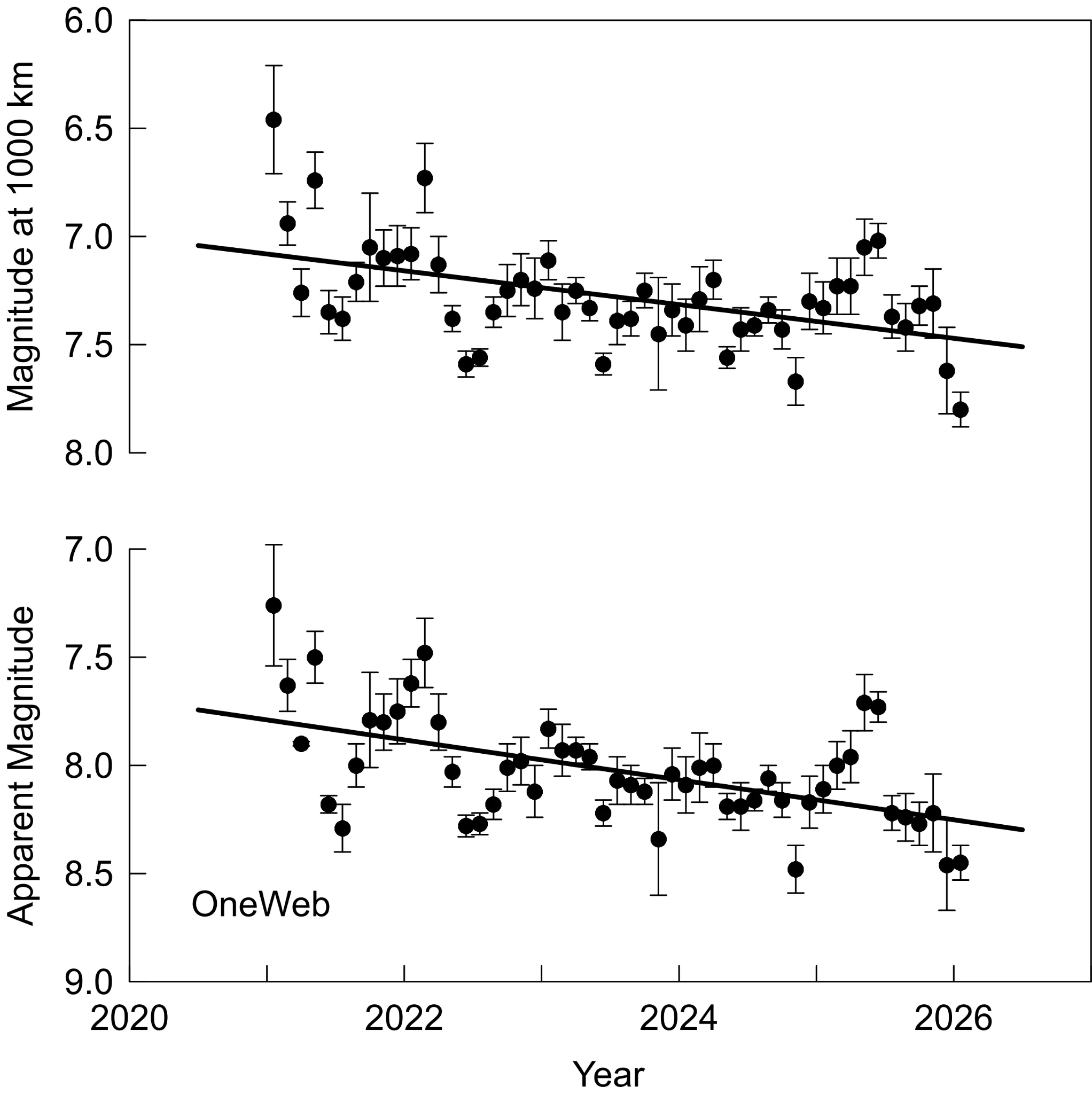
For five consecutive years, the automated MMT9 observatory measured the brightness of Starlink and OneWeb satellites using photometry (precise light measurement). The results were surprising: VisorSats, equipped with visors to reduce glare, became brighter by 0.6 magnitudes, while OneWeb, on the contrary, dimmed by 0.4. The scale is inverted: the smaller the number, the brighter the object. So "increased brightness" actually means the number got smaller.
These changes are like headlights on a dark road: some suddenly shine brighter while others grow dim. Such instability hampers astronomers: they search for exoplanets by detecting faint dips in starlight during a transit, but a passing satellite can flood the frame, mimicking a false signal. Projects like the Kepler telescope, launched under the leadership of William Borucki, and modern observations following the methods of David Charbonneau, may lose precious data because of this.
Satellite operators should take long-term trends into account and make their spacecraft darker and more stable. Otherwise, celestial traffic risks turning from an annoying nuisance into a real obstacle for science.
Original abstract
as written by the authors arXiv:2604.13145
Magnitudes recorded from 2021 through 2026 for Starlink VisorSats reveal brightening of 0.6 magnitudes, while those of OneWeb show dimming of 0.4. Both trends are significant at 3 sigma. This study is based on 1.6 million magnitudes recorded by the MMT9 robotic observatory.
The astronomical brightness scale works backward: the brighter the object, the smaller its number. So, "a brightness increase of 0.6" means the numerical value dropped by 0.6. This system was invented by ancient astronomers, who divided visible stars into six magnitudes — from first (brightest) to sixth (dimmest).