A Spectral Mosaic in Two Layers express
The glow of an ultrathin sandwich made of two semiconductor layers, molybdenum selenide and tungsten selenide, resembles a tangled musical score: many narrow colored lines that merge into a general background. Figuring out which line comes from where is nearly impossible.
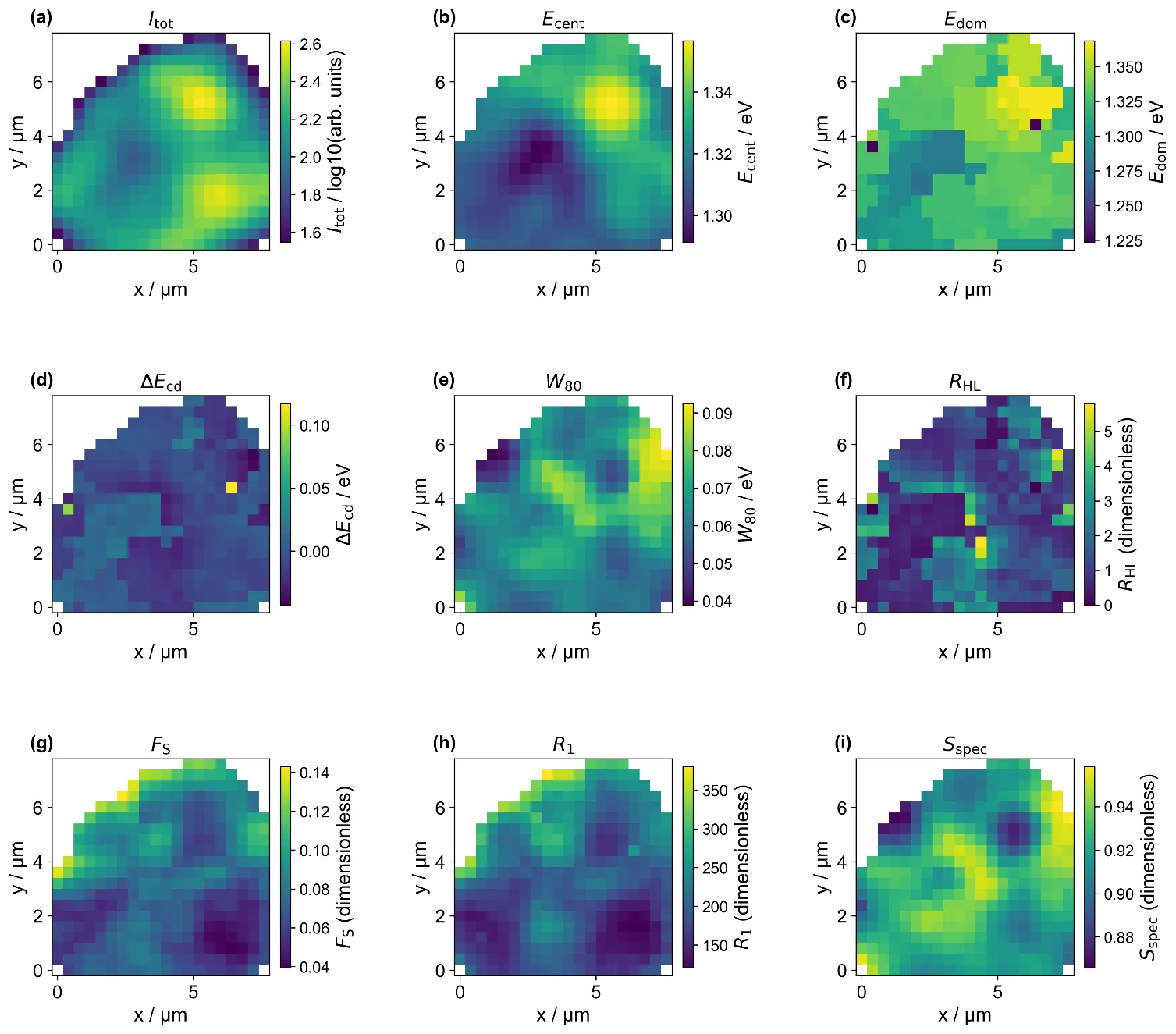
The authors did not try to disentangle the lines one by one. Instead, they mapped the emission with a step of 400 nanometers — hundreds of times thinner than a human hair. It turned out that the entire variety of lines falls into three broad groups, each occupying its own patch of the sample, like a patchwork quilt. These patches range from 1.27 to 2.05 micrometers in size, while the light spot used to illuminate the sample was only 0.85 micrometers across. In other words, each patch is larger than the beam used to examine it.
The researchers measured seven characteristics of the emission: the position of the main line, its width, asymmetry, roughness, and others. They found that the large-scale pattern, the arrangement of patches, and the fine complexity within them are related, but can be studied separately. The authors call this two-level order hierarchical inhomogeneity: first large regions, then fine structure inside.
This result helps understand the structure of so-called moiré superlattices — materials in which two layers are slightly rotated relative to each other, giving rise to a new periodic pattern, like when two combs with different tooth spacings are overlaid. The emission of such materials is important for future ultrathin light sources and quantum devices, where precise control of each photon is needed.
Original abstract
as written by the authors arXiv:2604.16939
Low-temperature photoluminescence from MoSe2/WSe2 moire superlattice often consists of a broad interlayer emission background with dense, narrow peaks, making microscopic line-by-line assignment difficult. Here, we use hyperspectral photoluminescence mapping and peak-decomposition-free spectral analyses to determine how this spectral complexity is organized in space. A 20 x 20 map acquired with a 400 nm pitch reveals three dominant spectral families that form contiguous real-space domains. Feature-wise spatial correlation analysis and whole-spectrum similarity yield a characteristic micron-scale length of 1.27-2.05 um, all exceeding the 0.85 um optical spot size. At the same time, individual pixels retain a dense, multi-peak structure, implying an unresolved local spectral manifold below optical resolution. Correlations among centroid, dominant energy, asymmetry, width, entropy, sharp fraction, and roughness indicate that the micron-scale energy landscape and local manifold complexity can be statistically separated, while remaining correlated across the map, consistent with a hierarchical organization of the emission spectrum. These results establish hierarchical inhomogeneity as an organizing principle of MoSe2/WSe2 moire superlattice photoluminescence.
The moiré pattern gets its name from moiré silk, a fabric whose interlaced threads create shimmering waves. In physics, the same effect occurs when two grids with slightly different spacings are overlaid, and it generates new, much larger periods.