A Drop Crawls, Wriggling express
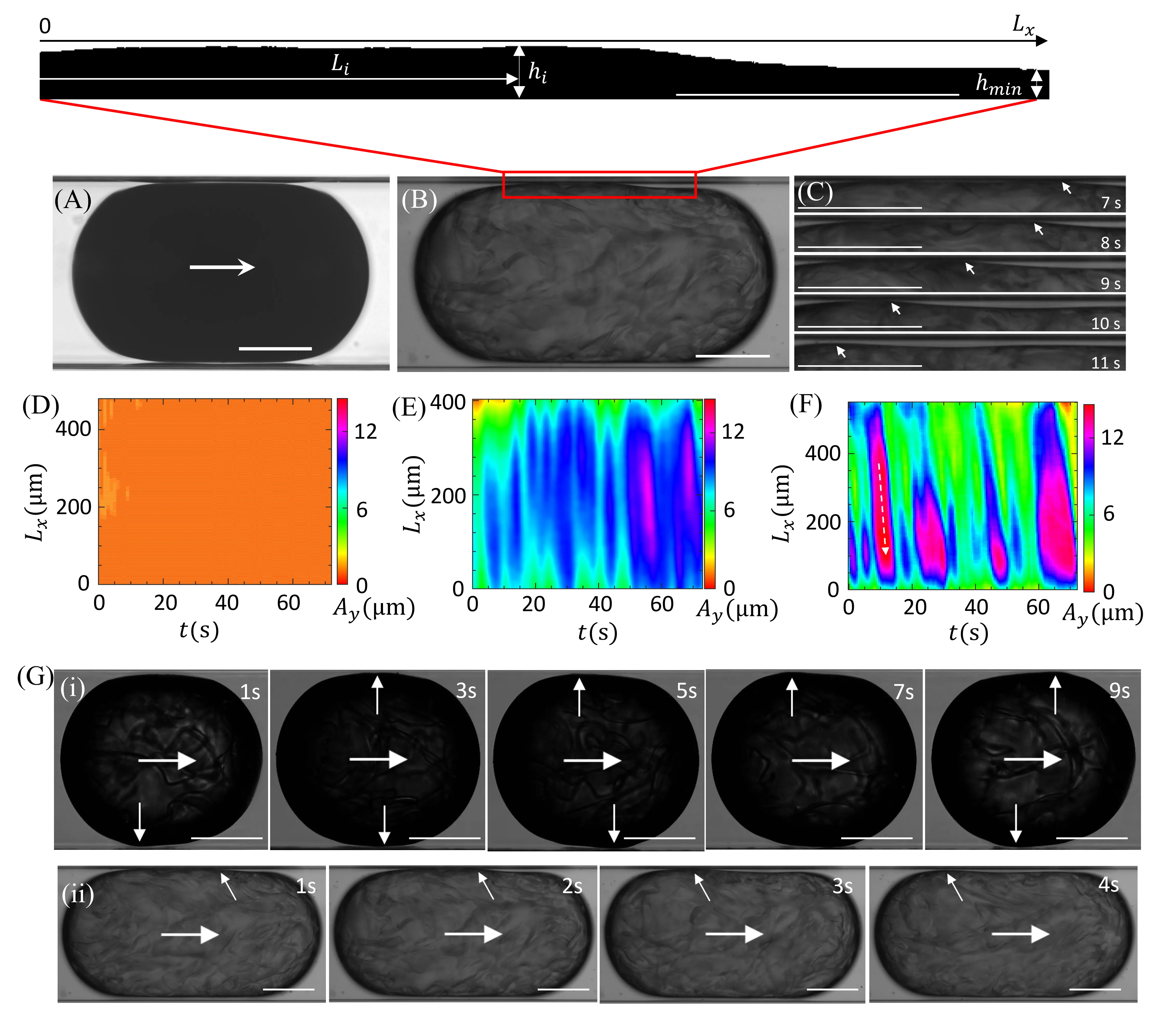
A tiny oil drop squeezes through a water channel narrower than itself. In pure water, it crawls along calmly, like a round bead. But add a little soap to the water, and the drop begins to bend, like a caterpillar.
Researchers observed this behavior by placing drops of a special liquid crystal into water with varying soap concentrations. In a weak solution, the drop keeps its shape; in a more concentrated one, rhythmic waves appear on its surface. Interestingly, the speed of motion barely changes: both the 'calm' and the 'wriggling' drop first slow down in the narrow spot, then settle into a constant speed. The key is the thin film of water between the drop and the channel wall.
The more soap, the thicker this film, and the easier it is for the drop to bend. The scientists also noticed that depending on the channel width, waves on the drop can travel from two sides or just one, as if the drop chooses which side is more convenient to push off from. Calculations showed that these waves are driven by an instability known as the Marangoni effect: differences in soap concentration across the drop's surface create forces that deform it.
This mechanism is an example of how living and non-living matter find similar solutions for moving in tight spaces. Microbes, when squeezing through narrow pores, also change their body shape. Understanding such 'dances' of drops could help create microrobots that deliver drugs to the most inaccessible corners of the body.
Original abstract
as written by the authors arXiv:2604.16994
Microorganisms navigating through narrow spaces encounter significant hydrodynamic challenges. To overcome these constraints and sustain efficient motion, they employ adaptive strategies, including adaptive oscillatory body deformations. While artificial microdroplets can traverse channels narrower than their diameter, studies of their locomotion have thus far been largely restricted to steady-shape regimes. In this work, we demonstrate a transition from steady shape to dynamic interfacial undulations in 5CB (4'-pentyl-4-cyanobiphenyl) droplets within aqueous trimethylammonium bromide (TTAB) solutions. We show that while droplets in dilute, additive-free solutions maintain a steady shape, the introduction of solutes or higher surfactant concentrations triggers pronounced interfacial undulations. Notably, both steady and undulating droplets exhibit a comparable velocity dependence on the confinement ratio, characterized by an initial deceleration followed by saturation, governed by the competition between hydrodynamic resistance and phoretic flow within the lubrication film. Furthermore, we find that increased surfactant concentration increases the capillary number, resulting in a thicker lubrication layer that facilitates a symmetry-breaking transition. Upon varying confinement, the droplet interface shifts from bilateral undulations to a mode localized on one side, forming a traveling-wave pattern strongly coupled to flow field fluctuations at the droplet's anterior. Linear stability analysis identifies the Yih-Marangoni instability as the underlying mechanism for these oscillations, revealing a previously unrecognized mode of adaptive locomotion in confined active matter.
You can see the Marangoni effect at home: if you drop some alcohol on the surface of water, the liquid will spread away from the spot — due to differences in surface tension.
In science fiction, such self-deforming drops resemble the liquid robots from the movie 'Terminator 2', which can seep through narrow cracks.