The Pulse of Quantum Matter: Breathing Droplets and Their Rhythmic Formula
At temperatures billionths of a degree above absolute zero, a Bose–Einstein condensate emerges — a state where thousands of atoms march in a single quantum key.
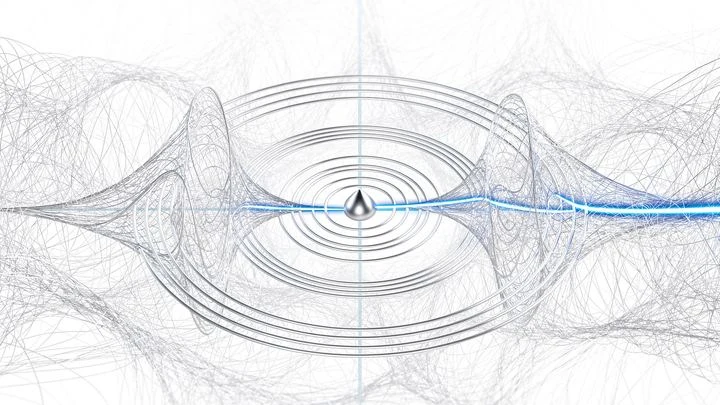
A macroscopic quantum state where particles form a coherent, self-bound object without a surface.A quantum droplet is a self-bound, liquid-like state of matter formed by a dilute gas of ultracold atoms, held together by quantum fluctuations rather than by surface tension or external confinement. Unlike a normal liquid droplet, which exists because of intermolecular forces, a quantum droplet arises from the delicate balance between attractive mean-field interactions and repulsive quantum corrections. These droplets contain thousands to millions of atoms and behave as a single coherent quantum object, yet they are macroscopic in size — visible under a microscope.
Quantum droplets were first predicted theoretically in the 1970s for helium, but in ultracold atomic gases they were proposed in 2014 by Dmitry Petrov and collaborators. They were first observed experimentally in 2016 in dipolar gases of dysprosium and erbium, and later in mixtures of bosonic atoms.
In a Bose-Einstein condensate, atoms can be made to attract each other via magnetic or optical tuning (Feshbach resonance). If the attraction is too strong, the gas collapses; if too weak, it expands. Quantum droplets emerge when the attractive mean-field energy is almost exactly canceled by the repulsive energy from quantum fluctuations (the Lee-Huang-Yang correction). This balance creates a stable, self-bound state with a fixed density, independent of atom number. The droplet's surface is not a sharp boundary but a smooth crossover, and it can exist without any external trap.
Quantum droplets are studied as a platform for quantum simulation, particularly for exploring supersolid phases and for building atomtronic circuits where coherent matter waves flow without dissipation.
Quantum droplets can be so dilute that their density is about a billion times lower than air, yet they remain self-bound in free space without any container.