Magnetite: A Mystery Unsolved for a Hundred Years express
A piece of magnetite, an ordinary iron stone, behaves strangely. At room temperature, it conducts electricity, but cool it below minus 150 degrees, and its resistance jumps sharply. This jump, discovered back in 1939, physicists could not explain for nearly a century.
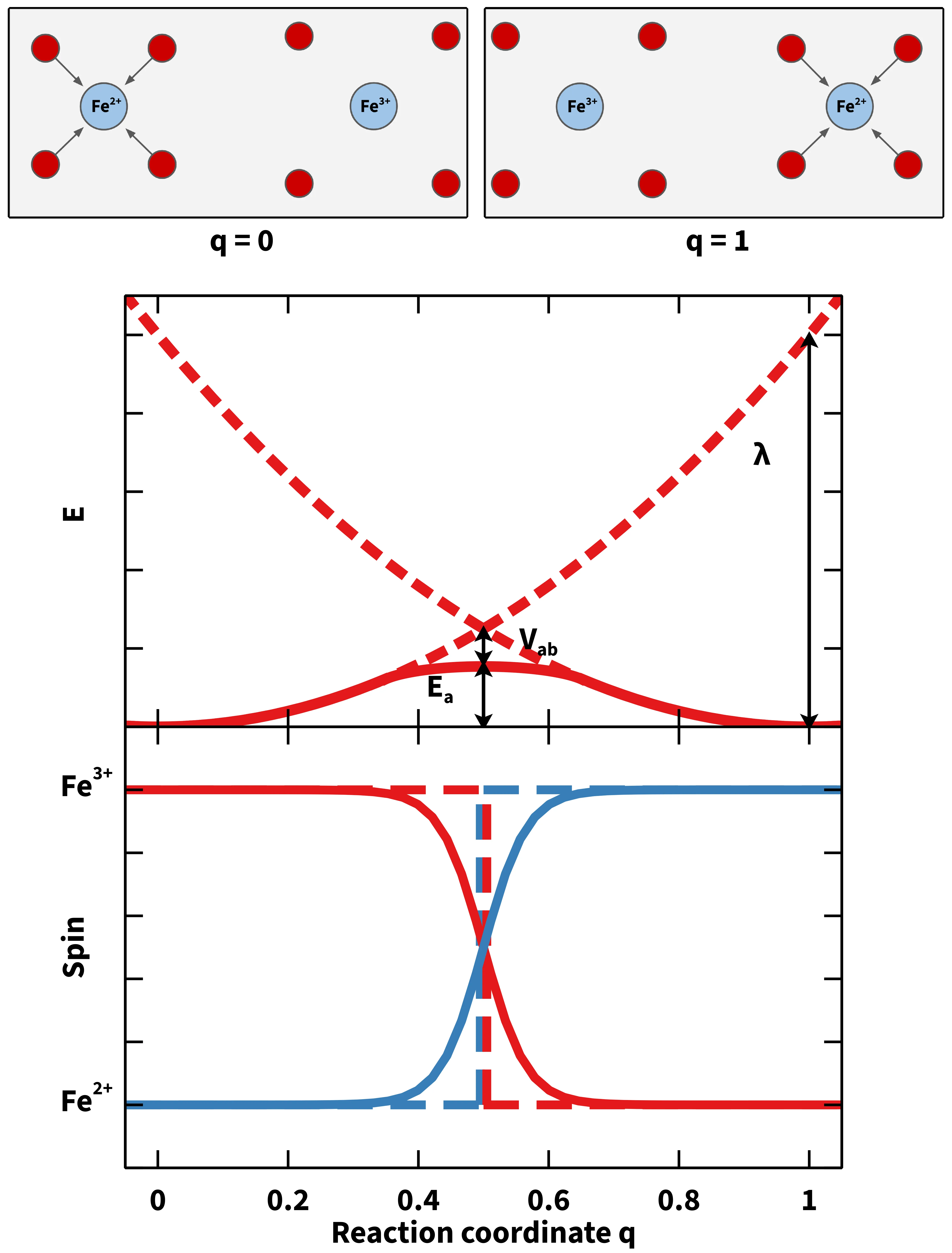
A new study offers a solution. The researchers built a computer model in which charge carriers are not free electrons but polarons: electrons 'dressed' in a cloud of crystal lattice vibrations. Such a particle is heavier than an electron and moves in jumps, like a person carrying a heavy backpack.
The model showed that the transition does not change the band structure — how electron energy depends on momentum. Instead, trimerons come into play: groups of three iron atoms that rearrange and begin to move. Previously, it was thought that the transition was linked to a change in band structure, but the calculations refute this.
The authors compared their model with experimental data on magnetite's conductivity at various temperatures. The match was excellent. This means that the Verwey mystery has finally been explained: the resistance jump is caused not by a change in electronic structure but by the collective motion of trimerons.
Original abstract
as written by the authors arXiv:2604.20642
The enigmatic puzzle of the Verwey transition in magnetite Fe$$_3$$O$$_4$$ has been unresolved for almost a century. We present an ab initio-based model of the polaron transport combining kinetic Monte Carlo and molecular dynamics calculations to directly describe the coupling of polarons with lattice vibrations. Contrary to the Ihle-Lorentz small-polaron model, we find no significant change in the band structure across the Verwey transition, however, trimeron hopping is observed. The proposed model provides dc-conductivity in agreement with experimental data across the Verwey transition.
Magnetite is the most magnetic mineral on Earth. Ancient Chinese made the first compasses from it two thousand years ago.
In Arthur C. Clarke's novel 'Childhood's End,' aliens use materials with unusual electrical properties to control gravity — perhaps such transition mechanisms could inspire science fiction writers.