Black Hole Loses Its Quantum Compass express
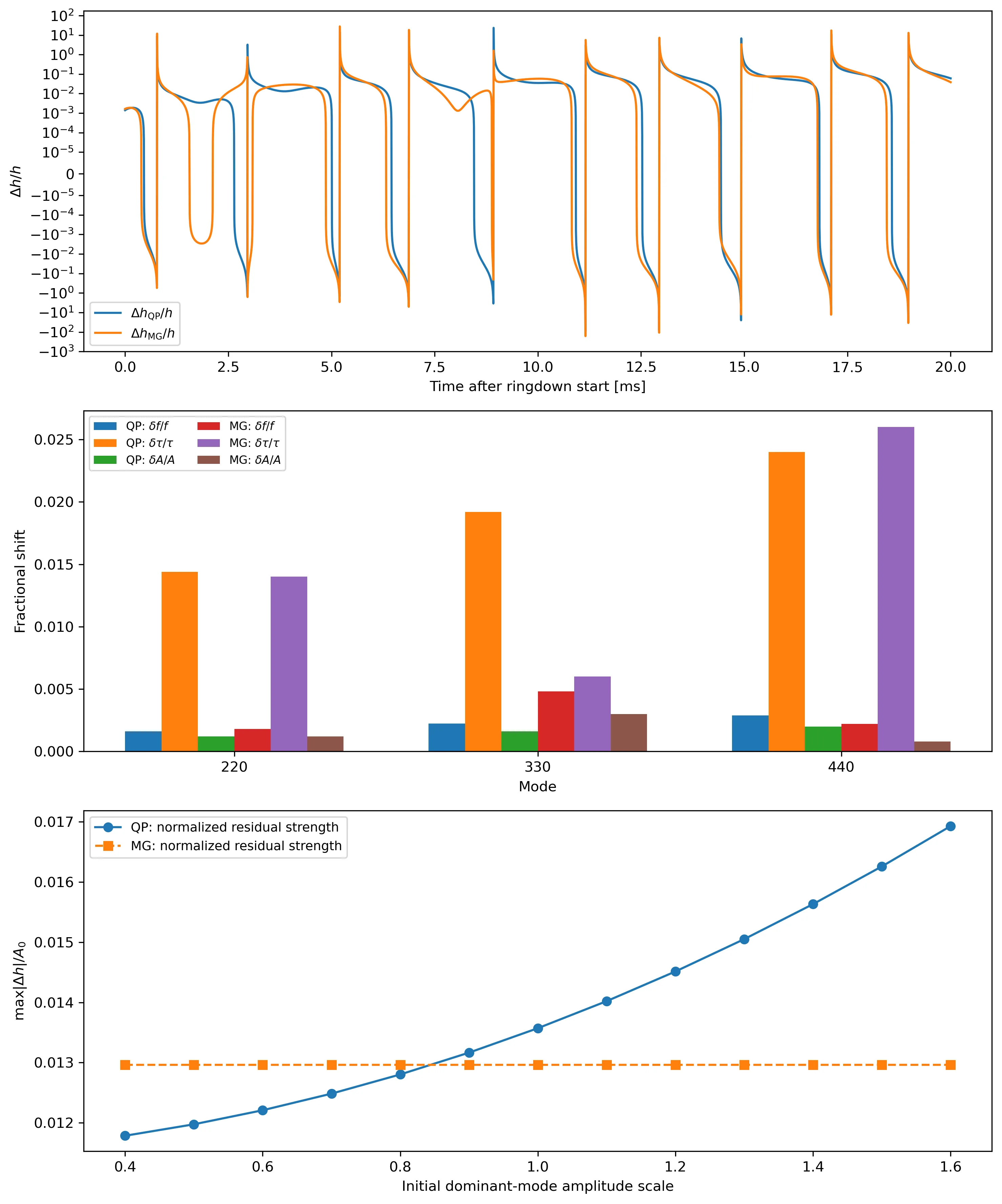
A bell struck by a hammer hums softer and softer. Its ring fades smoothly, like ripples on water after a stone is tossed in. A black hole behaves much the same way after colliding with another hole: it shudders, and those shudders, gravitational waves, fly off into space, gradually weakening. Physicists call this process the black hole's "ringdown," and they can listen to it with giant interferometer antennas.
But what if, near the event horizon, that invisible boundary from which not even light can return, time behaves a bit differently than we expect? In standard quantum mechanics, there's a strict rule: processes running forward and backward in time must be symmetric. This property is called Hermiticity. The authors of the new study proposed that in the strongly curved space around a black hole, this symmetry might break. The horizon would then act as a one-way valve for probability. Some quantum information would leak irreversibly into the hole, changing the very character of the ringdown.
The most important takeaway is that these three anomalies are not random. They are tightly linked because they arise from a single mechanism: that very flow of probability across the horizon. On their own, any one of the three signs could be mistaken for instrument noise or the effect of some exotic theory of gravity. But their joint appearance is like fingerprints that match only one suspect. It's precisely this coordinated pattern that future gravitational wave detectors will look for in their data.
If experiments confirm these distortions, we'll have to admit that Hermiticity isn't an iron law of nature but merely a temporary habit of our flat, quiet corner of the universe. Near black holes, quantum mechanics may wear different clothes. For now, we're still learning to listen to the bell and discern, in its fading hum, the whisper of laws yet unknown.
Original abstract
as written by the authors arXiv:2604.20922
Building on recent work introducing the idea of Quasilocal Probability in curved spacetime, we develop its observational implications for black hole ringdown in detail. We show that horizon-induced probability flux leads to an effective non-Hermitian dynamics producing three distinctive signatures, which are correlated multi-mode deviations, weak amplitude dependence and a mismatch between waveform damping and energy accounting. These effects arise from a single boundary-flux mechanism and therefore exhibit a constrained, low-dimensional structure not expected in generic modified gravity scenarios. We demonstrate that while individual deviations may be mimicked, their combined pattern provides a robust discriminator of quasilocal probability. We further argue that upcoming gravitational wave observations can probe these signatures at meaningful precision. We also establish that black hole ringdown is a novel arena to test whether quantum mechanical Hermiticity is really a fundamental property or an emergent symmetry in quantum gravity.
The gravitational "ringdown" of a black hole after a merger lasts fractions of a second but contains several overtones — much like a musical instrument. Each black hole has its own timbre, depending on its mass and spin.
In Carl Sagan's novel "Contact," a signal from space turns out to be a disguised message — similarly, distortions in the ringdown of black holes might carry hidden information about the nature of spacetime.