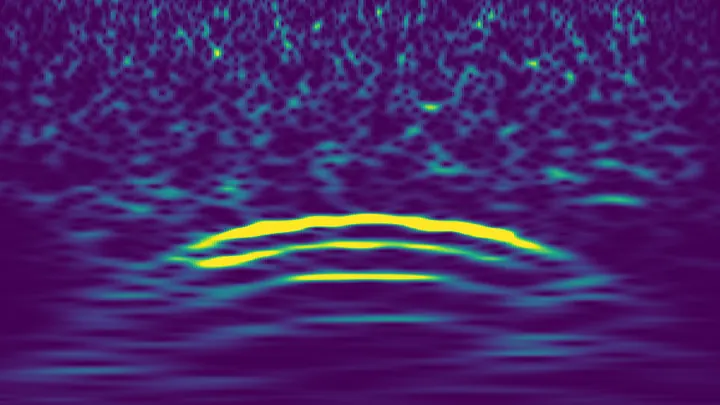
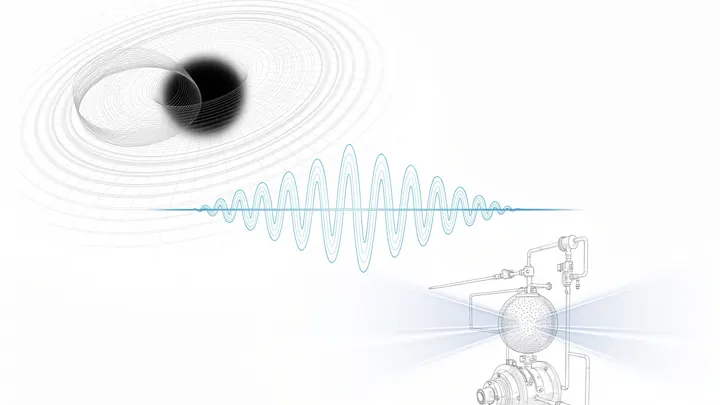
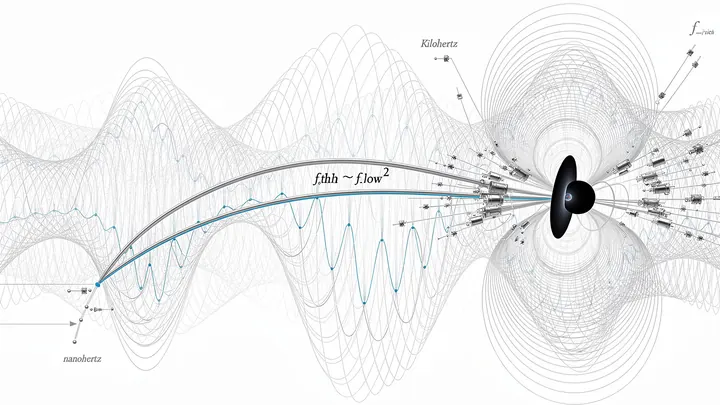
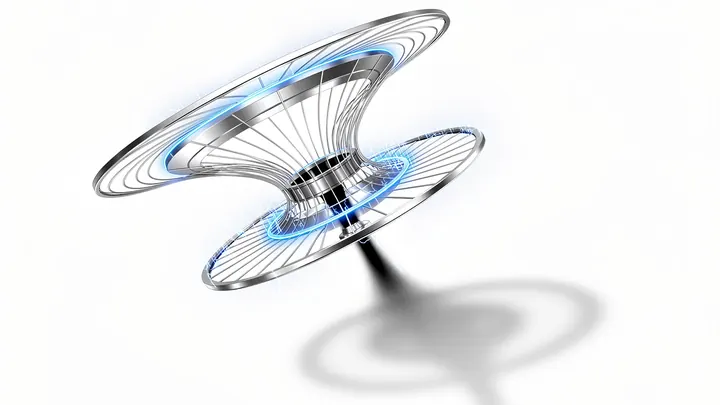
Wormhole resonance refers to the characteristic gravitational wave signals that would be emitted by a traversable wormhole, as opposed to a black hole. When a compact object like a neutron star falls into a wormhole, or when the wormhole itself is perturbed, it would ring at specific frequencies, similar to how a bell rings. However, the 'ringdown' of a wormhole would differ from that of a black hole due to the absence of an event horizon and the presence of a throat, which can cause echoes in the gravitational wave signal. These echoes are a key observational signature that could distinguish a wormhole from a black hole.
History
The idea of using gravitational wave echoes to test wormholes was proposed in the 2010s, following the first detections of gravitational waves by LIGO. Theoretical work by Cardoso, Pani, and others showed that exotic compact objects, including wormholes, would produce echoes in the ringdown signal. The concept gained attention as a way to probe quantum gravity effects near the horizon.
How it works
In general relativity, a wormhole's throat acts as a reflective boundary for gravitational waves. When a perturbation hits the throat, part of the wave is transmitted and part is reflected, creating a series of echoes with decreasing amplitude. The time delay between echoes depends on the wormhole's geometry, specifically the length of its throat. The resonance frequencies are determined by the wormhole's mass and spin, and can be computed using perturbation theory. Detecting these echoes in gravitational wave data would provide strong evidence for the existence of wormholes.
In practice
Wormhole resonance is a target for current and future gravitational wave detectors, including LIGO, Virgo, and LISA. Analyzing the ringdown of binary mergers for echoes could reveal the existence of wormholes or other exotic compact objects, providing a test of general relativity and quantum gravity.
Fun fact
If wormholes exist, they would be 'black hole mimickers'—their gravitational wave signal would look almost identical to a black hole for the first few milliseconds, but then differ by a series of repeating echoes, like a cosmic 'tail' that gives them away.
A vortex in a magnetic material is like a whirlpool, but instead of water, the directions of magnetization twist. An electron flying through such a vortex feels not just a magnetic field, but a curvature of space: its path bends as if it were rolling down a funnel with a narrow neck.
Drop a pebble into a pond, and ripples spread across the water. Something similar happens when a black hole merges with another: it emits gravitational waves that resemble the fading ring of a bell.
Imagine a lottery where instead of money, you win black holes. Each ticket is a random spot on the sky, and the prize is a gravitational wave from the merger of two giants. The chance of hitting the jackpot is minuscule, but if you do, the wave is heard across the entire universe.
Two tiny diamonds float in a vacuum, separated by a distance that light cannot cross during the experiment. Inside each, like a frozen spark, resides an entangled spin — a quantum state linking them into a single whole. Now the diamonds begin to move, but not just any motion: each one seems to split, existing in two places at once.
When two heavy balls merge into one, ripples spread across the water's surface for a long time. A black hole behaves similarly: after a merger, it 'rings' for a while, emitting special gravitational oscillations — quasinormal modes. Usually, this ring fades quickly, like an echo dying out in an empty hall.
You could send a short radio pulse toward a black hole and wait for the reflected echo. Intuitively, the shorter the signal, the better it would probe the finest details of spacetime right at the horizon: that region from which even light cannot return.
A bell rings not from the strike but from a fleeting shudder of space. A gravitational wave, like ripples on a pond, passes through a massive magnet, and it deforms ever so slightly. That deformation can be turned into an electrical signal.
At the center of a galaxy sits a supermassive black hole, surrounded by a vast, tenuous cloud of dark matter. It doesn't shine or heat, but its gravity warps space and changes the rules of the game for everything orbiting nearby.
In the first moments of its life, the universe resembled a boiling cauldron. Matter wasn't spread evenly — clumps and voids were brewing within it, and their violent motion gave rise to a trembling of space itself: gravitational waves.
89 milliseconds. That's how long a vortex avalanche lasts that abruptly speeds up the rotation of the Vela pulsar — one of the most famous 'glitching' pulsars. Pulsars are rapidly spinning neutron stars born in the collapse of supernovae.
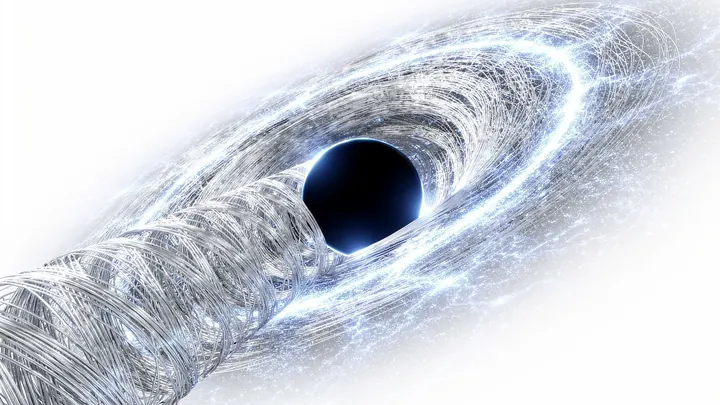
The spiral of water draining into a sink spins faster and faster toward the center. In an ordinary black hole, that funnel ends in an infinitely sharp point — a singularity where the laws of physics break down. But this new work considers a different picture: the funnel doesn't taper to a needle but ends in a smooth, swelling bubble.
Space is full of invisible waves — ripples in the fabric of spacetime left behind by cataclysms like black hole mergers. An ordinary black hole swallows everything without a trace. But there are hypothetical exotic objects — ultradense clumps of matter without an event horizon (a surface from which not even light can escape).
A spinning top that makes a hundred turns per second suddenly starts losing speed dramatically — much faster than any known top. That's exactly what pulsar J0435+3233 is doing. It's a dead star, crushed to the size of a city, but whirling at a furious rate.
It is commonly believed that a black hole is a merciless cosmic vacuum cleaner, sucking in everything indiscriminately. But new research flips the picture: right at the horizon, curvature transforms from a trap into a trampoline.
Gravitational-wave detectors are like sensitive microphones, listening for the whispers of distant cataclysms. But every now and then, a sharp crack bursts in — a brief noise spike known as a glitch.
A black hole merger is not a silent impact. The newborn hole quivers and decays, emitting gravitational waves — ripples in space itself. This signal is called the 'ringdown,' and it resembles the fading chime of a bell: it has a fundamental tone and several overtones.
The merger of two black holes is not just a silent dance, but a grand act after which spacetime itself vibrates for a long time. These damped oscillations — quasi-normal modes — are like the ringing of a gigantic bell. But there is another echo: barely perceptible, almost ghostly.
In the ocean of space, every storm of birth or merger of supermassive black holes generates ripples — gravitational waves traveling at the speed of light. Over billions of years, these waves superimpose, merging into a low-frequency hum, like a distant surf.
The mystery of dark matter has puzzled physicists for nearly a century. Among the candidates for its role are primordial black holes (PBHs), born in the fiery embrace of the first moment after the Big Bang.
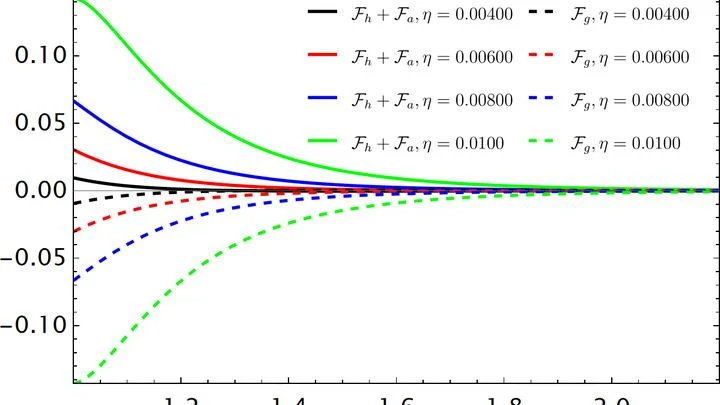
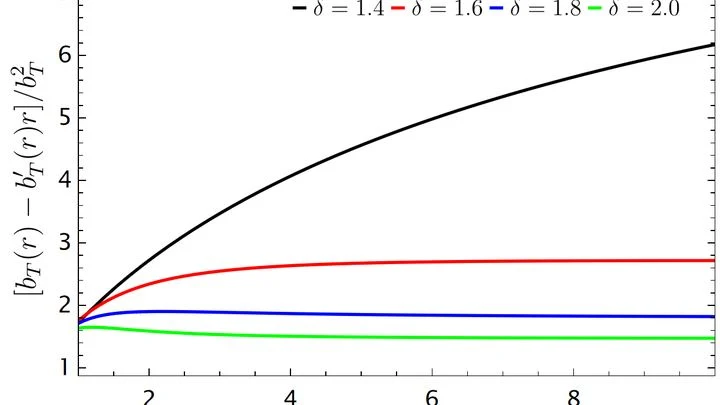
A wormhole is a tunnel connecting two distant regions of the universe. If such a wormhole existed and were traversable, a particle inside it would feel not only gravity but also a force from its own electric field. This force depends on how spacetime is curved around it.
Gravitational-wave detectors picked up a strange burst — the signal GW241011. Two black holes merged, but the pair looked unusual: one hole was about three times lighter than the other, and the system as a whole was spinning rapidly. Such a combination is a rare guest in the catalogs.
Wormholes — tunnels through curved spacetime, allowed by general relativity. To be stable, they need repulsive energy — the kind that pushes apart rather than attracts.
A blob of cold helium swoops dangerously close to a black hole. But this isn't just a blob: it's a dead star the size of Earth, yet with a mass comparable to the Sun's.
A wormhole is like a tunnel with a very narrow throat. If you send a sound signal into such a tunnel, part of the echo returns, while part gets stuck in the middle, and will leak out very slowly.
Two heavy spheres of dark emptiness hurtle toward each other and collide dead-on. This is not billiards: it's the collision of two equal black holes. The impact sends a tremor through space itself — gravitational waves.
Most of this tremor is a low hum that physicists call bremsstrahlung.
A black hole is like a pot that slowly boils away. Its surface emits particles, a process known as Hawking radiation. The hotter the pot, the faster it empties. But what if the pot is not ordinary, but has a double bottom — capable of turning into a passage to another place?
Drop a pebble into a pond — ripples spread across the water. In much the same way, a massive body circling a black hole perturbs the fabric of spacetime, generating gravitational waves. But what if the pond itself isn't flat, but has hidden folds — extra dimensions invisible to the eye?
When two neutron stars, compressed to the size of a city, approach in their final dance, the spacetime around them comes alive, emitting gravitational waves.
In 2019, the image of the M87* shadow was a sensation: for the first time, humanity saw the outlines of a black hole, predicted by Schwarzschild and shrouded in myth. But what if that glowing crescent isn't a portrait of an absolute abyss, but of a cosmic portal?
Spacetime is like a giant sheet of paper. Fold it, and distant corners come together. Poke a pencil through, and you get a wormhole, a short tunnel through the folds. But the paper wants to spring back flat, snapping the passage shut. To keep it open, you need a rare “gasket”—matter with negative energy.
After a merger, the newborn black hole emits a fading tremble — gravitational waves, similar to a ringing bell. By analyzing the overtones of this signal, spectroscopy can determine its mass and spin rate.
Light falling into a black hole carries information — for instance, the path a photon took. The horizon (the surface from which nothing returns) responds by changing its entropy — a measure of disorder, akin to the number of shuffled pages in a book.
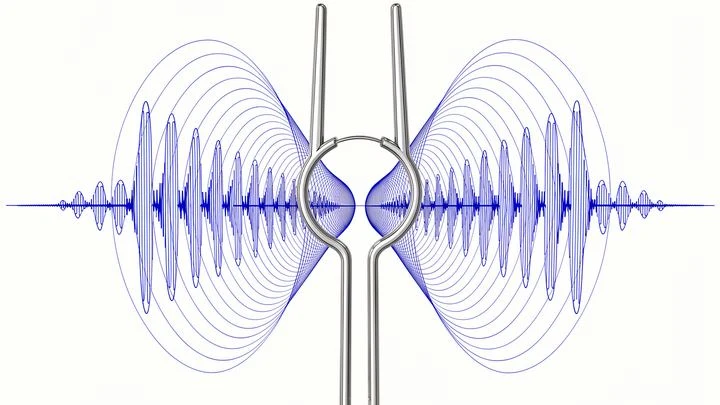
Strike a bell, and it rings. But the sound isn't arbitrary: the bell itself picks out the notes to which its metal is tuned. It turns out a black hole behaves the same way. When something falls into it, or its spacetime gets warped, it starts to oscillate.
Two ocean liners sail at night without lights. One was built in a shipyard from steel plates, the other seems to have grown by itself from foam and waves. By ear they are almost indistinguishable, but an experienced hydroacoustician will catch the difference in the hum of the propellers and the contours of the hull.
We know about neutron stars thanks to the work of Fritz Zwicky, Subrahmanyan Chandrasekhar, and Jocelyn Bell Burnell. They are former cores, squeezed to city size: a teaspoon of their matter weighs as much as Mount Everest.
Einstein and Rosen imagined a bridge connecting two sheets of reality. Wheeler gave it a name — wormhole, and Thorne with Morris proved: the tunnel is traversable if you fill it with exotic matter.
A stone falls into a well, and a second later, a splash. A star falls into a black hole, and disappears beyond the horizon, leaving only a ripple in space. But what if the bottom of the well is not a dead end but a passage? In the usual picture, matter compresses into a point of infinite density — a singularity.
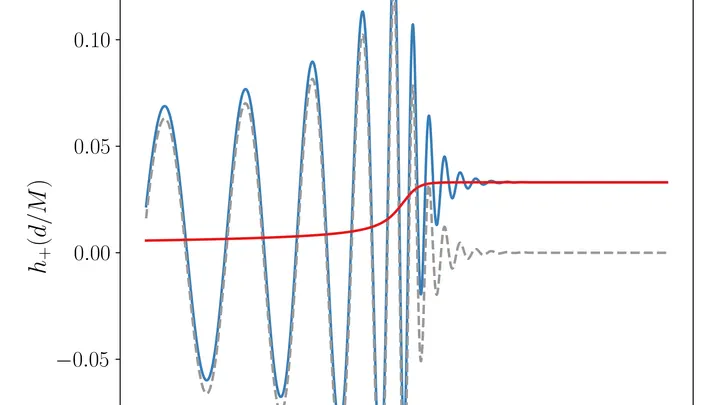
A black hole collision isn't just a burst of gravitational waves; it also leaves a lasting trace: an eternal curvature of spacetime — gravitational memory. Like a boat on water leaves a lingering wake, the cosmos 'remembers' the catastrophe.
The shadows of supermassive objects at the centers of galaxies, M87 and the Milky Way, have become icons of modern astrophysics. But what if these shadows are not from absorption, but passage? The equations of Einstein allow for traversable wormholes — tunnels in the fabric of spacetime.