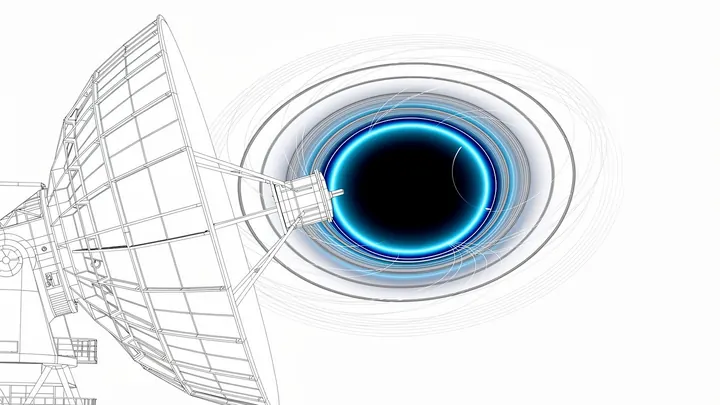
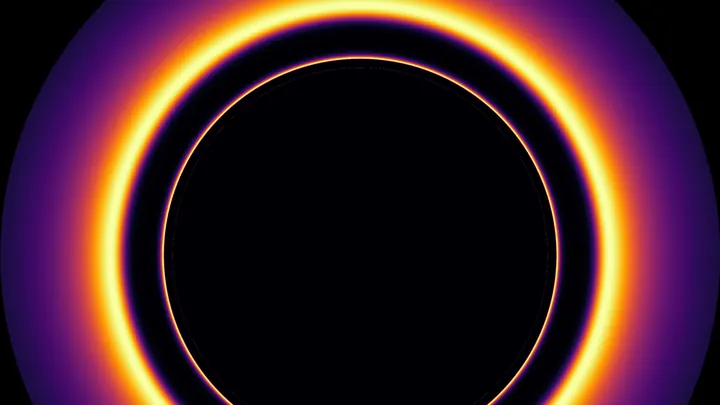
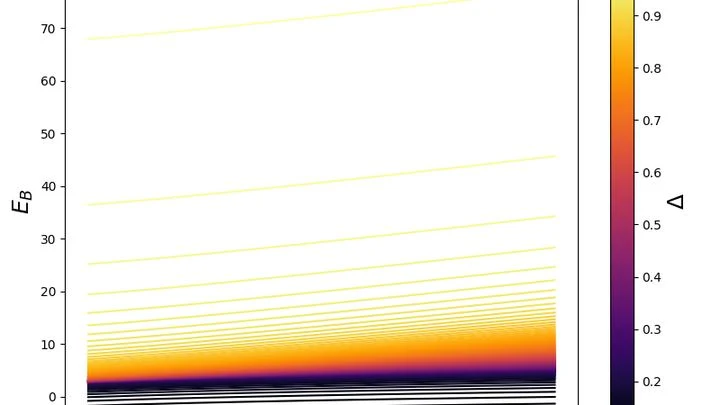
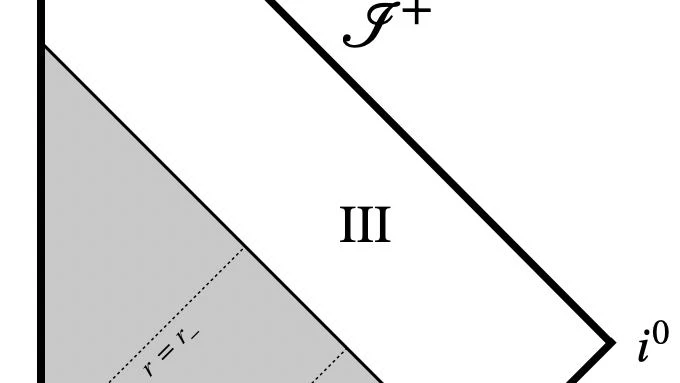
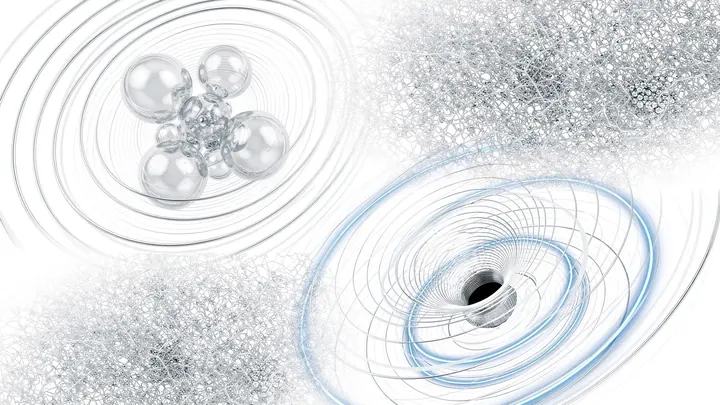
The inner horizon is a boundary inside a rotating or charged black hole, located between the outer event horizon and the singularity. It marks a region where the causal structure of spacetime changes dramatically: while the outer horizon is a one-way membrane from which nothing can escape, the inner horizon is a surface where time and space coordinates swap roles again, and where the gravitational pull becomes repulsive in a sense. This region is of intense theoretical interest because it is where quantum effects are expected to become significant, potentially altering our understanding of black hole interiors.
History
The concept was identified in the 1960s through the work of Roy Kerr and later analyzed in detail by Roger Penrose and others, who pointed out the instability of the inner horizon. The term 'Cauchy horizon' was used in general relativity, and the quantum implications were explored from the 1970s onward.
How it works
In a Kerr (rotating) or Reissner-Nordström (charged) black hole, the solution to Einstein's field equations predicts two horizons. The inner horizon is a Cauchy horizon, meaning that the future evolution of spacetime is not uniquely determined beyond it—information from outside cannot fully specify what happens inside. As matter or radiation falls into the black hole, it gets infinitely blueshifted near the inner horizon, leading to a 'mass inflation' instability where the energy density grows without bound. This suggests that the classical picture breaks down, and quantum gravity effects, such as the formation of a quantum 'fuzzball' or a bounce, may take over.
In practice
While not directly applicable in technology, the study of inner horizons informs theoretical models of black hole evaporation and the information paradox, which are central to current research in quantum gravity and cosmology.
Fun fact
The inner horizon is sometimes called the 'blue sheet' because any infalling radiation is infinitely blueshifted there, which would destroy any observer or spacecraft that tried to cross it—making the interior of a rotating black hole even more hostile than the exterior.
A black hole is a maze with no way out. But what happens to the information inside? To test this, physicists didn't fly to the nearest hole; instead, they built a tiny replica on a quantum processor. The maze was played by a chain of 32 superconducting qubits, where each step leads only forward, like a one-way corridor.
A courier delivers packages to a building with two entrances. While the door is open, he freely enters both. But once one door starts to close, getting inside becomes harder and harder. That's roughly how information behaves at a black hole's horizon — the invisible boundary from which nothing can escape.
In the new study, scientists described this process as two opposing flows.
A black hole that swallows matter might not just evaporate over billions of years: it could pop like a soap bubble and turn into its opposite: a white hole. This scenario emerged from numerical experiments in semiclassical gravity.
A cosmic object spins, but its shadow isn't round. Astrophysicists examined a black hole in an unusual version of gravity — the so-called brane world (where our universe is a three-dimensional surface in a space of higher dimensions).
A black hole doesn't just spin: it's surrounded by bristles of an extra field (the Kalb–Ramond field). This paper explores how a massive field (waves with mass) behaves near such a black hole when it's almost spinning at its maximum rate.
The Klein–Gordon–Fock equation for this field was separated into two independent parts — radial and angular.
At the center of a galaxy sits a supermassive black hole, surrounded by a vast, tenuous cloud of dark matter. It doesn't shine or heat, but its gravity warps space and changes the rules of the game for everything orbiting nearby.
In 1973, Jacob Bekenstein proposed that black hole possess entropy — a measure of hidden disorder. Stephen Hawking later confirmed this by adding radiation, but the microscopic origin of entropy remained obscure.
A black hole sitting on a thin cosmic membrane (brane) resembles a heavy ball stretching an elastic sheet. In classical physics, it is bald — only mass, charge, and rotation. But add a scalar field (an invisible substance like temperature), and the hole can spontaneously grow 'fur' from this field.
A black hole is a place from which nothing can escape. But some theories allow that deep inside, at the quantum level, it might bounce and turn into its opposite — a white hole, which only spews out matter and light.
A group of physicists built a computer model of such a transformation.
A black hole is not just an abyss where everything falls. Right at its horizon, in the so-called quantum atmosphere, a faint glow is born — Hawking radiation. This is not calm light but a churning stream of particles that can influence the most delicate quantum connections.
At the center of most galaxies lurk supermassive black holes — the overlords of gravity. Since 2019, thanks to interferometry with very long baselines, we’ve glimpsed their shadows: dark silhouettes set against a blazing gas backdrop. But what exactly is painting that shadow?
For a long time, the event horizon behaved like a cosmic dictator: everything that crossed its boundary vanished irretrievably from our Universe. But quantum mechanics, like a dissident's voice, whispered: information cannot simply disappear.
An ordinary black hole hides a singularity at its center — a point where density and curvature become infinite and the laws of physics break down. The authors of the new work built a model of a rotating black hole that, instead of a singularity, contains a calm "core" resembling ordinary flat space.
At the center of a classical black hole lurks a singularity — a point where the density and curvature of spacetime become infinite. Physics goes silent there.
The cosmological horizon — the edge of the observable Universe, which is expanding at an accelerating rate — is like a safe with a timer. Information about what crosses this boundary doesn’t vanish but returns, albeit with a delay. Physicists have figured out how long this pause lasts.
In quantum field theory, there is a long-standing mystery: infrared divergences. Usually they are seen as an annoying technical nuisance that must be carefully 'papered over' in calculations. But what if this is not a bug, but a feature?
At the centers of many galaxies lurk supermassive black holes. One of them, Sagittarius A* at the heart of the Milky Way, has become a testing ground for a new idea. The authors of the work took Einsteinian gravity and added an unusual electromagnetic field to it.
When a giant star runs out of fuel, it collapses into a black hole. Such a hole has an outer boundary — the event horizon, beyond which even light cannot escape. But many black holes also have an inner boundary — a second horizon that separates the outer layers from the singularity core.
A black hole's interior is layered like an onion. In the new model, instead of an infinite point at the center, there are three regions: a dense core, a transition layer, and a crust just below the horizon. All arise from a single field that interacts with itself.
A black hole is like a perfectly dark room: from outside, you can't see what's inside, and anyone crossing the threshold seems to vanish from the outside world. But what does the falling observer feel? In classical physics, nothing special: the event horizon isn't marked by any signpost.
A black hole with a magnetic field resembles a whirlpool in a river, where water doesn't flow into the vortex but swirls in place. Usually, the hole's rotation picks up waves and amplifies them: this is called superradiance. But add a magnetic field, and everything changes.
A black hole horizon is like a soap film stretched over an abyss. From a distance it looks perfectly smooth, but up close it trembles. This ripple arises from quantum fluctuations — the continuous birth and death of particles in the vacuum.
The Schwarzschild black hole is the simplest model in general relativity. But when you switch to teleparallel gravity (TEGR), where torsion replaces curvature, the horizon develops a problem. Some quantities built from torsion tend to infinity.
A black hole resembles a safe that slowly gives up its contents, energy and information, through a faint glow known as Hawking radiation. But if the safe opens too quickly, a 'firewall' may flare up at its boundary — a region where the familiar laws of physics break down.
In the new work, physicists complicated the model of this safe.
A star contracts under its own gravity, and at some point its fate hangs on a razor-thin balance. Classical physics paints a grim picture: if the mass and the force of compression are tuned with terrifying precision, what emerges is not a black hole but a 'naked' singularity.
A black hole is not just a dark spot in the sky. Its shadow falls on the glowing backdrop of infalling matter and carries the imprint of spacetime geometry itself. If gravity works even slightly differently than we think, the shadow will give it away.
In a new study, physicists traced light rays around a rotating black hole in so-called Rastall gravity.
Space is like a sheet of paper: gravity bends it, making lines converge toward the center. But if you bend too hard, the paper tears, just as space, under monstrous curvature, doesn't collapse into a point but forms a torn edge. That edge is the quantum boundary.
At the center of attention is a black hole with two points of no return: the outer and inner horizons. Beyond the outer horizon, space and time swap roles, but the journey is not over. Further in, at the inner horizon, gravity has another surprise in store.
A bonfire doesn't burn out all at once. If you glance at the flames at a random moment, all you see is a jumble of fire tongues, and you can never tell what exactly burned: a wet branch, an old magazine, or an armful of dry grass. But if you watch the fire hour after hour, rhythms emerge in its dance: a burst of heat, a lull, a change in color. These rhythms tell the story of what was thrown into the flames.
Gravitational waves from a tiny body falling into a black hole work like an X-ray image. Only instead of a bone, they illuminate the curved spacetime itself.
The gravity of a black hole creates a curvature of spacetime, acting like a lens: light from a distant galaxy splits in two, stretching into arcs. Dark matter around the hole barely changes the picture, as if a transparent curtain was added to a window pane.
A black hole is like a perfect safe: anything that goes in seems lost forever. But at the microscopic level, it doesn't destroy information: it shuffles it with its internal degrees of freedom, much like a deck of cards after a thorough shuffle.
Light falling into a black hole carries information — for instance, the path a photon took. The horizon (the surface from which nothing returns) responds by changing its entropy — a measure of disorder, akin to the number of shuffled pages in a book.
A quantum particle can be in two states at once, like a coin spinning, both heads and tails. Near a black hole, the event horizon, where spacetime curvature bends space and time to the extreme, acts as a one-way gate.
The event horizon of a black hole is often depicted as a one-way membrane: everything falls in, nothing comes out. But what if it's not an empty boundary but a cloud of the tiniest 'bits' of spacetime itself?
Usually, a black hole is an abyss with a point-like dip at the center, where density is infinite and everything breaks down. Einstein and Schwarzschild described such a scenario. But infinity is a sign that the theory stumbled.
The mystery of dark matter, first glimpsed in the stellar whirlpools by Vera Rubin, has been tormenting physics for nearly a century. One of the boldest hypotheses: primordial black holes, born in the scalding broth of the early universe.
Our Universe behaves like a stretched elastic sheet: massive bodies dent it, creating spacetime curvature — gravity. In brane-world theory, a hidden dimension is added, and this sheet becomes just a surface in a higher-dimensional space. The brane tension determines how much the sheet dents: the weaker the tension, the weaker the gravity.
Two black holes fly toward each other and collide head-on. In the familiar picture, their horizons (the surfaces from which not even light can escape) stretch toward each other like water droplets and merge into one smooth shape. But calculations show otherwise: before merging, a sharp beak, a cusp, extends from each horizon.