The look-elsewhere effect is a statistical phenomenon that occurs when a researcher searches for a significant result across many different places — such as many energy ranges, many possible signal locations, or many candidate variables — and finds a 'significant' result purely by chance. The more places you look, the more likely you are to find a false positive. This effect is the reason why a local significance (e.g., a 3-sigma bump in one bin) is not the same as a global significance (the probability of seeing such a bump anywhere in the entire search space).
History
The concept has been known in statistics for decades, but it became widely prominent in high-energy physics during the search for the Higgs boson, where physicists had to correct for the fact that they were scanning a wide mass range.
How it works
When you perform many independent tests, the probability of at least one false positive increases dramatically. For example, if you test 100 independent hypotheses at the 5% significance level, you expect about 5 false positives by chance alone. The look-elsewhere effect quantifies this inflation and provides a correction: the global p-value is the probability of seeing a result as extreme as the observed one anywhere in the search space, not just at the specific location where it was found. This is often computed using Monte Carlo simulations or analytic approximations.
In practice
It is essential in particle physics (e.g., searching for new particles), in genomics (scanning the genome for disease associations), and in astronomy (searching the sky for signals).
Fun fact
In particle physics, a '5-sigma' discovery claim is often quoted with the look-elsewhere correction factored in — the famous Higgs boson discovery had a local significance of 5.9 sigma, but a global significance of about 5.1 sigma.
Two runners start a race on a course with changing incline. One starts earlier, the other later, and the judge measures their speeds without knowing about the staggered starts. So it is with virus variants: data arrive with delays, and if those delays are unequal, estimates of competitive advantage can be badly wrong.
Crystals fascinate us with their perfect spatial order: atoms frozen at lattice points, like beads on an invisible string. But what if the same symmetry unfolds in time? Time crystals are systems that, without any external cue, start repeating their states cyclically — clocks wound by nature itself. Inside this tireless rhythm, disorder seems to have no place.
Imagine a ball in an unfamiliar hall: two guests start from opposite corners. Their movements are not a smooth waltz but chaotic improvisation in search of rare treasures. Contrary to intuition, the outcome hinges not on tempo but on the geometry of the floor.
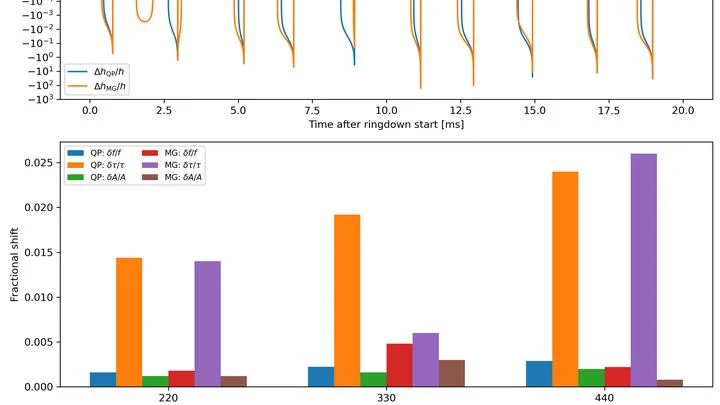
A bell struck by a hammer hums softer and softer. Its ring fades smoothly, like ripples on water after a stone is tossed in. A black hole behaves much the same way after colliding with another hole: it shudders, and those shudders, gravitational waves, fly off into space, gradually weakening.
In quantum communication, a secret key is transmitted using single photons. Eavesdropping on such a channel is supposedly impossible: any interception attempt disturbs the particle and leaves a trace. But the idea has a weak spot — the real hardware, which sometimes behaves differently than theory dictates.
In two neighboring ponds, the same microorganisms swim. Food appears now in one, now in the other — randomly, with no rule. After a month, there are a hundred times more of them in the first pond than in the second. No one chose where to live. Just luck.
This is how disequilibrium works. While the environment keeps changing, abundances don't have time to even out.
According to physicist Hugh Everett, every observation splits the universe into parallel branches. Normally, your memory of the outcome locks you into one branch, like a key keeping a door shut. A new protocol, reality steering, shows you can pick that lock: erase the memory, and the barrier fades, letting you slide into another reality.