The Brain's Conductor: How the Parietal Region Switches Modes express
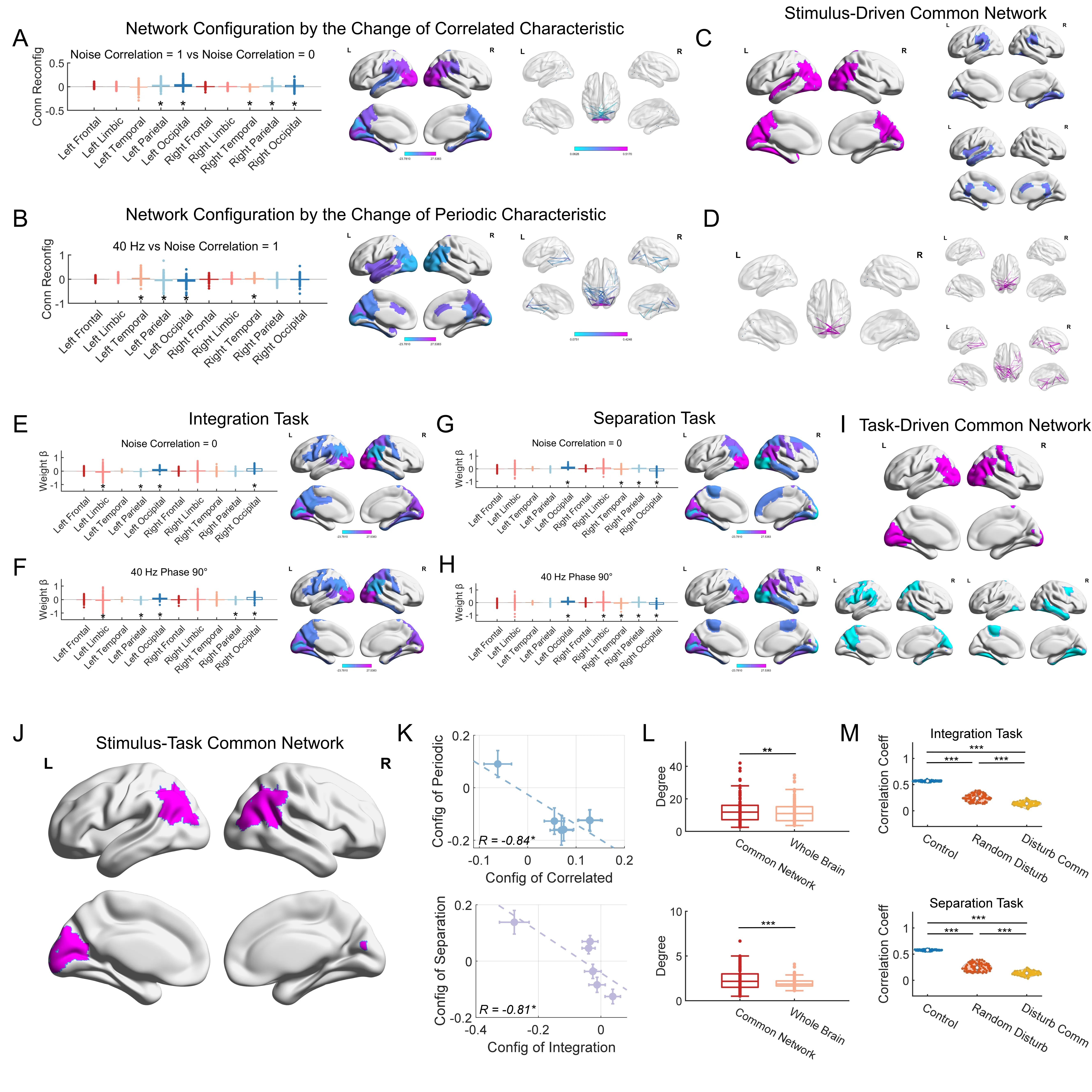
The brain constantly juggles tasks: it reacts to a sharp sound, solves an equation, or drifts into daydreams. Scientists have long suspected that switches between different "scenarios" of neural network activity underlie this, but extracting them from the chaos of electrical signals was difficult. Now researchers have applied a computational model, akin to a conductor who, from a multitude of instruments, isolates three main parts: reaction to the external world, information processing, and spontaneous activity.
The model was trained on recordings of electrical brain activity from 114 people at rest. It was able to extract hidden factors that govern network dynamics and showed that neural network oscillations in the parietal region are key to cognitive flexibility. It's like finding the master volume and timbre controls in an orchestra where each musician is a separate group of neurons.
This division helps understand how the brain switches between concentration and distractibility, between perception and reflection. In the future, this could lead to new diagnostic methods for attention disorders or to interfaces that more accurately read human intentions.
Original abstract
as written by the authors arXiv:2604.23525
The foundation of cognitive flexibility and higher-order intelligence lies in the functional structure and activity of brain networks, which can be dynamically configured by both external environments and internal states. However, decoding these dynamics from high-dimensional neural data remains a challenge. In this study, we propose a computational framework using Recurrent Neural Networks (RNNs) with neural dynamic constraints to model source-localized resting-state EEG data from $$114$$ participants. We aim to clarify the "triple brain network configurations" driven by exogenous and endogenous factors, including external stimuli, information processing tasks, and spontaneous activities. Our model identifies the parietal network as a critical hub supporting these multiple configuration patterns. Furthermore, we reveal that the anterior and posterior parietal regions exhibit distinct functional specializations under different stimulus modalities. By formalizing a triple configuration framework, this work separates latent factors of brain dynamics and underscores the computational significance of parietal regions in orchestrating higher-order intelligence.
The parietal region is involved even in simple actions: when you reach for a cup, it coordinates hand movements, and when you gaze at the stars, it helps estimate distances.
The idea of brain mode switching echoes the "modes" in Daniel Keyes's novel "Flowers for Algernon," where the protagonist's intelligence changes in leaps.