Braess's paradox occurs in networks with selfish or decentralized route choice. The classic example is road traffic: opening a new street can increase travel time for each driver. In biology, this phenomenon is observed in transport networks (vascular systems, mycelium), in metabolic pathways, and even in population genetics. Adding a new 'channel' or regulatory mechanism that seems beneficial to each element actually reduces overall performance due to overload of bottlenecks.
History
Dietrich Braess, a German mathematician, formulated the paradox in a 1968 paper for transportation planning. However, there were anticipations by Ailing and others. In biology, the paradox began to be actively discussed in the 2000s after experiments with Physarum polycephalum networks and metabolic models. Early microscopic observations of biological structures by Robert Hooke laid the foundation for studying networks, although the paradox was not realized by him.
How it works
Consider a network where flow Q must pass from A to B. There are two paths: through node 1 and through node 2. Travel time on an edge depends on the flow f: T(f). Suppose selfish agents minimize their time, and Nash equilibrium is reached when the time on all used paths is equal. If a new edge is added connecting nodes 1 and 2 with zero travel time, initially it seems attractive. But in the new equilibrium, all agents use the new edge, redistributing flow so that the overall average time increases. Mathematically, this is expressed through a system of nonlinear equilibrium equations. In biological networks, the role of 'time' is played by flow resistance or metabolic cost. Principles of dissipation minimization are applied, but taking into account selfishness at the level of cells or organisms.
In practice
Understanding this paradox helps biologists design optimal systems in synthetic biology and better explain strange failures in the body's natural networks.
Fun fact
The slime mold Physarum polycephalum has no brain, but it builds an efficient transport network. When scientists artificially created additional connections, the network degraded instead of improving — a pure Braess's paradox.
A crowd at the entrance to a narrow corridor behaves differently than in a spacious hall: some people get pressed against the walls, others are pushed forward. Roughly the same happens when an elongated particle finds itself in a fluid teeming with self-propelled dumbbells. Until now, it was unclear why such a particle moves faster along its long axis than across it, and how the crowd density affects its speed.
Imagine a large orchestra without a conductor. Each musician hears everyone else and adjusts to the collective hum. If every instrument amplifies its neighbors, the sound builds to a screech; if some occasionally dampen it, the orchestra may fall into silence or break into cacophony.
Two runners start a race on a course with changing incline. One starts earlier, the other later, and the judge measures their speeds without knowing about the staggered starts. So it is with virus variants: data arrive with delays, and if those delays are unequal, estimates of competitive advantage can be badly wrong.
When an antibody meets a virus, it doesn't latch on with a single death grip. Rather, it's like two bunches of grapes tumbling in water, catching each other with dozens of short tendrils. Each tendril is weak on its own, easily torn by the thermal jitter of water molecules, but together they hold tight.
A mail carrier delivers letters along one-way streets. As long as he only drives forward, the route is simple and predictable. But if U-turns are suddenly allowed, he'll start doubling back, crossing his own tracks, and the delivery pattern gets tangled. That's roughly how an infection behaves when people can get sick more than once.
In some quantum theories, symmetries intertwine in an unusual way, as if a lock had two keys, but turning one slightly shifted the other. Such intertwined symmetries are called 2-groups. One is an ordinary symmetry acting on point particles (0-form), and the other is a 'linear' symmetry (1-form) governing extended objects like strings or lines.
Hot water sometimes freezes faster than cold. Ice forms more quickly from boiling water. This paradox, discovered by schoolboy Erasto Mpemba, long puzzled physicists. It turns out: the farther a system is from equilibrium, the faster it relaxes back to it.
The Mpemba effect remains controversial today: too many variables, hard to reproduce.
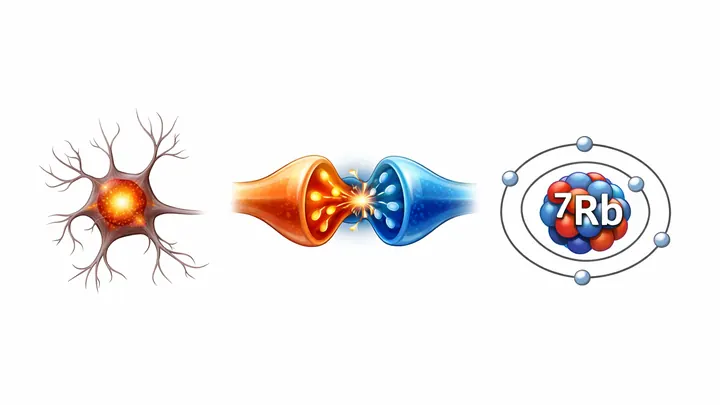
A cloud of atoms cooled to near absolute zero suddenly starts behaving like a brain. One excited atom triggers a chain reaction — neighbors light up in turn, and an avalanche of activity sweeps through the gas. Physicists call this Rydberg facilitation: atoms are easier to excite when an excited one is nearby.
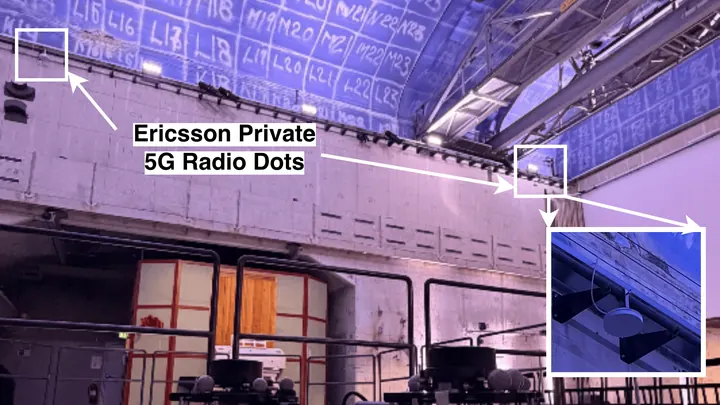
Wireless communication for robots is like a conversation in a noisy workshop, where every word can get lost in the din or arrive too late. In this mess, entropy of the channel, robots fail to yield in time, and coordination breaks down.
Two gardeners haggle over water from a magical well. One proposes how many buckets to take, the other can agree or refuse. If the deal goes through, the water decreases; if not, the well gradually refills. This haggling repeats hundreds of times, and the gardeners' habits sometimes change randomly, as if they're trying new tactics.
In the web of life, predators and prey exchange carbon and water, and each act of eating slightly increases the universe's disorder. But the intrusion of disease turns this system into a giant seesaw. When a mid-level predator gets sick, its hunting abilities decline, and it becomes easy prey.
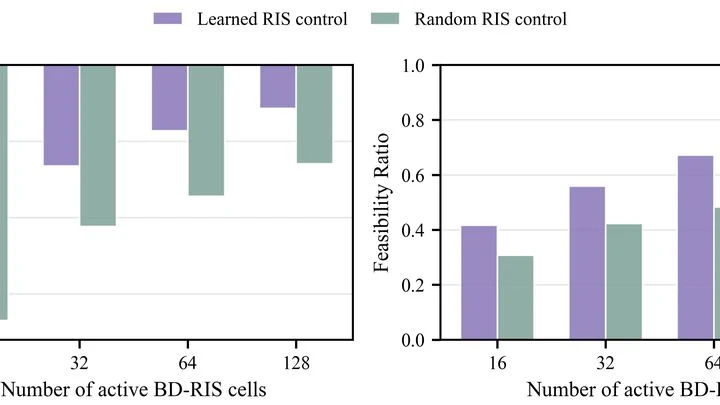
Radio waves from a smartphone, traveling at the speed of light, easily reflect off walls and corners, losing strength. Smart surfaces are programmable mirrors: they catch the scattered signal and redirect it precisely to its target, like a deft magician making a beam bypass obstacles.
Biological complexity has long eluded us: you can count genes, cells too, but how do you grasp the organization of the proteome itself — a multi-thousand ensemble of proteins woven from carbon, oxygen, and hydrogen?
You buy a new kitchen scale, but instead of exact weight, it only shows deviations from some "norm." To find out how much an apple weighs, you first have to weigh dozens of other apples and calculate the average.
A city is a living system: it consumes resources, produces waste, and its 'circulatory system'—the road network — delivers people and goods to their destinations. But while engineers design transport arteries as rigid geometry of straight lines, nature has spent millions of years perfecting ideal distribution networks.
The vessels inside the skull resemble a mountain road's hairpin turns — sharp bends, narrowings, unexpected curves. When a traffic jam forms on such a serpentine, blood stops reaching the brain properly. To predict trouble, doctors need to see the entire flow: where it accelerates, where it swirls into eddies. The full picture comes from a special MRI, like slow-motion cinematography of fluid.
After a heart attack, the dead section of heart muscle can be replaced with living cells grown from stem cells. But a common problem arises: the fresh transplant starts acting as its own pacemaker, and the heart falls out of its proper rhythm. Doctors see the arrhythmia on an ECG, but what exactly happens at the junction between 'self' and 'foreign' remains hidden.
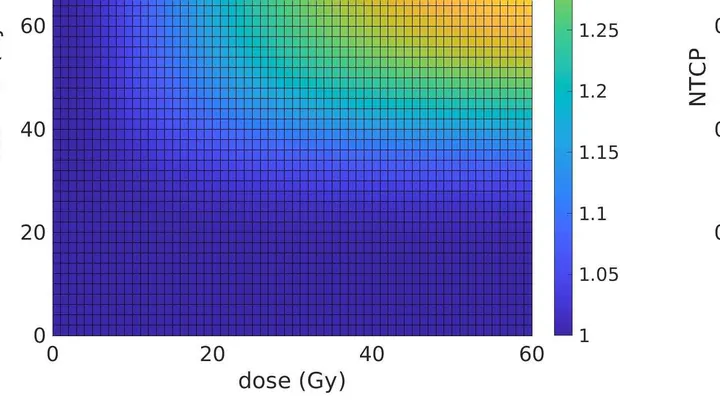
Radiation therapy targets tumors, but healthy tissue suffers too. Flash therapy delivers radiation in a fraction of a second and, remarkably, spares healthy cells without reducing the punch to the cancer. Exactly how this works remains unclear, but the authors set out to test whether this protection depends on the organ's own architecture.
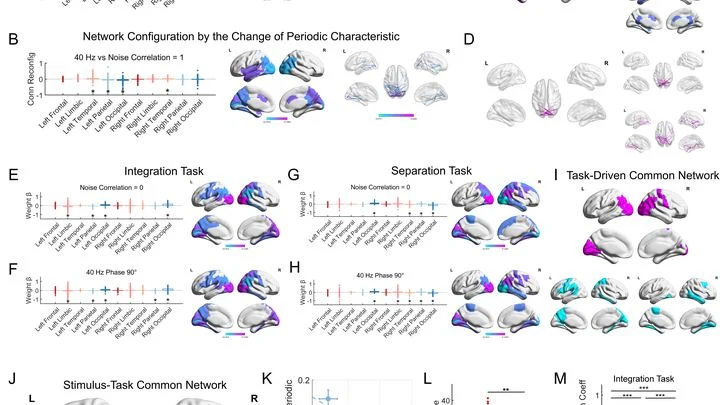
The brain constantly juggles tasks: it reacts to a sharp sound, solves an equation, or drifts into daydreams. Scientists have long suspected that switches between different "scenarios" of neural network activity underlie this, but extracting them from the chaos of electrical signals was difficult.
The microbial community in the gut is like an orchestra: what matters is not only the musicians but how they play together. When disease strikes, it's not just the lineup of microbes that changes: their interconnections shift too. Researchers built interaction networks of microbial genes in healthy and sick individuals.
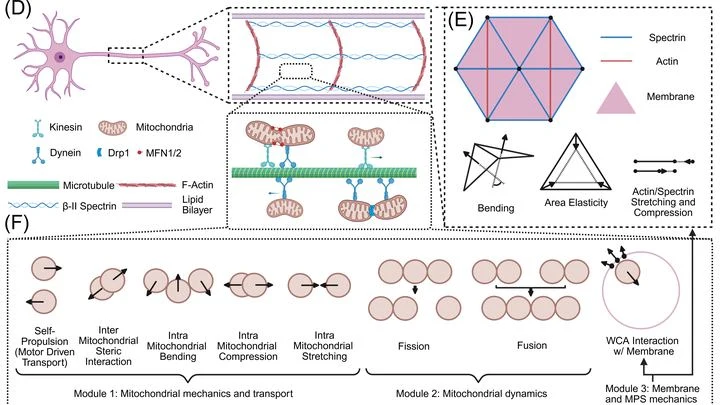
Inside every neuron, there's a long, thin channel, the axon, through which signals travel from the cell body to other cells. To keep this channel working, mitochondria constantly shuttle along it. These tiny organelles produce energy and move in both directions, like cars on a narrow road.
A pot of water sits on the stove. The temperature drops: plus one degree, zero, minus one — the water stays liquid. But at some point, a light breath is enough to make the whole mass instantly freeze into ice. Physicists call such jumps first-order phase transitions.
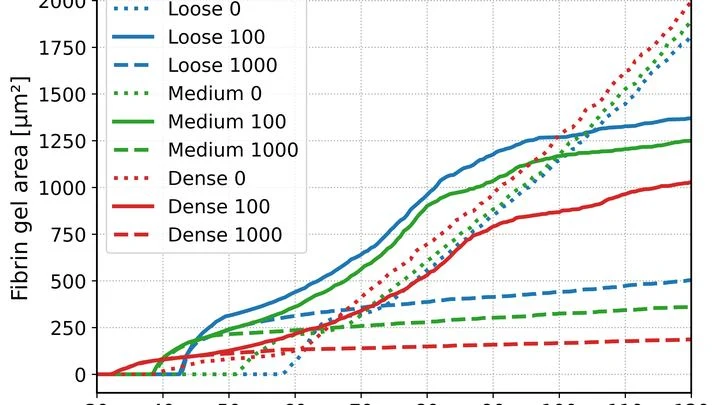
A thrombus is not just a clump of cells. When a vessel wall is damaged, platelets stick together into a plug, but it is still fragile. What makes it strong is fibrin — a protein that forms a network of fibers, like rebar in concrete. The model showed that the plug's density decides where this network appears.
In a pot of boiling water, bubbles of steam are born and pop, but the water itself remains a liquid. Something similar happens in an ultracold atomic gas: atoms constantly form pairs and then fly apart again, even though superfluidity has not yet set in.
Two runners on the same track. One starts halfway down the course, the other from the starting line. Who's faster? The answer is obvious, but in brain science, such a trick went unnoticed for a long time. Neural networks that replicate the connections of a real fruit fly brain were considered better learners than random networks.
In urban planning, Braess's paradox is well known: adding a new road to a transport network can worsen traffic rather than ease it. For a long time, it was explained by the selfish behavior of drivers, each seeking personal gain. However, ant colonies, acting as a single coordinated superorganism without personal interests, exhibit the same trap.
A neuron in the brain is like a person handing out business cards at a crowded conference. At first, making acquaintances is easy, but as the address book fills up, each new contact requires more effort: there's little room left. The authors based their model on this 'crowding' rule: the more incoming connections a neuron already has, the harder it is to form another one.
Normally, electric current is the same in both directions, like water in a straight pipe. But at the boundary between a normal metal and a superconductor, this rule breaks down. Two waves on water, going around a wide obstacle from different sides, can arrive with different delays and meet ‘out of step’.
A dense social network: everyone is connected to almost everyone else, and in this web it's hard to see who really matters. Too many threads — computers choke, simulations stall. Scientists have figured out how to prune such networks without losing what's essential.
The idea is to remove connections that don't participate in shortest paths.
A branching network, like a river delta or a tree crown, is built on the principle of economy. The classic law, derived back in 1926, stated that the cube of the parent vessel's diameter equals the sum of the cubes of the daughter diameters. This rule worked beautifully for ideal tubes, but real arteries stubbornly gave a different exponent — around 2.7 instead of 3.
The authors of the new study found the reason.
A piece of dough, when pulled from the sides, doesn't stretch evenly: in one spot it thins and tears. Living tissue behaves similarly, but instead of a tear, shear bands appear — narrow zones where cells begin to slide past each other, like cards in a deck when cut.
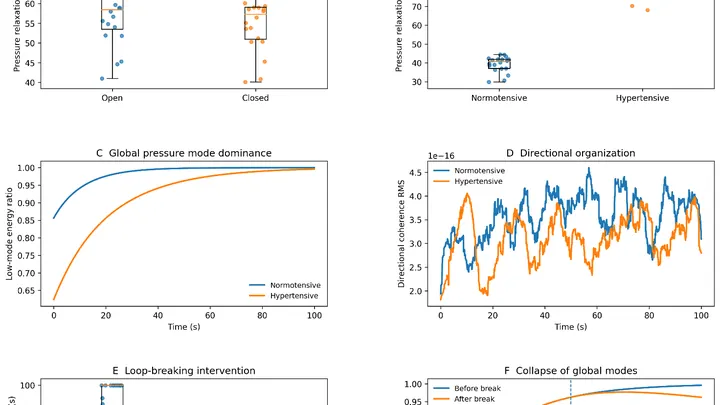
Water in a circular hose, pumped around by a pump, won't stop even if you pinch one section: the flow finds a detour and keeps going around. That's roughly how some parts of our circulatory system are arranged — not as single pipes but as closed loops.
Scientists built a computer model of blood flow and compared two scenarios: an open vessel and a closed loop.
An ordinary rubber pad dampens vibration the way a thick blanket muffles sound: the thicker and heavier, the better. Engineers have long dreamed of a material that is light yet "eats" oscillations as well as a massive damper.
Over the course of a day, the brain accumulates impressions the way a room accumulates stuff. At night, during deep sleep, it doesn't just rest: it tidies up: it sorts through the day's events and decides what to keep and what to toss. Scientists built a computer model of the brain that learns from a few examples during the day and 'replays' them at night, as if dreaming.
An orchestra without a conductor plays a complex piece. The listener hears the overall music but wants to understand who leads the melody and who merely echoes it in unison.