How to Catch a Molecule's Jitters express
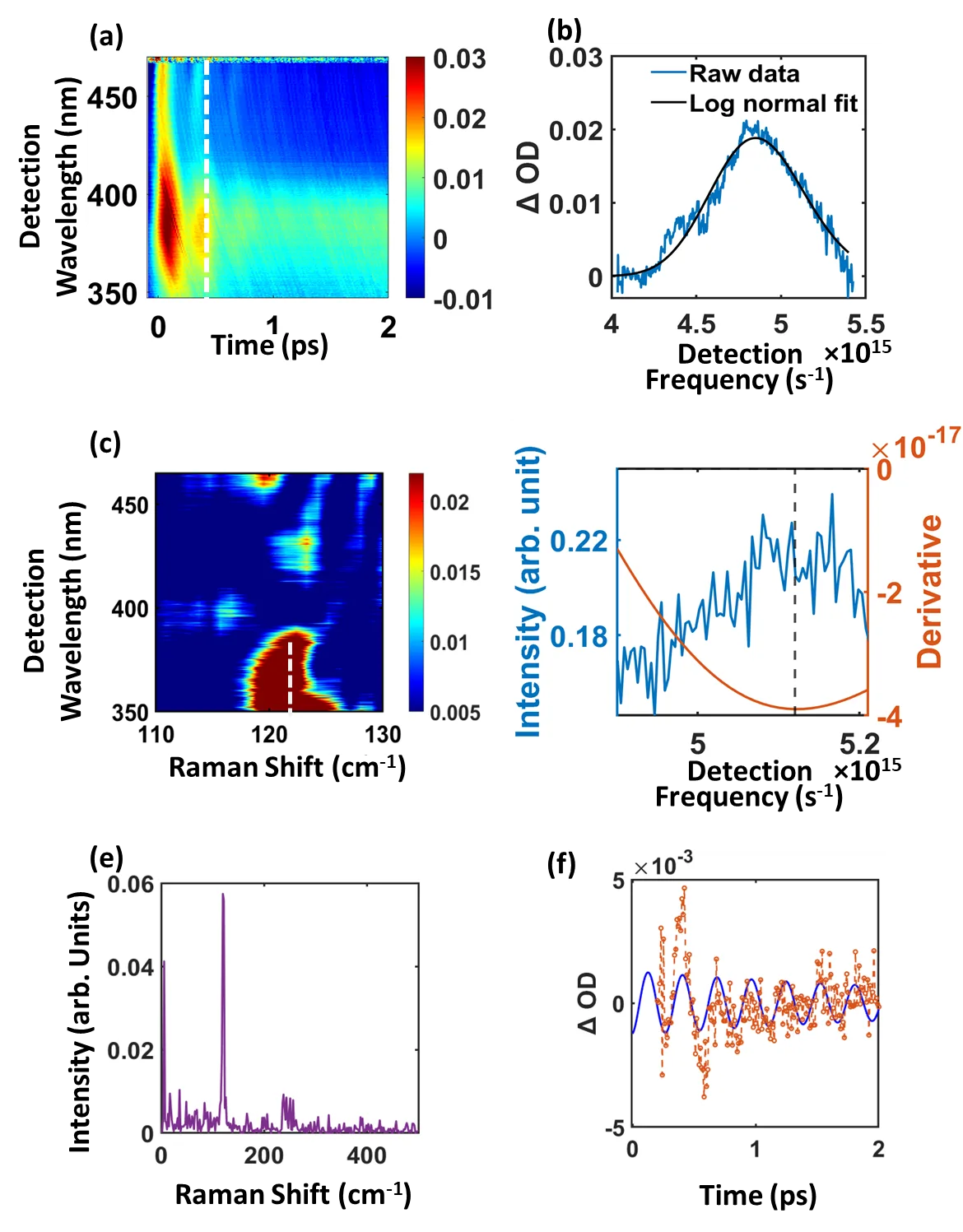
A short laser pulse hits an iodine molecule, and its atoms start to vibrate like a ball on a spring. Scientists track these vibrations with a second, broadband pulse that captures a spectrum at different moments in time.
It turns out that vibrations in the excited B state quickly shift in frequency and fade out, and then vibrations appear in the A state. It's like a relay race: the molecule falls apart, but the solvent, like a cage, holds the fragments close together, and they recombine, passing the vibrational energy on to a new state.
Wavelet analysis, mathematical 'microscopes' for frequencies, revealed how vibrational frequencies change from picosecond to picosecond. This helps separate signals that overlap in a regular spectrum.
This approach is like a stethoscope that hears not just a heartbeat but every rustle in the chest. It opens the door to studying coherence in complex photochemical processes.
Original abstract
as written by the authors arXiv:2604.23731
Vibrational wavepacket dynamics in the ground (X) and excited (B) electronic states of iodine under impulsive-pump/broadband-probe excitation are revisited. A method for accurate chirp correction, necessary to determine the zero time for each component of spectrally dispersed data and thereby separate coherent vibrational dynamics from coherent artifacts and population kinetics, is introduced. While from these processed time-domain data the absolute Raman cross-section in the ground electronic state can be calculated using steady-state absorption, we show that the same can be done using the pump-probe data itself, and further extend this method as a benchmark to calculate the same for the excited electronic state; these cross-sections report on vibronic couplings specific to these states. Further, since the Fourier transform of the processed data yields information on vibrational modes averaged over the dephasing time, a wavelet analysis is performed to yield a joint time-frequency distribution of the vibrational modes, demonstrating how the time evolution of their frequencies can be extracted. The vibrational modes of the ground and excited electronic states are shown to exhibit distinct dispersion characteristics. Since overlapping spectral features appear at different time windows, such an analysis can disentangle spectral congestion, even from a simple one-dimensional measurement. Most interestingly, a rapid time-dependent spectral shift and decay of the B state mode, followed by the appearance and growth of the A-state mode, directly correlates with the pre-dissociation, followed by solvent caging-induced recombination. Thus, the present work reveals transfer of vibrational coherence from one electronic state (B) to another (A), mediated via nonadiabatic coupling to the intermediate dissociative state (a), underscoring the importance of electronic coherence.
Iodine in solution looks purple, but its vapor is blue-violet; the color depends on how the molecules interact with their surroundings.