Raman spectroscopy is a technique that probes molecular vibrations by analyzing how light scatters inelastically. When a photon hits a molecule, most of it scatters elastically (Rayleigh scattering) with the same energy, but a tiny fraction exchanges energy with the molecule's vibrational or rotational modes, shifting the photon's wavelength. This shift, called the Raman effect, provides a unique 'fingerprint' of the molecular structure and composition, making it a powerful tool in chemistry, biology, and materials science.
History
The effect was predicted by Adolf Smekal in 1923 and experimentally observed by C.V. Raman and K.S. Krishnan in 1928. Raman received the Nobel Prize in Physics in 1930 for this discovery.
How it works
A laser beam illuminates a sample, and the scattered light is collected and analyzed with a spectrometer. The Raman spectrum shows peaks at frequency shifts corresponding to specific molecular vibrations. The intensity and position of these peaks reveal the chemical bonds, crystal structure, and even stress or temperature in the material. Because Raman scattering is inherently weak (about one in a million photons), modern systems use high-power lasers, sensitive detectors, and techniques like surface-enhanced Raman scattering (SERS) to amplify the signal.
In practice
Raman spectroscopy is used in pharmaceutical quality control, forensic analysis, art conservation, and biomedical diagnostics. It is also a key tool in planetary science, such as on NASA's Perseverance rover, which uses it to detect organic compounds on Mars.
Fun fact
Raman spectroscopy can identify the composition of a single cell or a grain of dust without damaging it, which is why it is used to analyze precious artifacts and even the contents of ancient pottery.
In the layered crystal CrSBr, the magnetic moments of atoms are arranged like notes in a score: within each layer they point in the same direction, but between layers they point in opposite directions. This antiferromagnetic melody plays up to 132 kelvin, beyond which thermal motion destroys the order.
A weak laser beam falls onto a tiny structure — a hybrid cavity made of metal and glass. Inside is trapped a single light-emitting molecule. Normally, such light only slightly changes color as it scatters off thermal vibrations of atoms.
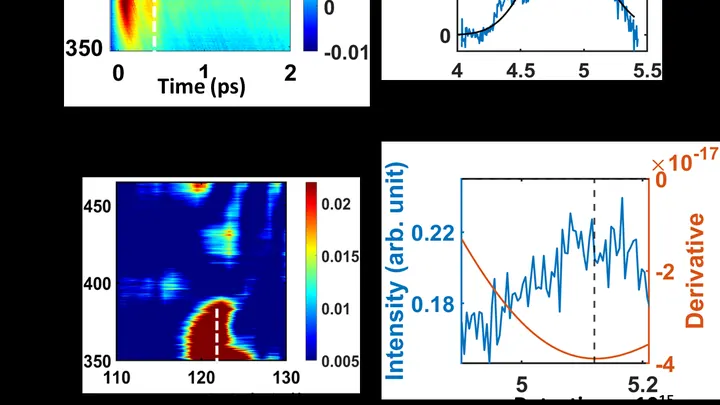
A short laser pulse hits an iodine molecule, and its atoms start to vibrate like a ball on a spring. Scientists track these vibrations with a second, broadband pulse that captures a spectrum at different moments in time.
It turns out that vibrations in the excited B state quickly shift in frequency and fade out, and then vibrations appear in the A state.
A protein in a cell is like a tightly coiled spring. Its shape determines what it does, but seeing that shape in a single molecule without disturbing it was nearly impossible. The new microscope works differently: it sends a short laser pulse that slightly heats the molecule.
Laser light is like a perfectly aligned row of soldiers on parade: all waves oscillate in the same plane. Such light is called polarized. In a new study, physicists have for the first time produced polarized gamma rays by colliding electrons with a powerful laser pulse.
A tuning fork rings dully when it strikes a crack. That principle scales up in this experiment: physicists turned molecules into an ultrasensitive tuning fork to eavesdrop on the electron's asymmetry.