Molecular vibration is the periodic motion of atoms within a molecule, where bonds stretch, bend, and twist around their equilibrium positions. These vibrations occur at specific frequencies, typically in the infrared region of the electromagnetic spectrum. When infrared light matches a vibrational frequency, the molecule absorbs that light, providing a unique spectral fingerprint. This phenomenon is the basis of infrared spectroscopy, a powerful tool for identifying molecules and studying their structure and environment.
History
The concept of molecular vibrations was developed in the late 19th and early 20th centuries with the advent of quantum mechanics. Infrared spectroscopy was first used systematically in the 1930s, and the theory of normal modes was formalized by physicists like Max Born and Theodore von Kármán.
How it works
A molecule with N atoms has 3N-6 vibrational modes (or 3N-5 for linear molecules). Each mode corresponds to a collective motion of atoms, such as symmetric stretching or bending. The frequency of each mode depends on the masses of the atoms and the strength of the bonds. When infrared light hits the molecule, it is absorbed if its frequency matches a vibrational mode, causing the molecule to jump to a higher vibrational energy state. The absorptionspectrum reveals which modes are active and at what frequencies, allowing chemists to infer molecular structure and bonding.
In practice
Infrared spectroscopy is used in chemistry, biology, and materials science to identify unknown substances, monitor chemical reactions, and study molecular interactions—for example, in the article 'Как вода танцует с углеродными кольцами: спектроскопия молекулярного д'.
Fun fact
The vibrationalfrequency of a bond can be used to measure its strength: stronger bonds vibrate faster, which is why the stretching vibration of a triple bond appears at a higher frequency than that of a double bond.
A protein is like a tiny machine that switches on and off on command. The command arrives when another molecule sticks to it, like a key in a lock. The protein then changes shape and passes the signal along. But exactly how the signal travels inside the protein has long been a mystery.
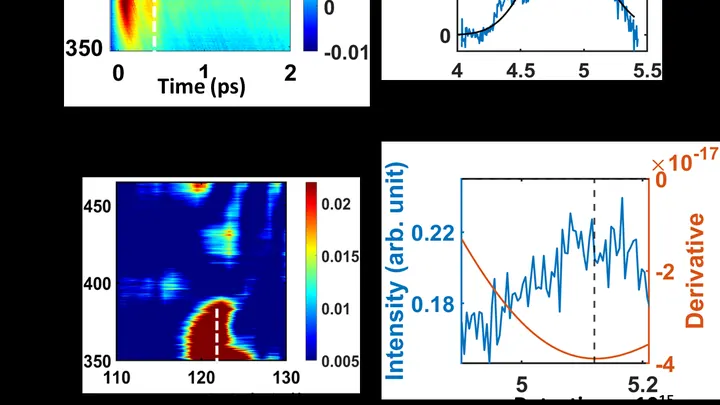
A short laser pulse hits an iodine molecule, and its atoms start to vibrate like a ball on a spring. Scientists track these vibrations with a second, broadband pulse that captures a spectrum at different moments in time.
It turns out that vibrations in the excited B state quickly shift in frequency and fade out, and then vibrations appear in the A state.
A water molecule, finding itself near a carbon ring, starts to vibrate, and immediately falls under the sway of an invisible conductor. The ring's electron cloud, like a maestro, dampens some vibrations while amplifying others.
An ordinary comb parts hair into even strands. A laser 'comb' does the same to light: it emits not one color but thousands, spaced at exactly equal frequency steps. Such a tool has already helped measure time to billionths of a second and peer inside atoms.
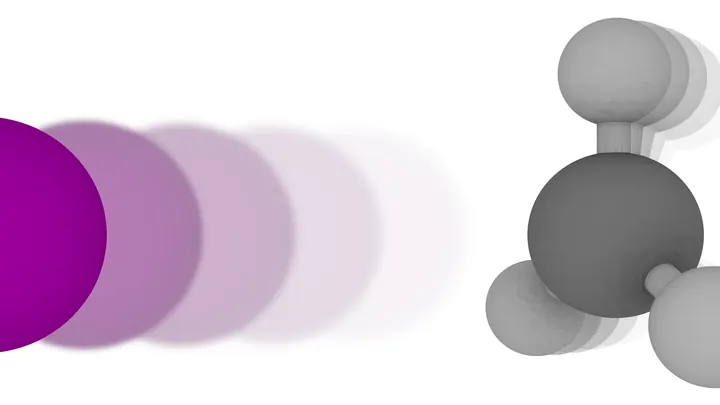
A chemical bond is like a stretched spring between atoms. When it's snapped, the molecular fragments fly apart, but they don't freeze: they keep vibrating, like a plucked string. That's exactly the vibration a team of researchers caught when they broke a methyl iodide molecule with an ultraviolet laser.
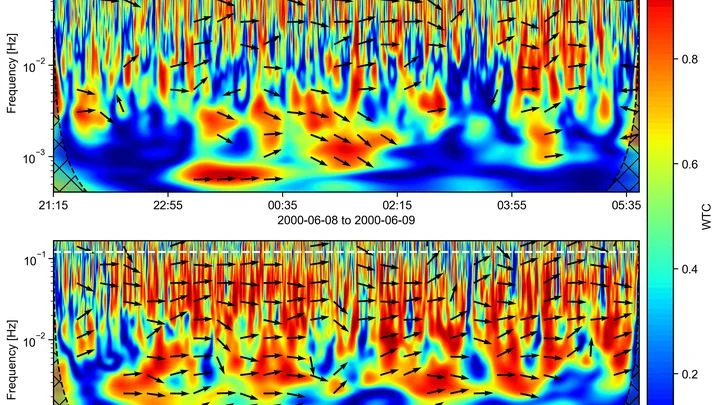
The Sun constantly emits a stream of charged particles, mostly hydrogen — the solar wind. Sometimes the Sun ejects dense blobs of magnetized gas, inside which calm usually reigns. But in 2000, scientists noticed two regions inside one such cloud where the gas was churning.
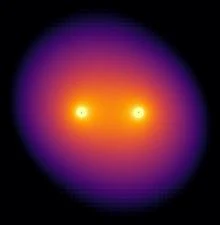
Two black holes circle in a tight dance, and around them something remarkable is born: a gravitational molecule. A cloud of ultralight bosons, particles with masses below an electronvolt, envelops the pair like the electron cloud in an H2+ ion.