The excitationspectrum of a system is the set of energy levels it can occupy when promoted from its ground state. It's like a fingerprint of the system's internal dynamics, revealing how energy is absorbed or emitted in discrete quanta. For atoms, this spectrum is the familiar series of spectral lines; for more complex systems like quantum gases or crystals, it includes collective excitations such as phonons or magnons.
History
The concept of discrete excitationspectra dates back to the early 20th century with Bohr's model of the hydrogen atom, later formalized by quantum mechanics.
How it works
When a system absorbs energy, it transitions to a higher energy state. The excitationspectrum lists all possible such states, each with a specific energy. The structure of this spectrum is determined by the system's Hamiltonian, which encodes interactions and confinement. Measuring the spectrum—for example, by scattering particles or photons off the system—reveals the allowed energy levels and their lifetimes, providing a direct window into the system's underlying physics.
In practice
Excitationspectra are used in spectroscopy to identify materials, in quantum computing to characterize qubit energy levels, and in condensed matter physics to probe exotic phases like superconductors.
Fun fact
The excitationspectrum of a superfluid helium-4 shows a roton minimum, a dip in energy at a specific momentum, which was a major puzzle until Landau explained it as a precursor to turbulence.
A stadium packed with fans hears the announcer’s voice for the first time, and instantly the whole place erupts. The message sounds again and again. Only a handful of people in nearby rows respond. That’s roughly how neural networks behave in brain organoids — tiny lab-grown replicas of the brain.
A guitar string keeps vibrating even after the musician lets it go, and that vibration changes the sound the listener hears. Magnetic moments in a crystal behave much the same way: they align into a strict antiferromagnetic order (neighbors point in opposite directions), but they never completely freeze.
The quantum world is full of surprises. In a Kerr parametric oscillator, a device where light is trapped in a ring and driven by an external field, researchers recently noticed something strange: pairs of energy levels merge in an embrace. Physicists have dubbed this a "spectral kiss" spectroscopy.
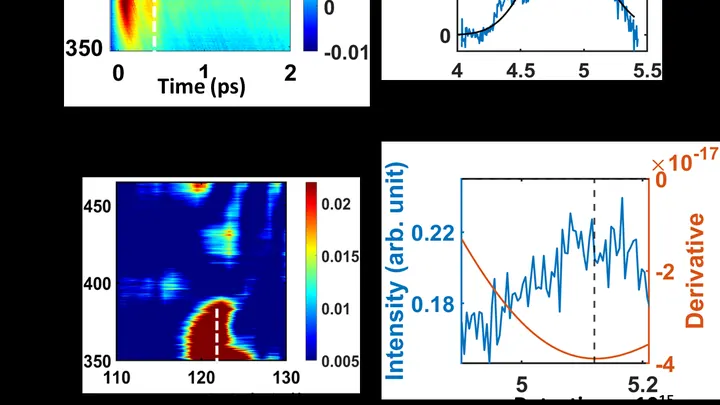
A short laser pulse hits an iodine molecule, and its atoms start to vibrate like a ball on a spring. Scientists track these vibrations with a second, broadband pulse that captures a spectrum at different moments in time.
It turns out that vibrations in the excited B state quickly shift in frequency and fade out, and then vibrations appear in the A state.
Two quantum dots are like two tiny pockets in a piece of silicon where an electron can sit, like a ball in a cup. When the pockets are far apart, each electron lives on its own, and its energy resembles the levels of a solitary atom.
Physicists built a chain of Rydberg atoms — atoms with electrons in enormous orbits, comparable to planetary paths. These giant atoms feel their neighbors intensely, turning the chain into a quantum analog of a string.