Tiny black holes as dark matter express
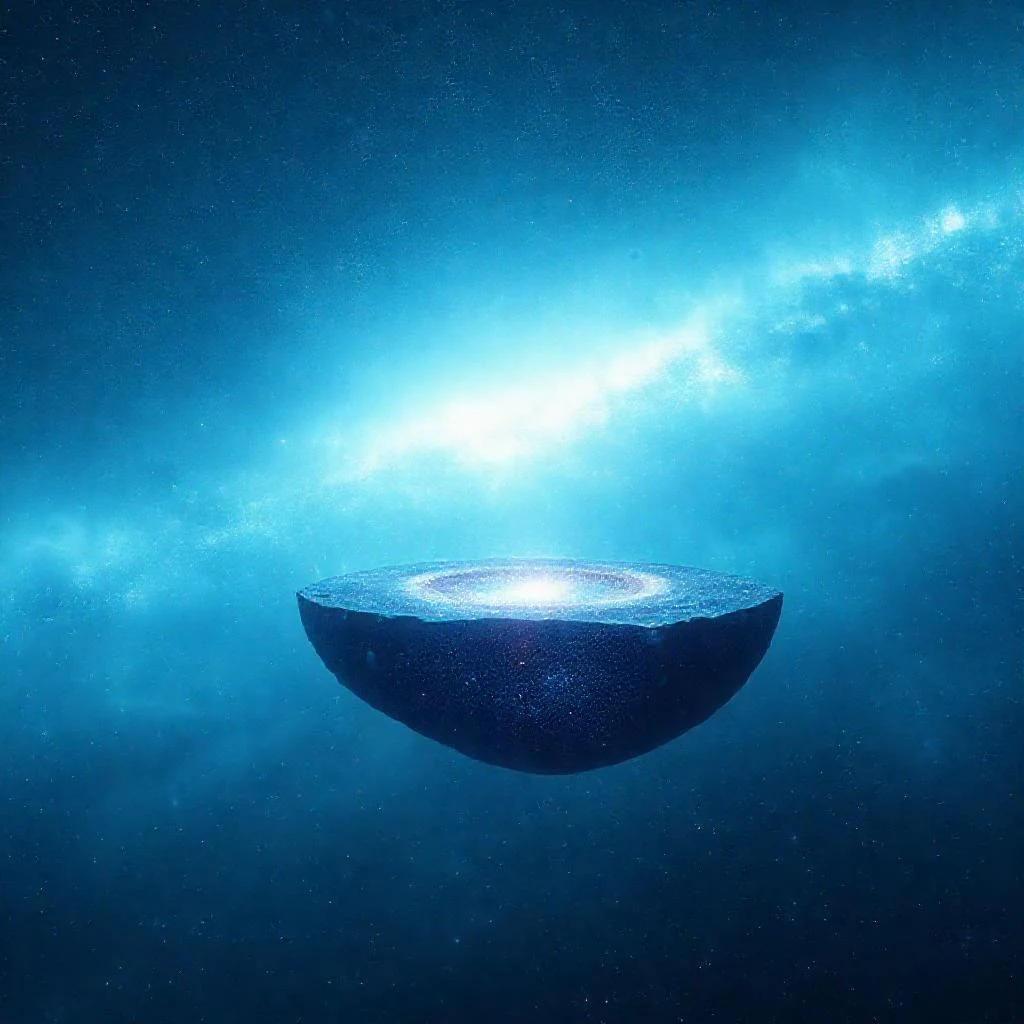
After the Big Bang, the Universe resembled a tightly inflated balloon: pressure prevented matter from clumping together. But hypothetical superheavy particles — sort of ‘heavyweights’ of the microcosm — momentarily made the balloon less stiff. Matter easily clumped, giving birth to black holes with masses from a billion to a billion billion tons. The size of an atomic nucleus, they emit no light, yet their collective gravity governs the motion of stars and galaxies. Calculations show: if such holes make up all dark matter, everything matches observations. The usual model gives too few holes and has been rejected. An unexpected twist: these same tiny ones could have become the seeds of supermassive black holes at the centers of galaxies.
Original abstract
as written by the authors arXiv:2604.26005
We study the formation of asteroid-mass Primordial Black Holes (PBHs) as a dark matter candidate in supersymmetric extensions of the Standard Model. We show that the presence of heavy particles predicted in the Minimal Supersymmetric Standard Model (MSSM) can lead to a transient softening of the equation of state of the Universe during their non-relativistic transition, enhancing PBH formation. We compute the effective equation of state for different realizations of the MSSM mass spectrum, parametrized by three characteristic mass scales. Assuming a broad and approximately scale-invariant primordial curvature power spectrum, we evaluate the resulting PBH mass functions and compare them with current observational constraints. We find that, for supersymmetric masses above $$\sim 10^5\,\mathrm{GeV}$$, the PBH mass function is significantly enhanced in the asteroid-mass window, allowing PBHs to account for the total dark matter abundance without violating existing bounds. In contrast, within the Standard Model the same configurations lead to PBH mass functions that are observationally excluded. For lighter supersymmetric mass spectra, PBH production is shifted toward masses above $$\sim 10^{22}\,\mathrm{g}$$, which are strongly constrained by microlensing searches, thereby reducing their allowed contribution to the dark matter density.
An asteroid-mass black hole is microscopic: passing through Earth, it would leave only a thin tunnel and cause weak tremors. The chance of such an event is extremely small.