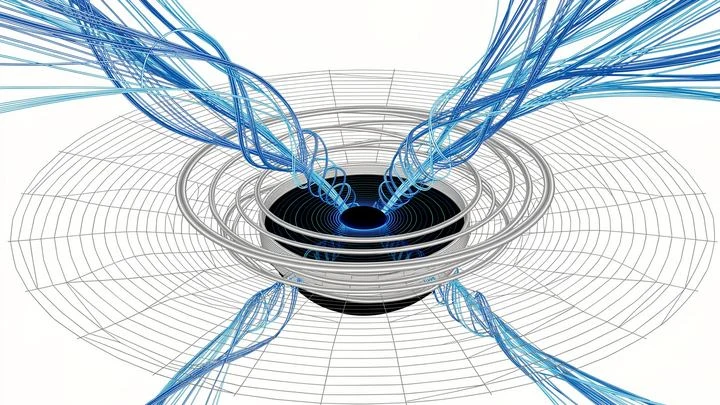
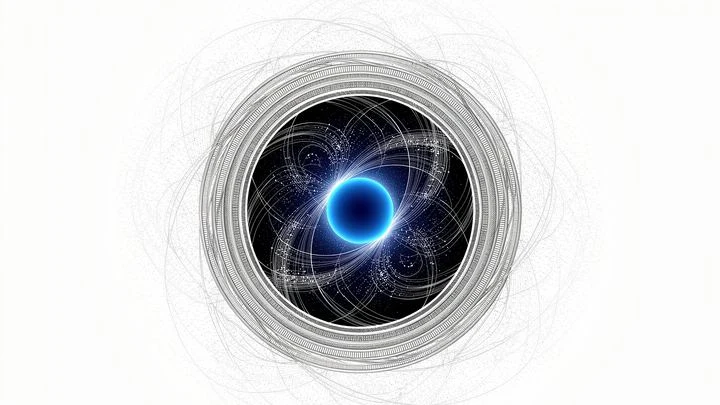
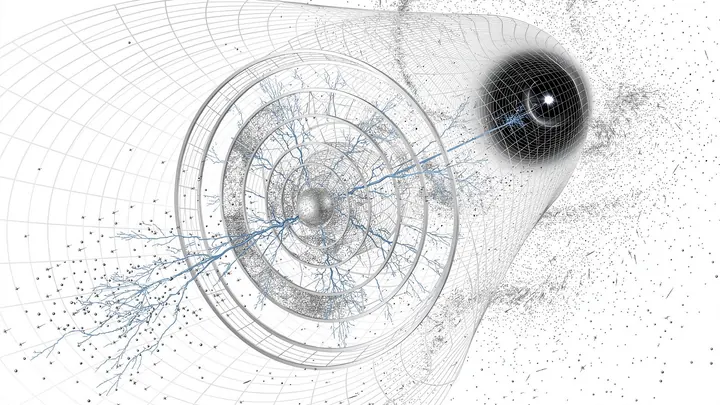
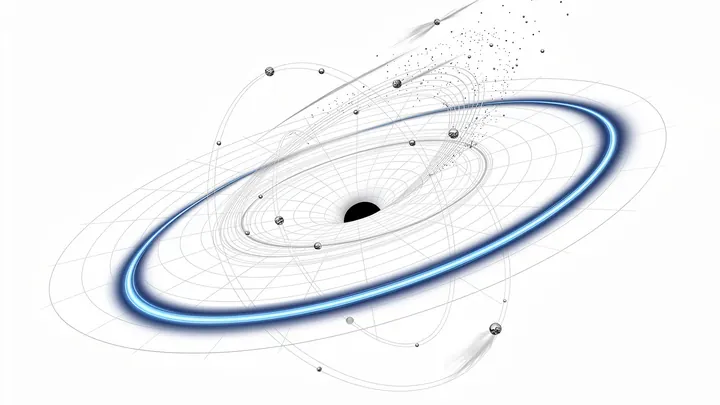
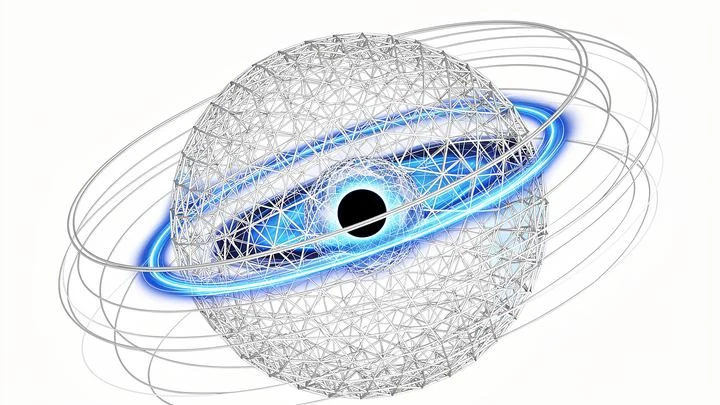
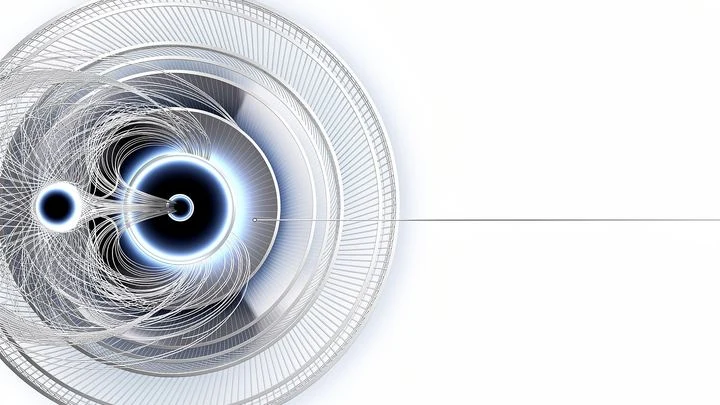
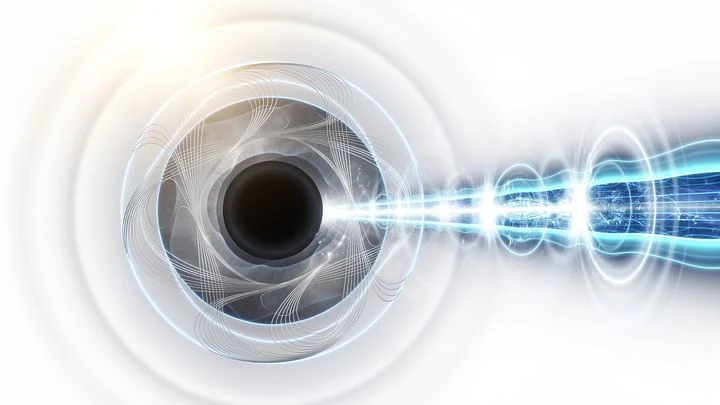
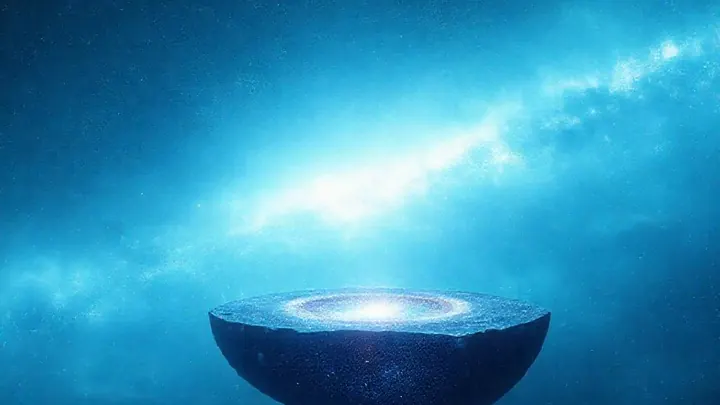
A dark star is a hypothetical type of star that is powered not by nuclear fusion, but by the annihilation of dark matter particles. In the early universe, regions of high dark matter density could have hosted such stars, which would have grown to enormous sizes — potentially thousands of times the mass of the Sun — because they did not rely on fusion to counteract gravitational collapse. Instead, the energy from dark matter annihilation provided the necessary pressure support.
History
The concept of dark stars was proposed in 2007 by Katherine Freese, Douglas Spolyar, and Paolo Gondolo. They suggested that the first stars in the universe might have been powered by dark matter annihilation, which could explain the existence of supermassive black holes in the early universe.
How it works
Dark matter particles, if they are their own antiparticles, can annihilate when they collide, releasing energy. In a dense dark matter halo, this energy could heat up ordinary gas (hydrogen and helium) enough to form a star-like object. The star would be 'cool' in the sense that its surface temperature is low (around 10,000 K) compared to fusion-powered stars, but it would be very luminous due to its huge size. As dark matter is consumed, the star would eventually contract and ignite fusion, transitioning into a normal star or collapsing into a black hole.
In practice
Dark stars are primarily a theoretical concept used to explain the formation of supermassive black holes and the properties of the first galaxies. They are also a target for observational searches, as they would have distinct spectral signatures in the infrared.
Fun fact
Dark stars could grow to be as massive as 10 million solar masses, making them some of the largest stars ever imagined — far exceeding the most massive known stars today, which are around 300 solar masses.
In the first moments after the Big Bang, matter and antimatter should have been created in equal amounts. But today, everything around us is ordinary matter, and antimatter is almost nowhere to be found. Where did it all go? The standard answer: a tiny imbalance in favor of matter wiped out almost all antimatter.
A stellarator fusion reactor resembles an intricately twisted magnetic cocoon. Its job is to confine superheated plasma so that hydrogen nuclei fuse and release energy. But the cocoon's three-dimensional shape creates gaps: some particles escape, especially the fastest ones, which carry most of the heat.
The universe is like a vast invisible scaffold. We don't see it directly, but we know it's there: galaxies and clusters hold together thanks to it. This scaffold is dark matter. The most popular version says it is "cold," made of heavy, slow-moving particles.
A star runs out of fuel and rapidly collapses under its own gravity. According to classical ideas, it collapses into a point of infinite density — a singularity. But what if nature abhors infinities? In models of regular black holes, instead of a singularity, a dense core of unknown matter forms at the center.
Neutron stars — remnants of supernovae — are among the densest objects in the Universe. Their central density exceeds nuclear density many times over, and gravity is surpassed only by black holes.
At the center of the Milky Way, where the supermassive black hole Sagittarius A* reigns supreme (its metric first derived by Karl Schwarzschild), star S4714 makes a dizzying voyage.
In 1933, Fritz Zwicky first spoke of an invisible mass holding galaxy clusters together. Decades later, Vera Rubin mapped galactic rotation, revealing the ghostly presence of dark matter. Today we know it pervades the cosmos, but its particle nature remains elusive.
At the center of a galaxy, gravity condenses dark matter into a dense 'spike.' Such a dark spike resembles a funnel of invisible particles around a massive body. But if both the center and the particles are primordial black holes, the picture breaks down.
The universe is full of the invisible. We know about dark matter from galaxy rotation and gravitational lensing, but its nature has eluded us for a century.
The James Webb space telescope peered into an era when the Universe was less than a billion years old and discovered hundreds of strange objects there. Tiny yet dazzlingly bright, they glowed a deep red — like burning coals scattered across the black velvet of space.
Using the James Webb telescope, astronomers peered into an ancient quasar — the dazzling heart of a galaxy where a giant black hole sucks in matter. It turns out it doesn't just destroy, but also creates: its powerful outflows and shock waves act like a true cosmic mill.
In the silent theater of the cosmos, a star’s life plays out over billions of years. But sometimes an invisible director sneaks onto the stage — a primordial black hole.
Drop a stone into a pond, and ripples spread outward. Something similar happens inside compact clumps of dark matter when they encounter a special medium — a scalar field. This field, which pervades everything around us, can spontaneously intensify in the depths of such objects, much like ripples on water growing ever taller and more pronounced.
Axions are hypothetical elementary particles introduced in 1977 by Roberto Peccei and Helen Quinn to resolve the so-called strong CP problem in the Standard Model of particle physics.
After the Big Bang, the Universe resembled a tightly inflated balloon: pressure prevented matter from clumping together. But hypothetical superheavy particles — sort of ‘heavyweights’ of the microcosm — momentarily made the balloon less stiff. Matter easily clumped, giving birth to black holes with masses from a billion to a billion billion tons.
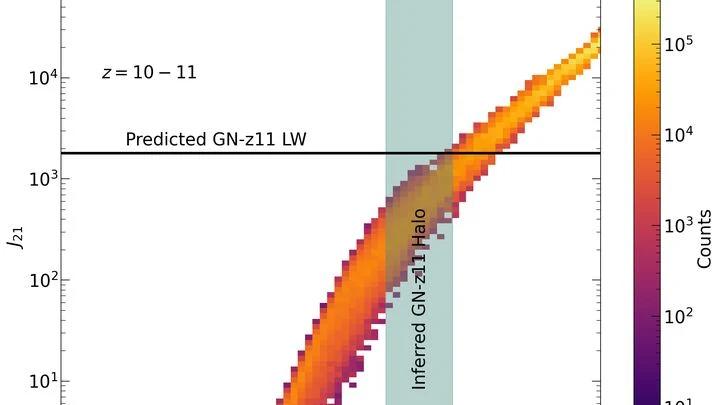
A bonfire built of pure alcohol burns hot and gives off almost no smoke. That's roughly how the first stars shone: they contained no heavy elements, only hydrogen and helium left over from the Big Bang. The James Webb Space Telescope may have caught one such "bonfire" in the galaxy GN-z11.
A tiny black hole the size of an atomic nucleus floats in the hot soup of the early universe. Normally, such a little one should quickly evaporate, releasing energy like a drop of water on a hot skillet. But if space is more complex than it seems and contains hidden dimensions, everything changes.
The James Webb Space Telescope has spotted tiny, unnaturally bright red objects in the early universe. Their light outshines by a hundredfold what you’d expect from ordinary galaxies of that era.
Tiny black holes, born right after the birth of the universe, are supposed to evaporate — shedding mass as invisible particles. This was predicted by Stephen Hawking, and this 'Hawking evaporation' contributed to the expansion of the young cosmos.
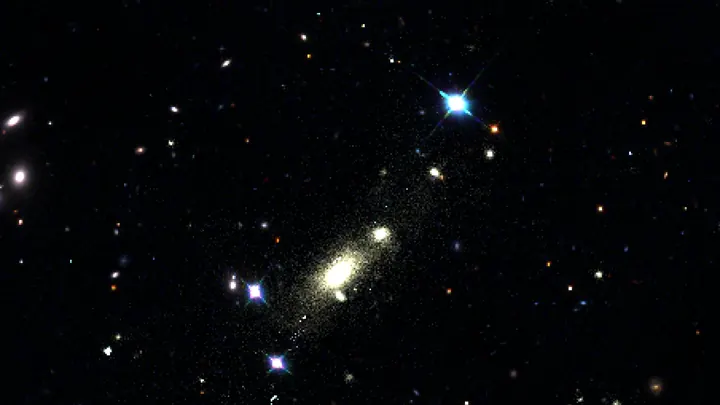
In the constellation Cetus, 65 million light-years from Earth, three dwarf galaxies nestle: DF2, DF4, and DF9. All have been declared “galaxies without dark matter” — the mysterious invisible substance that usually holds stars together.
Images of distant galaxies are riddled with curved arcs and smears — light warped on its way to us. This effect, predicted by Albert Einstein, acts like a giant funhouse mirror: a massive galaxy cluster distorts the images of background sources.
Dough rises faster when it already contains yeast. Similarly, galaxies may have assembled faster if they already had black holes inside. Astrophysicists considered a scenario where the universe contained primordial black holes from the very beginning — objects that could have formed in the first instants after the Big Bang.
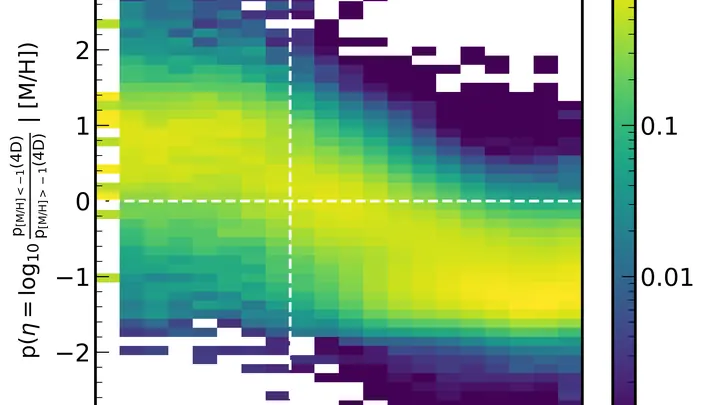
The galaxy's kitchen has a recipe for stellar soup. The main ingredient is hydrogen, but the flavor depends on a pinch of metals. Astronomers have now peered into the pots where that pinch is almost absent, and found that the smallest stars are missing.
In the Large Magellanic Cloud, a galaxy that orbits our Milky Way, astronomers have caught five stars that look like fossils from the very distant past. They contain almost no metals, only one-hundredth to one-thousandth of what the Sun has, but they have tens of times more carbon.
Astronomers pointed the James Webb at three galaxies whose light traveled 12 billion years. Early data pointed to incredibly fast growth — like an infant reaching adult height in just a year, clashing with the expansion of the Universe.
In 2014, astronomers spotted a massive yellow star in the Andromeda galaxy. By 2022, it had vanished without a trace — without the usual blinding explosion of a supernova. It was as if someone simply switched off the light.
Tiny black holes, the size of an atom but heavier than an asteroid, were born right after the Big Bang. Now, they are probably the dark matter — the invisible mass that keeps galaxies from flying apart. You can't catch them directly: they emit almost nothing.
Neutron stars are the compressed remnants of massive stars: their matter is squeezed so tightly that a thimble-sized amount would weigh a colossal amount. If dark matter, the mysterious invisible substance thought to hold galaxies together with its gravity, accumulates inside such an object, under certain conditions this accumulation becomes fatal.
After the Big Bang, the universe was hot and dense. In clumps of dark matter, invisible stuff felt only through gravity, its particles, colliding, annihilated, giving birth to powerful radiation. This hidden heat, like an invisible furnace, warmed gas clouds from within.
At the center of galaxy NGC 1600, 200 million light-years away, astronomers spotted a dense cluster of stars. It looked like a bright knot against the diffuse glow, and that was unexpected.
The James Webb Space Telescope has spotted a scattering of compact objects in the early universe, nicknamed 'little red dots.' They are too red and too dim to be ordinary quasars, and astrophysicists are scratching their heads over what powers them.
The light from a distant galaxy split into two, then three, then four, and in the center a fifth ghost appeared. That is HerS-3: a young galaxy full of dust and newborn stars, whose light passed through a gravitational lens, a massive object that bends rays like a magnifying glass bends light.
A homogeneous dust sphere begins to contract under its own gravity. Inside it, like a rescue bubble, a region of negative pressure inflates: the de Sitter bubble. It expands, slows down near the very edge of the fall, and freezes at the Schwarzschild radius.