Proton measured with watchmaker precision express
Hydrogen is the simplest atom: one proton and one electron. You'd think there's nothing left to study. But it's precisely on hydrogen that physicists test the most delicate laws of the microcosm. The electron in an atom can occupy different energy levels, like steps on a ladder. To jump to a higher step, it must absorb light of a very specific frequency — like a key that fits only its own lock.
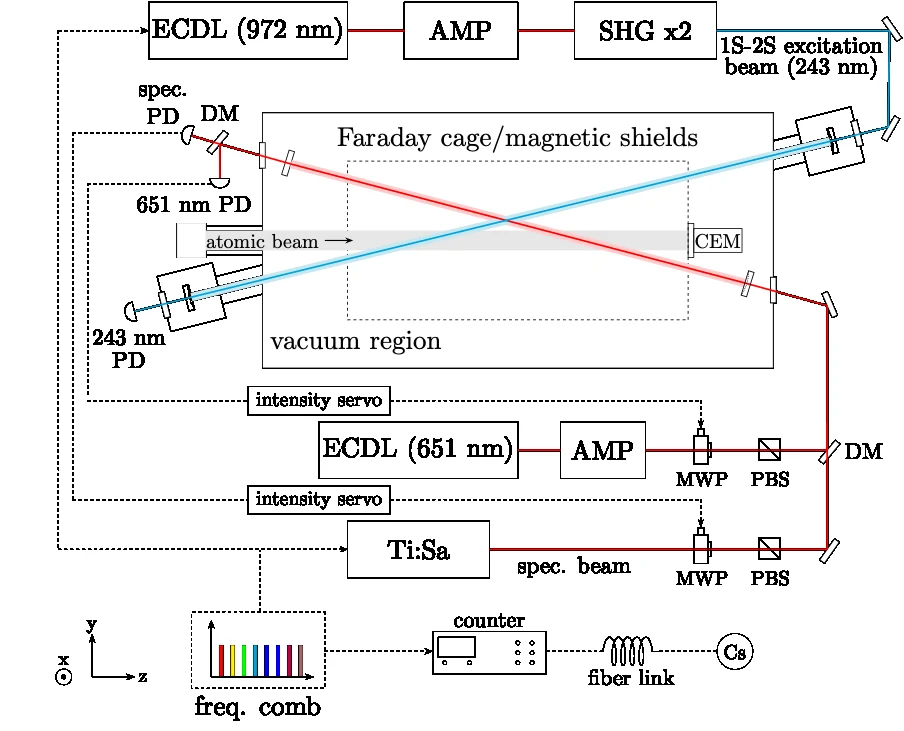
The authors of the new study cooled a beam of hydrogen atoms to cryogenic temperatures — nearly absolute zero. In such cold, atoms move slowly and are easier to "examine." Then they aimed a laser at the beam and made electrons jump from the 2S level to higher levels: 8S, 9S, and 10S. The light frequency was measured with enormous precision: the error was just 2.6×10⁻¹². In everyday terms, that's like measuring the distance from the Earth to the Moon with an error no thicker than a human hair.
From these measurements, the scientists calculated two crucial quantities. The first is the proton radius: it turned out to be 0.8433 femtometers (one femtometer is a millionth of a billionth of a meter). The second is the Rydberg frequency, a fundamental constant that ties together all energy levels in an atom. Both numbers matched the CODATA 2022 recommended values beautifully — as if two independent watchmakers, working in different workshops, produced clocks that keep time to the second.
Such a precise "lock" of light and atom not only confirms our knowledge but also prepares the ground for future discoveries. Perhaps it's on the simplest atom that we'll spot the first cracks in the Standard Model — and then the ladder of energy levels will lead us to new physics.
Original abstract
as written by the authors arXiv:2604.26401
We present absolute frequency measurements of 2S_{1/2}-nS_{1/2} two-photon transitions with n = 8, 9, and 10 in a cryogenic beam of atomic hydrogen. Each transition has been measured with a fractional uncertainty of approximately 2.6*10^(-12). Combining the results from this work and the 1S_{1/2}-2S_{1/2} transition frequency, we extract a root-mean-square proton radius of r_p = 0.8433(31) fm and a Rydberg frequency of cR_{\infty} = 3,289,841,960,252.9(9.7) kHz. These are in good agreement with the CODATA 2022 recommended values.
If you scaled the proton up to the size of a soccer ball, the electron in a hydrogen atom would be about 10 kilometers away — that's how empty the atom is inside.
In Stanisław Lem's novel Solaris, the ocean could manipulate quantum states — possibly using transitions similar to those measured in this work.