How to Make a Waterfall and a Wave Get Along express
A boiling pot, a gust of wind, a wisp of smoke from a campfire — all obey equations that mathematicians call 'nonlinear and dissipative.' In plain terms, energy is lost to friction, and parts of the flow influence each other so strongly that predicting the motion ahead of time is a task on the edge of feasibility. These equations, the compressible Navier–Stokes equations, describe almost any fluid medium, from water to interstellar gas. But they have a peculiar trait: they look nothing like the clean, reversible waves that quantum mechanics lives by.
The authors found a way to dress these equations in a new suit. They introduced special quantities — something like 'probability amplitudes' for density and flow velocity, but with one crucial difference: time here flows not as in the real Schrödinger equation, but as in a heat diffusion problem (such time is called imaginary). To put it simply: instead of describing the flow directly as a set of vortices and compressions, they rewrote it in a language where each piece of fluid behaves like a damped wave in a complex, self-generating field. This is not an approximation — the transformation is exact, like translating a poem into another language without losing meaning.
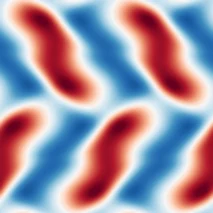
The key idea is to split the flow velocity into two parts: one responsible for compression and expansion (like a blacksmith's bellows), the other for rotation (like a whirlpool in a river). After a logarithmic substitution, both parts become a pair of Schrödinger-type equations coupled together. In the two-dimensional case, things get especially elegant: the density and the 'compressive' amplitude merge into a single variable that obeys an equation with a vector potential — something akin to a magnetic field acting on a quantum particle. The approach was tested on a classic problem — the Kelvin–Helmholtz instability, where two layers of fluid slide past each other and produce beautiful curls. A numerical experiment showed perfect agreement with direct simulations of the Navier–Stokes equations.
Such a view of fluid flow is not just a mathematical toy. It exposes operator structures that could be useful for creating simplified flow models. And crucially, equations in a form close to quantum ones can be solved on future quantum computers, where operator evolution happens naturally. The same waterfall, described in the language of waves, might one day be computed in seconds.
The Navier–Stokes equations are so complex that a million-dollar prize is offered for proving the smoothness of their solutions in the three-dimensional case: it's one of the Millennium Prize Problems.
In Liu Cixin's novel 'The Three-Body Problem,' aliens unfold protons into multidimensional computers — reformulating flows in quantum form makes such a feat slightly less fantastical.