Charged Layers in the Pulsar Wind express
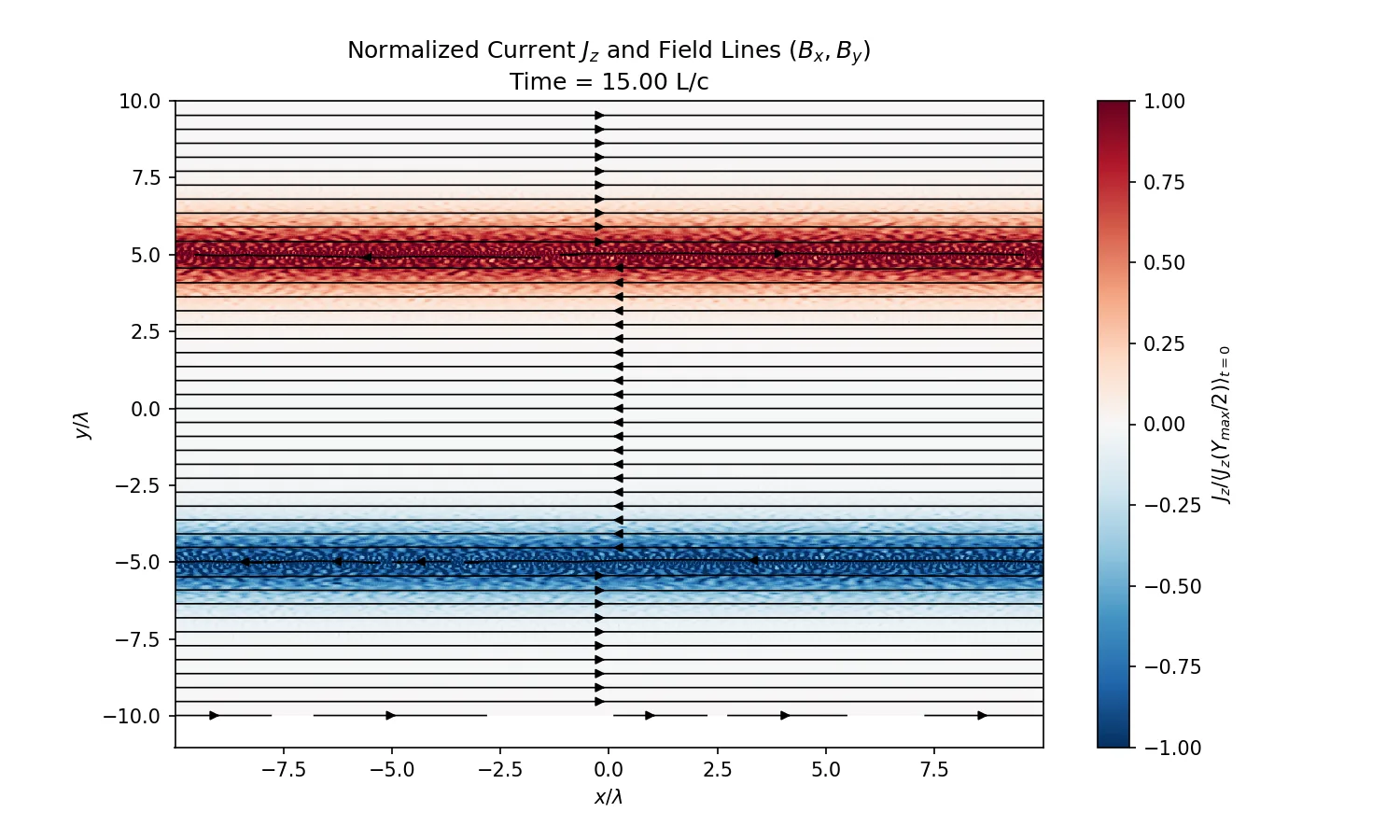
A thin layer of oil on the surface of water breaks into separate droplets at the slightest disturbance. Something similar happens in the pulsar wind — a stream of particles ejected by a rapidly rotating neutron star. This stream also contains plasma layers, which can break apart into clumps — magnetic islands. But unlike oil, these layers carry an electric charge.
In the new study, scientists used computer simulations to find out how charge affects the tearing. Initially, the charged layer loses uniformity: fast oscillations, Bernstein waves, are born in the plasma (similar to ripples running along a taut string). These waves shuffle the charge, making its distribution patchy. However, this has little effect on the growth of the magnetic islands themselves: they only become slightly charged.
Another scenario involves rotating layers. If the layer is not just stretched but twisted, like a vortex in a drain, charge plays a more noticeable role. Under certain conditions, tearing accelerates: magnetic islands multiply faster than in the uncharged case. This resembles a notched sheet of paper that tears more easily if it has been crumpled beforehand. The results help understand how the energy of the pulsar wind is converted into radiation and high-energy particles.
Original abstract
as written by the authors arXiv:2605.06085
Astrophysical current layers, e.g., in pulsar winds, can be electrically charged, while the plasma is charge-symmetric, $$e^\pm$$. Using PIC simulations, we investigate dynamics and plasmoid formation (tearing instability) in charged Harris-type and rotational current layers. Electrically charged current layers, initially in global force-balance, are electrostatically unstable: the resulting dynamics is an intricate interplay between electrostatic Bernstein waves (BWs) and the current tearing mode. Besides overall density and magnetic field, plasma temperature is an important factor. In the charged Harris sheet set-up, the quickly generated BW are trapped within the layers (internally reflected at the upper hybrid resonance). BWs quickly redistribute the charge modifying the initial stage of tearing, but without strongly affecting overall plasmoid growth; resulting plasmoids are mildly charged. In rotational current layers: (i) even initially overall uncharged configurations develop large fluctuations of charge density; (ii) overall dynamics depends on the initial overall temperature; (iii) for certain combination of parameters tearing rate is greatly increased in the charged case.
Bernstein waves are named after physicist Ira Bernstein, who described them in 1958. They do not leave the plasma but are trapped inside it, like sound in a musical instrument.