A Quantum Motor Powered by a Double Pendulum express
A heat engine doesn't have to be made of iron. In the microworld, a single electron can play the role of a piston, and the measurement process itself can serve as fuel. Two neighboring 'pockets' for electrons are connected by a narrow bridge. An electron can sit in the left or right pocket, but its quantum nature allows it to leak through the bridge: this is called tunneling.
This new study treats such a double quantum dot as the working fluid of a motor that is powered not by heat but by sequential measurements. The cycle consists of three steps. First, the system is briefly connected to a hot reservoir: it receives a burst of energy, like a kettle on a stove. Then the first measurement is performed: we check where the electron is, giving the system a shake. Then a second measurement follows, but of a different type. Each such 'peek' changes the energy and disorder in the system.
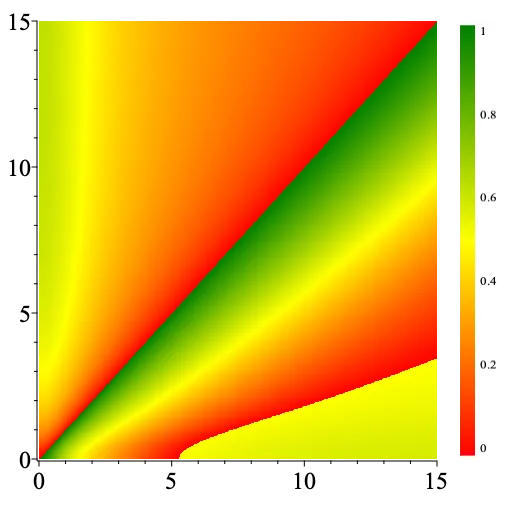
The authors calculated how, depending on parameters (temperature, level detuning (the difference in pocket heights), and tunneling strength) the machine chooses one of four roles. It can be an engine: taking energy from measurements and delivering it to the outside. It can be an accelerator: spending energy to heat up even faster. It can be a plain heater. Or it can be a refrigerator, drawing heat away from the reservoir. And here's the key: without tunneling, the cooling mode disappears. It is precisely quantum tunneling that opens up this possibility.
On the practical side, double quantum dots can already be fabricated in laboratories. This isn't abstract theory but a platform where a measurement-driven quantum motor can be assembled in real life. A tiny electronic pendulum, rocked not by pushes but by the very act of observation, could one day cool microchips or harvest scattered heat into useful work.
Tunneling is when a particle passes through a barrier that, by classical standards, it shouldn't be able to overcome. Sort of like walking through a wall just because you're very small and quantum.
The idea of extracting energy from measurements echoes Asimov's 'The Last Question': there, entropy was reversed; here, measurements feed orderly motion.