In 1824, French engineer Sadi Carnot, pondering the improvement of steam engines, arrived at a fundamental theorem. He realized that the maximum efficiency of any heat engine is determined solely by the temperatures of the heater and the cooler and does not depend on the working substance. The idea came from an analogy with a water mill: the work is determined not by the mechanism but by the difference in levels. Carnot introduced the concept of a reversible cycle where there are no losses due to friction, etc., and proved that all reversible engines have the same efficiency, and irreversible ones have less. This result later formed the basis of the second law of thermodynamics.
History
Sadi Carnot in 1824 published a treatise 'Reflections on the Motive Power of Fire', where he described an idealized heat cycle and derived his theorem. His work remained little known until William Thomson (Lord Kelvin) in 1848 realized its significance for formulating the second law of thermodynamics. Rudolf Clausius mathematically justified Carnot's result by introducing the concept of entropy in the 1850s. Thus, Carnot's theorem became the starting point for the development of thermodynamics as a science.
How it works
The theorem is used as a benchmark for evaluating the efficiency of real heat engines: steam turbines, internal combustion engines, refrigeration units. Its range of applicability: valid for systems where reservoir temperatures are kept constant, processes are quasistatic, and dissipative losses are absent. It breaks down when considering finite process speeds, as well as in microscopic systems where fluctuations become significant.
In practice
Car engines and power plants operate more efficiently the greater the temperature difference between fuel combustion and exhaust; increasing this difference is a direct engineering task.
Fun fact
The efficiency of even an ideal gasoline engine (combustion temperature ~2500°C, exhaust ~500°C) does not exceed 70-80%, and real efficiency is around 30%.
Inside an ultracold chamber, two atomic clouds collide: a few dozen cesium atoms acting as the working fluid, and thousands of rubidium atoms serving as the heat reservoir.
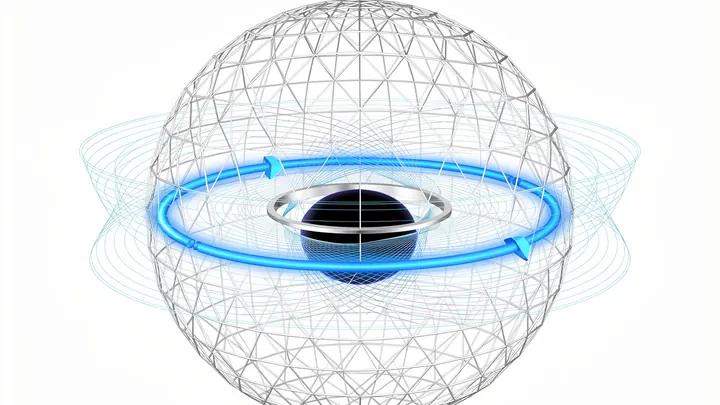
The Kerr-NUT black hole is not just a cosmic vacuum cleaner. It's a solution to Einstein's equations where the hole has mass, rotation, and a strange NUT parameter. This parameter behaves like a magnetic charge for gravity: seemingly invisible, yet it alters the properties of surrounding space.
Inside every cell, logistics is in full swing: tiny protein motors, like couriers, haul cargo along a network of microtubules. One of the main workhorses is kinesin, which steps using the energy of ATP (the cell's main energy currency). For a long time, researchers tried to evaluate it like a car: how much fuel it burns, how fast it gets there.
In classical thermodynamics, heat engines are like a virtuoso musician on stage: the closer to perfection in performance (Carnot efficiency), the slower the tempo (power).
Imagine a steam engine where instead of a steel piston there is an event horizon, and the cylinder is curved space itself. This metaphor has gained mathematical flesh: physicists have for the first time constructed a complete set of reversible heat cycles with a Schwarzschild black hole confined in a spherical cavity.
A quantum calculation sometimes resembles an interpreter who gets distracted by every rustle in the hall, and a one-hour meeting turns into two. In physics, such a "rustle" is called the sign problem: it arises when probabilities in formulas become negative or complex, and ordinary computer simulations start to fail.
In 1867, James Clerk Maxwell proposed an image that still stirs physicists today. Two compartments of gas are separated by a door. Molecules dart about chaotically: fast and slow. A tiny gatekeeper opens the door only for fast ones, letting them through to one side, and slow ones to the other. The hot compartment gets hotter, the cold one colder.
A pot of water on the stove eventually settles down: the temperature evens out, the liquid stops boiling. Physicists call this thermal equilibrium — a state where energy is distributed in the most probable way.
A heat engine doesn't have to be made of iron. In the microworld, a single electron can play the role of a piston, and the measurement process itself can serve as fuel. Two neighboring 'pockets' for electrons are connected by a narrow bridge.
A piece of metal heated at one end produces a weak electric current: this has been known for nearly two hundred years. But what if, instead of a simple metal, you take a layered "sandwich": a superconductor, a thin insulator, and a flat layer of electrons?
An ordinary heat engine is like a mill between the hot and cold banks of a river: the greater the drop, the stronger the current. Here, the drop is tiny, just one or two degrees, but water can still turn the wheel. The secret is that water is made to boil not by heating but by a sudden drop in pressure, so steam bursts out even from barely warm liquid.
The idea of a expanding universe, proposed by Georges Lemaître, finds an unexpected analogy. Space behaves like a piston in a cylinder: dark energy pushes it, much like steam. The relationship between pressure and volume in this 'engine' is strikingly similar to that of a steam boiler.
A regular motor burns fuel and wastes a ton of energy as heat — that's dictated by the laws of thermodynamics. A quantum engine does it differently: its fuel isn’t heat, but a perfect rhythm. Physicists call this rhythmic precision quantum coherence.
Water always flows downhill, and heat from hot to cold. That's what энтропия dictates. But the quantum world finds loopholes.
Physicists made light particles interact with hot and cold environments in an uncertain sequence — like a flipped coin that hasn't landed yet.
Atoms, like a swarm of fireflies, shine in unison. When they flash together, the light multiplies — a hundred atoms shine ten thousand times brighter than one. Physicists have turned this trick into a heat engine. A typical motor needs both a hot and a cold source, but here the atoms operate with just a cold one.
An orchestra without a conductor, where each musician hears only the hall's echo, can create a powerful melody. That's how a quantum battery works: many particles, immersed in a warm environment, don't dissipate heat but exchange it synchronously. Instead of chaos, an orderly charge emerges.
A heat engine is like a sailboat: to move forward, it needs a difference. Usually that means a temperature difference between hot and cold reservoirs. But what if the reservoir itself starts moving? The wind that fills the sails is created not only by a pressure difference but also by the motion of air masses.
Two qubits, quantum bits, two-level systems, glide through hot and cold thermal baths. One moves at 0.8 times the speed of light. At that moment, familiar thermodynamics cracks: a moving qubit senses temperature differently than a stationary one. For it, the cold bath can feel hotter, and the hot bath colder.