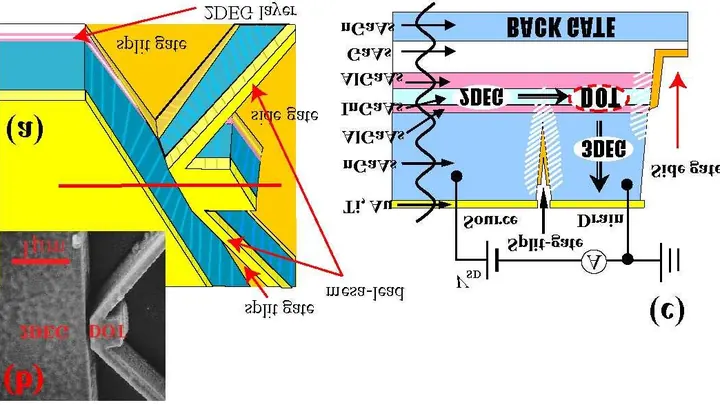
A double quantum dot is a nanoscale system consisting of two small conductive regions, each capable of holding a small number of electrons, coupled together by a tunnel barrier. The electrons can move between the dots via quantum tunneling, and the system's behavior is controlled by external voltages applied to nearby electrodes. This setup allows precise control over the number of electrons on each dot and the coupling between them, making it a versatile platform for studying quantum mechanics at the single-electron level.
History
The first double quantum dots were realized in the late 1990s in semiconductor heterostructures, building on earlier work on single quantum dots. Key experiments by researchers like Leo Kouwenhoven and Charles Marcus demonstrated controlled electron tunneling and quantum coherence in these systems.
How it works
Each quantum dot acts like an artificial atom with discrete energy levels. By adjusting gate voltages, one can tune the energy levels of each dot and the tunneling rate between them. When the energy levels of the two dots are aligned, electrons can coherently tunnel back and forth, forming a quantum state that is a superposition of being on either dot. The system can be operated in different regimes, such as the Coulomb blockade regime where electron transport is controlled by electrostatic repulsion, or the coherent regime where quantum superpositions are maintained. Measurements are typically performed by passing a current through the system and observing conductance peaks.
In a double quantum dot, electrons can be made to 'dance' in a controlled way, and researchers have used them to demonstrate the quantum mechanical phenomenon of coherent superposition, where a single electron exists on both dots simultaneously.
Imagine a ladder whose rungs are tiny magnets. If neighboring magnets point in opposite directions, the ladder is "calm." But if you make them all point the same way, the whole structure becomes magnetized and "stubborn."
Scientists built such a ladder from germanium atoms — a semiconductor used to make transistors.
In a pot of boiling water, steam bubbles appear and disappear — a similar struggle takes place in two-dimensional materials. Here, electrons both create magnetism and try to extinguish it.
At low temperatures, many materials become superconductors — current flows without resistance. But how exactly does this happen if electrons were initially trapped in an insulator? Half a century ago, Philip Anderson suggested that the answer lies in a special quantum dance of particles.
In superconductors, electrons pair up and flow without resistance. Usually, these pairs are distributed uniformly, like water in a calm lake. But sometimes ripples appear in the material — pairs bunch up and thin out with a certain period. This state is called superconductivity with pair-density waves.
Two dancers on stage must move in perfect sync, but if one hesitates, the whole routine is ruined. That's roughly how quantum computers with neutral atoms work: two atoms are entangled by putting them into a Rydberg state (as huge as a balloon compared to an ordinary atom), and then you wait for them to 'dance' their part.
A guitar string keeps vibrating even after the musician lets it go, and that vibration changes the sound the listener hears. Magnetic moments in a crystal behave much the same way: they align into a strict antiferromagnetic order (neighbors point in opposite directions), but they never completely freeze.
A sheet of paper with square grid, one with diamond grid, and one with honeycomb — three different universes for an ant. Change the sheet, and the rules of movement change. That's roughly how electrons experience the crystal lattice: geometry dictates whether they become little magnets, superconductors, or something else. In ordinary materials, the lattice is as rigid as if engraved.
Three guitar strings on the same instrument, but each tuning peg turns with a different resistance: one gives way immediately, another is stiff, and the third is completely stuck.
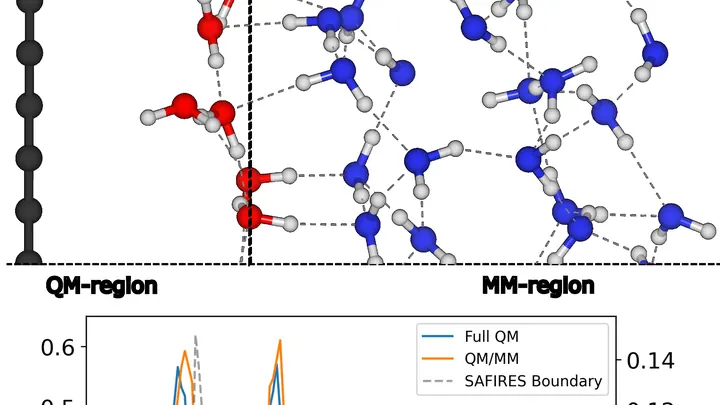
Imagine a huge swimming pool. In one corner, a chemical reaction is underway that needs to be calculated with jeweler-like precision. But the surrounding water is not just decoration: its molecules jostle, attract, and influence the reaction. How do you account for this endless dance of particles without drowning in calculations?
An ordinary crystal is like an apartment building: electrons move through shared hallways and staircases, influencing each other through the walls. Now, imagine removing all the walls, leaving just a single line of apartments. How would the residents behave?
Hydrogen has nothing to do with it, but the collective behavior of electrons takes center stage.
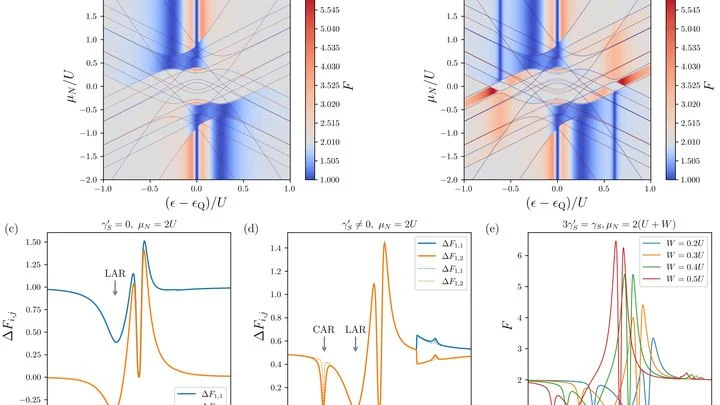
In the world of superconductors, electrons don't like to be alone. They typically pair up into Cooper pairs and move without resistance, like figure skaters holding hands. But you can make them dance in fours. The authors of this work propose a scheme where Cooper quartets, groups of four electrons exchanging partners in a rapid rhythm, are born.
A quantum dot is a trap for electrons, just a few atoms in size, where a particle behaves like a ball in a tiny box. Place two such boxes side by side, and electrons can hop between them, making the system akin to a pair of communicating vessels.
Two quantum dots are like two tiny pockets in a piece of silicon where an electron can sit, like a ball in a cup. When the pockets are far apart, each electron lives on its own, and its energy resembles the levels of a solitary atom.
A quantum dot is like a tiny island where one or a few electrons can settle. In this new work, such an island was connected to two 'seas' of electrons: one flat like a pancake, the other bulky like an ocean. Electrons can hop from the island to the seas and back, and this hop depends on the shape of the electron's wave on the island.
An ordinary superconducting qubit is like a swing that any gust of wind can set rocking. The slightest change in electric charge nearby, and the quantum state is already spoiled.
The surface of the uranium compound UTe2 crystal looks like a frozen sea: in some places, electrons move freely; in others, they get stuck near atoms. A scanning tunneling microscope, a device that probes the surface with an atomically sharp tip and senses individual electrons, revealed that this landscape is not random.
A uranium crystal the size of a grain of rice was cooled to one-fiftieth of a degree above absolute zero. At such temperatures, heat is not transported chaotically but strictly according to the rules of the quantum world.
A laser strikes a strontium atom, and two electrons fly out at once. Previously, it was thought that in such double ionization each electron acts on its own: one is knocked out first, the second later, randomly.
A semiconductor diode normally conducts current in only one direction, like a spring-loaded door: it opens easily one way but pushes back the other. But if you dope the crystal heavily, the door starts behaving strangely: under reverse bias, the current doesn't just flow: it shoots up.
A quantum dot is a box so small that an electron inside cannot have just any energy, but only strictly defined values, like the steps of a staircase. Each step can accommodate several electrons, but exactly how many is the question. If a step is double, two electrons can stand on it; if single, only one.
When a molecule absorbs light, it doesn't just heat up: it transitions into a special, excited state. Its electrons rearrange, like musicians who, after a loud chord, start playing a new melody.
In the quantum world, particles can walk through walls: this is quantum tunneling. If you place a detector right in the path of such a 'ghostly' passage, the moment of detection acts like a starting pistol: the particle gets a sharp kick and flies out of the barrier with excess energy, turning into a tiny engine.