How Liquid Elasticity Reshapes the Particle Trap express
A drop of thick shampoo falls into water and freezes into a strange rope. A liquid that both flows and springs back is called viscoelastic. In it, tiny particles under ultrasound behave quite differently than in water.
In a microchannel filled with such a liquid, ultrasound is turned on, and two flows arise. One, acoustic, pushes particles into certain zones, like wind driving pollen toward a fence. The second, vortical, from the intense sound, stirs the liquid itself and can blow particles away. In a viscoelastic medium, these forces intertwine differently: the liquid's elasticity acts like an invisible net that sometimes catches a particle, sometimes lets it go. The scientists built a model based on equations for an Oldroyd-B fluid — a mathematical description where the liquid remembers recent deformations, like a rubber band.
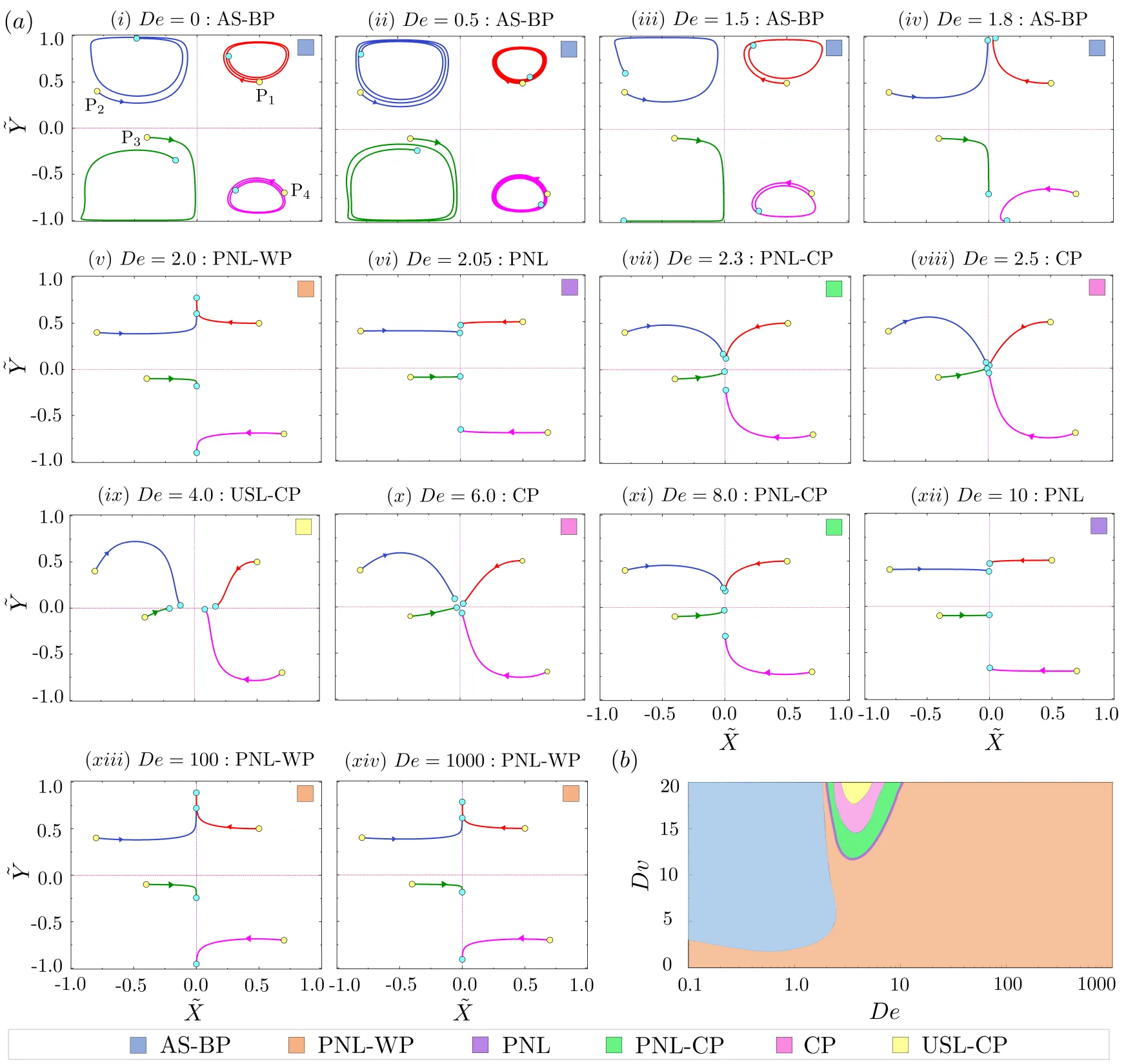
The main control knobs turned out to be two numbers. The Deborah number (De) compares the relaxation time of elastic stresses in the liquid to the ultrasound period: the larger it is, the longer the liquid 'remembers' the push. The viscous diffusion number (Dv) shows how quickly vortices decay due to viscosity. By changing them, you can transplant the particle trap from one place to another: from the channel center to the wall, to a line where pressure doesn't oscillate, or to the symmetry axis of the sound.
This gives birth to acoustofluidics for complex liquids — the ability to contactlessly sort particles smaller than a micrometer. It's a direct path to delicate work with living cells, viruses, or drug droplets, where it's crucial not to damage the cargo. And all because the liquid springs back a little.
Original abstract
as written by the authors arXiv:2605.08906
Particle migration and trapping in ultrasonically actuated microscale flows arise from the competition between acoustic radiation forces and streaming-induced drag. While these mechanisms are well understood in Newtonian fluids, the role of fluid viscoelasticity in governing particle dynamics remains largely unexplored. Here, we investigate particle transport and trapping in a viscoelastic fluid within an ultrasonically excited microchannel under the combined action of acoustic streaming and radiation forces. Using a perturbation framework, we solve the continuity, momentum and constitutive equations for an Oldroyd-B fluid to obtain the oscillatory acoustic field and the resulting steady streaming flows in the bulk and near-wall boundary layers. Acoustic radiation forces, incorporated through a semi-analytical model, drives particle migration, while streaming-induced drag can oppose, alter or suppress trapping. We show that particle trajectories and equilibrium trapping locations are governed primarily by the Deborah number ($$De$$) and viscous diffusion number ($$Dv$$). At high $$Dv$$, increasing $$De$$ shifts the trapping location from the bulk region to the channel wall, pressure nodal line, channel centre or ultrasound symmetry line. We further determine the critical particle size governing the transition between radiation-dominated and streaming-dominated regimes as a function of $$De$$ and $$Dv$$. The critical particle size can become significantly smaller than that in a Newtonian fluid, enabling effective manipulation of submicron particles and overcoming a key limitation of conventional acoustofluidics. These results demonstrate how viscoelasticity fundamentally modifies acoustophoretic transport and establish new mechanisms for tunable particle migration and trapping in complex fluids.
The Deborah number is named after the prophetess from the biblical Book of Judges, who said: 'The mountains melt before the Lord'—a hint that even the solid can flow if you watch long enough.
In the novel 'Expanse', engineers use sound fields to control flows in zero gravity — a similar principle, but instead of viscoelasticity, inertia does the work.