Quantum capacitor charges in an instant express
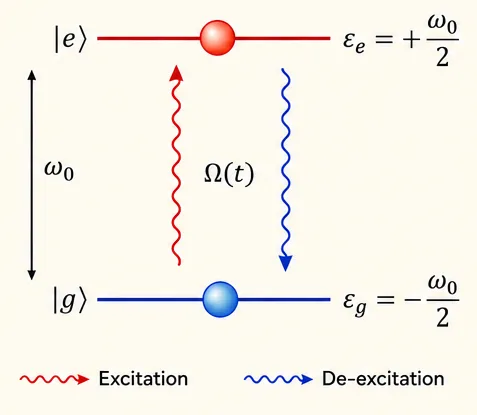
An ordinary battery in a phone stores energy in chemical bonds — slowly, with heat and wear. A quantum capacitor works differently: it charges not with matter but with rhythm. A swing that is pushed in time with its motion accumulates energy in the motion itself, without friction. Here, the swing is played by a quantum system with two levels (like two riverbanks), and the pushes are an external electromagnetic field. When the field "hits the rhythm," the system polarizes: charges shift in unison, and energy is stored in that shift, like in a stretched spring.
The main advantage is reversibility and speed. An ordinary battery releases energy in bursts, losing some as heat. Here, energy bounces back and forth between the field and the capacitor almost without loss, like a ball in a perfect ping-pong game. The authors calculated the "quantum capacitance"—a measure of how much energy can be stored at such resonance. It turns out that if you bring many such systems together and let them interact, their total capacitance and charging power increase dramatically. The particles help each other swing.
The practical side is still far from the power outlet, but the idea is tempting: tiny energy storage for microdevices, charged by light or radio waves. The characteristic charging time of such a capacitor is picoseconds (trillionths of a second). In one picosecond, light travels only a third of a millimeter. And the main enemy here is the environment, which disrupts the rhythm, causing decoherence (loss of quantum coherence). Fighting this is the next step toward real devices.
Thus, physicists turn the abstract concept of quantum coherence into a working resource — much like 19th-century engineers tamed electrical capacitance in Leyden jars. Only now, instead of glass and foil, we have cold atoms and superconducting chains.
Original abstract
as written by the authors arXiv:2605.09527
Quantum batteries have recently emerged as promising candidates for microscopic energy-storage technologies exploiting uniquely quantum mechanical effects. In this work, we introduce the concept of a quantum capacitor, a coherence-based quantum energy-storage device exhibiting reversible and ultrafast charging-discharging dynamics. Unlike conventional quantum batteries, which primarily focus on extractable work, the proposed quantum capacitor operates through reactive energy accumulation mediated by coherent quantum polarization. We formulate a theoretical framework based on a driven two-level system and define a dynamical quantum capacitance associated with the response of stored energy to coherent external driving. The charging power, reversible energy exchange, and the effects of environmental decoherence are investigated analytically within the Lindblad formalism. We extend the proposal to interacting many-body systems and show that collective coherence and interactions can enhance the effective quantum capacitance and charging power, potentially leading to cooperative energy-storage advantages beyond the single-qubit regime.
Quantum capacitance, unlike ordinary capacitance, does not depend on the geometry of the plates: it is determined only by the strength of particle interactions and the field frequency, meaning it is an "invisible" capacitor without plates.
In Isaac Asimov's novel "The Gods Themselves," aliens use quantum exchange to transfer energy between universes, a local analog of reversible lossless charging.