The Universe in a Wine Glass: How New Worlds Are Born ✛ ✎ ✦
Immediately after the Big Bang, according to the theory of Alan Guth, space instantly inflated. The cause of the jolt remained a mystery: calculations break down at the point of infinite density.
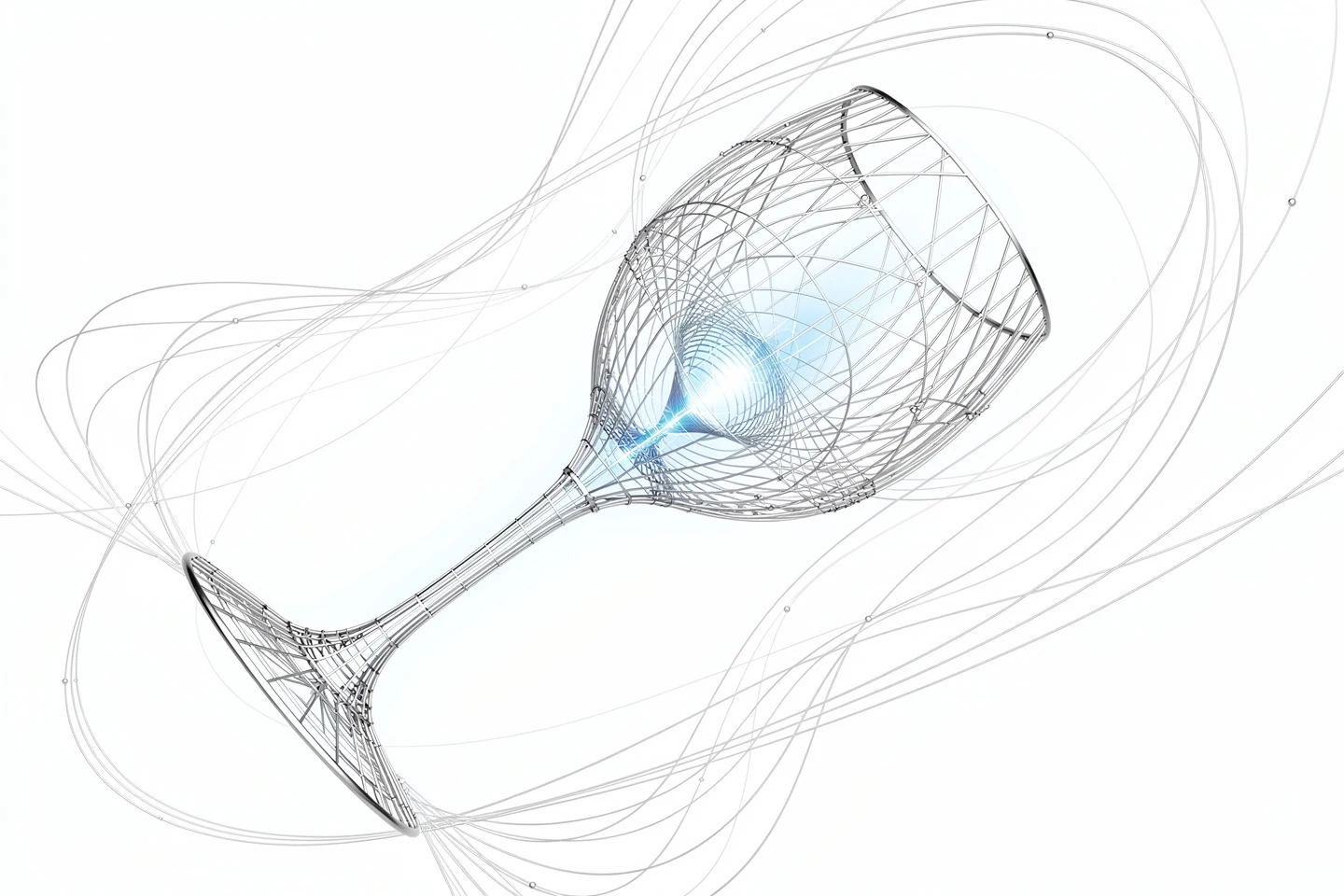
Physicists found an answer at the quantum level: microscopic bridges — wormholes — in the fabric of spacetime. If such a bridge carries an axion field or a magnetic charge, it stretches into the shape of a wine glass. The bowl is our inflating universe, the stem is a narrow neck, and the base is the parent world.
At the zero limit, the stem disappears. The glass loses its connection to the base, turning into a bubble with dark energy. This is exactly the picture of 'birth from nothing' painted by Hawking. Now both scenarios are just edges of one shape. The quantum wine glass becomes the cradle of creation: it gives a beginning without a singularity and accelerates growth.
At the zero-charge limit, the stem disappears, and the wine glass turns into two disconnected objects: an inflating bubble and a void. This is how the theory unites two seemingly opposite scenarios of the universe's birth.
In the movie 'Interstellar,' wormholes are passages between galaxies, but here they give birth to entire universes, remaining invisible quantum bridges.