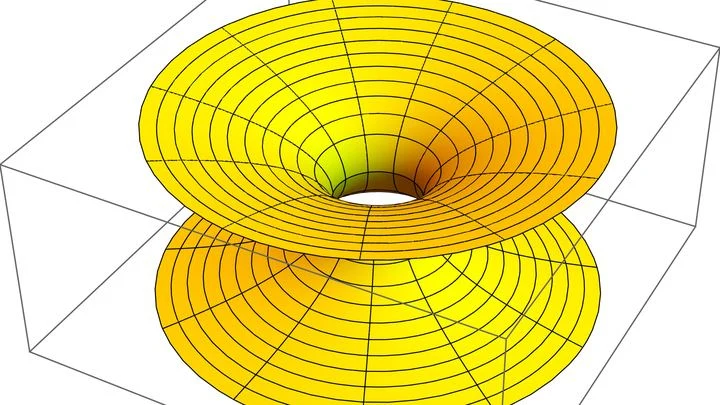
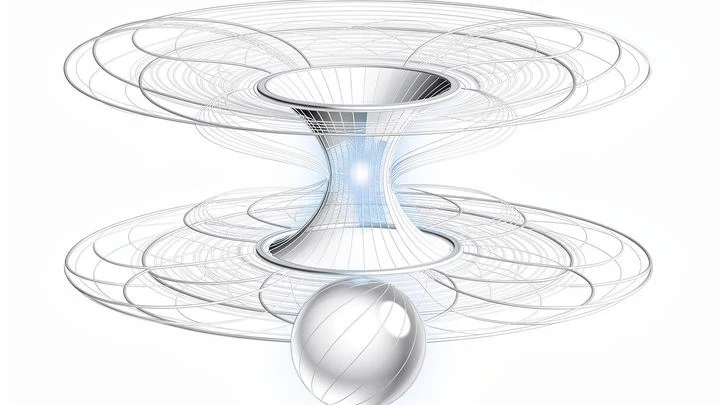
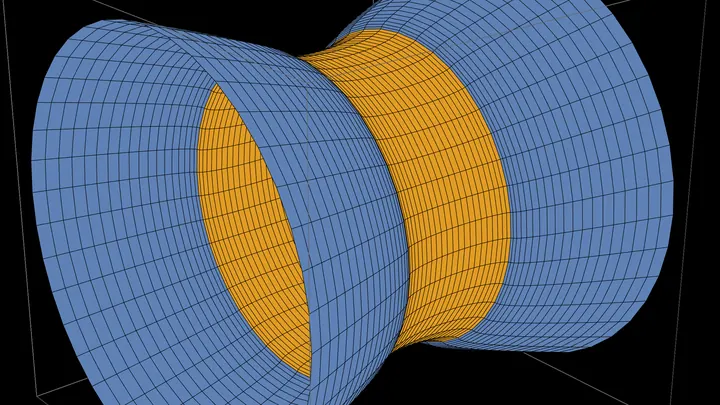
A traversable wormhole is a hypothetical tunnel-like structure in spacetime that connects two distant points, potentially allowing matter or signals to pass through faster than a journey through normal space. Unlike a black hole, which traps everything that crosses its event horizon, a traversable wormhole would have an open throat that permits two-way passage. This concept challenges our understanding of gravity and spacetime, suggesting that the universe might have hidden shortcuts that could revolutionize travel and communication.
History
The concept of wormholes dates back to 1935, when Albert Einstein and Nathan Rosen proposed the Einstein-Rosen bridge, though it was not traversable. The idea of a traversable wormhole was formalized by Kip Thorne and his collaborators in 1988, who showed that such structures could exist in principle if exotic matter were available.
How it works
In general relativity, a wormhole is a solution to Einstein's field equations that describes a bridge between two regions of spacetime. For it to be traversable, the wormhole must be held open by 'exotic matter' with negative energy density, which counteracts the gravitational collapse that would otherwise close the throat. Recent theoretical work has explored alternatives, such as pure geometry or quantum entanglement effects, that might avoid the need for exotic matter, but no experimental evidence exists yet.
In practice
While purely theoretical, traversable wormholes are studied in quantum gravity and holography, where they serve as models for understanding entanglement and the information paradox in black holes.
Fun fact
Some physicists have proposed that a traversable wormhole could be created by manipulating quantum entanglement, as suggested by the ER=EPR conjecture, which links wormholes to entangled particles.
A vortex in a magnetic material is like a whirlpool, but instead of water, the directions of magnetization twist. An electron flying through such a vortex feels not just a magnetic field, but a curvature of space: its path bends as if it were rolling down a funnel with a narrow neck.
A black hole is not an eternal vacuum cleaner. Surround it with a non-ideal fluid (matter with internal friction), and the geometry starts to lead a life of its own. The authors of the paper showed that a special geometric flow, the almost η-Ricci–Yamabe soliton, acts like an invisible sculptor.
Two metal plates in a vacuum attract each other without any magnets or charges. This is the Casimir effect: the void is not empty; particles constantly pop in and out of existence, and there are fewer of them between the plates than outside. The pressure difference pushes the plates together.
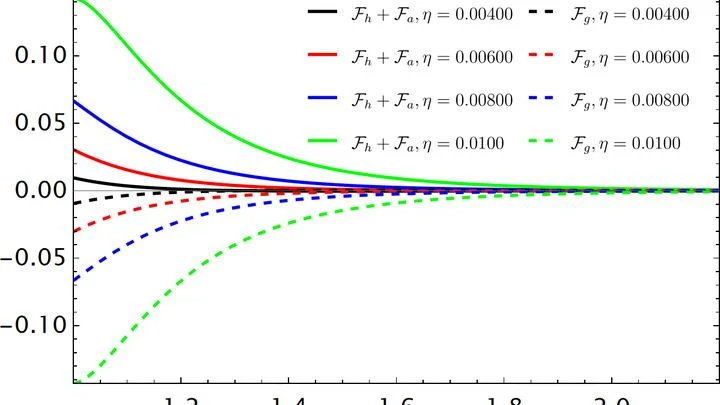
A wormhole is a tunnel connecting two distant regions of the universe. If such a wormhole existed and were traversable, a particle inside it would feel not only gravity but also a force from its own electric field. This force depends on how spacetime is curved around it.
The black hole paradox has haunted physicists for decades. If a hole evaporates, where does its contents go? Discoveries by Stephen Hawking and Jacob Bekenstein showed that saving the laws of nature requires an unconventional move.
Imagine the universe as a woven blanket of invisible threads.
Wormholes — tunnels through curved spacetime, allowed by general relativity. To be stable, they need repulsive energy — the kind that pushes apart rather than attracts.
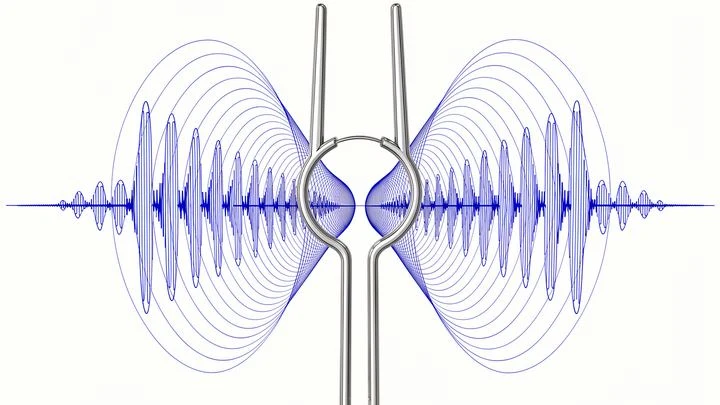
A wormhole is like a tunnel with a very narrow throat. If you send a sound signal into such a tunnel, part of the echo returns, while part gets stuck in the middle, and will leak out very slowly.
In 2019, the image of the M87* shadow was a sensation: for the first time, humanity saw the outlines of a black hole, predicted by Schwarzschild and shrouded in myth. But what if that glowing crescent isn't a portrait of an absolute abyss, but of a cosmic portal?
A wormhole is a hypothetical tunnel in curved spacetime connecting two distant regions of the universe and potentially shortening the journey between them.
Every quantum system (whether an atom, a crystal, or the entire Universe) has its own set of allowed energies, like the steps of a ladder. The hotter the system, the more readily particles climb to higher rungs.
Spacetime is like a giant sheet of paper. Fold it, and distant corners come together. Poke a pencil through, and you get a wormhole, a short tunnel through the folds. But the paper wants to spring back flat, snapping the passage shut. To keep it open, you need a rare “gasket”—matter with negative energy.
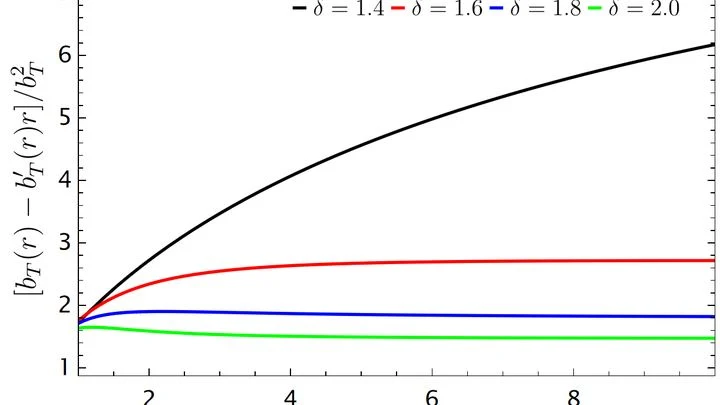
A wormhole is a tunnel through the fabric of spacetime, an idea expanded by John Wheeler and Kip Thorne. Just as a mountain passage tends to cave in, the throat of a wormhole wants to snap shut.
A research probe is planned for the nearest black hole — a region of spacetime whose gravity traps even light. After a hundred years of flight, the spacecraft will enter orbit around the mysterious object to answer a key question: are we looking at a black hole or a neutron star — the ultra-dense remnant of a massive star, compressed to nuclear…
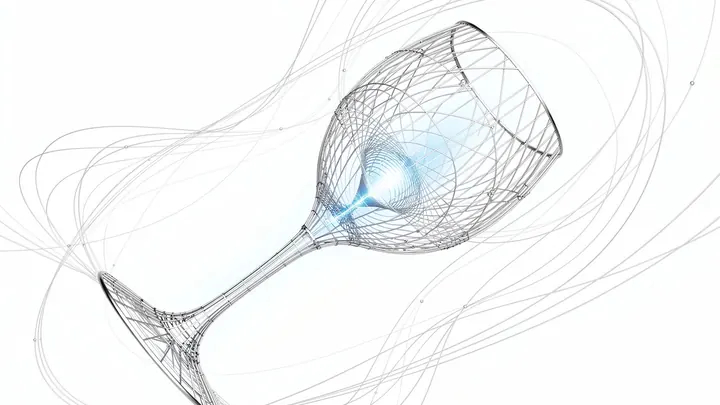
First thing that comes to mind when thinking about the birth of the Universe is an explosion. But modern cosmology paints a more refined picture: birth through the neck of a wine glass. This geometry is not a sommelier's fantasy, but a rigorous form of Euclidean wormhole that connects two anti-de Sitter worlds.
Cosmology has long sought a loophole behind the Big Bang. Inflation, proposed by Alan Guth, stretches and smooths out primordial inhomogeneities, but what lit the fuse itself?
Einstein and Rosen imagined a bridge connecting two sheets of reality. Wheeler gave it a name — wormhole, and Thorne with Morris proved: the tunnel is traversable if you fill it with exotic matter.
Spacetime sometimes resembles a sheet of paper in which you can punch a hole and connect the edges with a short tube: you get a wormhole. In the simplest mathematical models of such wormholes, massless scalar fields appear — something like an invisible fog filling everything around.
The term 'wormhole'—coined for physics by John Archibald Wheeler in 1957—still teases the imagination. It's a hypothetical tunnel through curved spacetime, connecting distant regions of the Universe or even different universes.
You can poke a pencil through a folded sheet of paper, and the path between two points becomes shorter. That's roughly how the idea of a wormhole works: a tunnel in space connecting distant regions.
A drop of cream falls into a cup of coffee, and within a minute, the entire drink turns beige. This mixing process can be quantified: how much "stirring" is needed to transform one distribution of particles into another? In mathematics, this approach is called optimal transport, and the measure of effort is the Wasserstein distance.
The authors applied this idea to quantum systems.
Physicists found out: to open a wormhole, you have to shake it hard. Not literally — but on a quantum chip, they simulated a system of 8 particles, so chaotic and entangled that it turned into a vibrating hologram of a black hole.
Some black holes are remnants from the Big Bang. Usually they fade via a slow radiation leak — predicted by Stephen Hawking. But a quantum switch could invert them into white holes, explosively releasing all energy like popcorn kernels that suddenly pop.
Two non-spinning black holes at the moment of merger give birth to gravitational waves — ripples in the very fabric of spacetime, captured by instruments developed with the help of Kip Thorne.
An ion channel in a cell membrane is a gate just a few atoms wide. Every second, millions of charged particles, sodium and potassium ions, pass through it. Classical physics said that to get through, an ion must jump over an energy barrier, like a traveler crossing a high mountain pass.
A particle wanders through a medium scattered with obstacles. Sometimes it pushes them aside like a snowplow, and it was thought that this pushing is what eventually stops the motion. But in three-dimensional space, that mechanism doesn't work.
It turns out that stopping arises from rare events: every so often, a particle randomly finds itself in a trap, and all exits close, as if doors slam shut.
An ordinary door swings both ways, but the physicists rigged a one-way door for atoms — enter at will, but leaving is off-limits. The atoms were cooled nearly to absolute zero — in such deep cold, they merge into a single cloud. This cloud was placed in a neat lattice of laser beams, adding a tiny irregularity, like a step at the threshold.
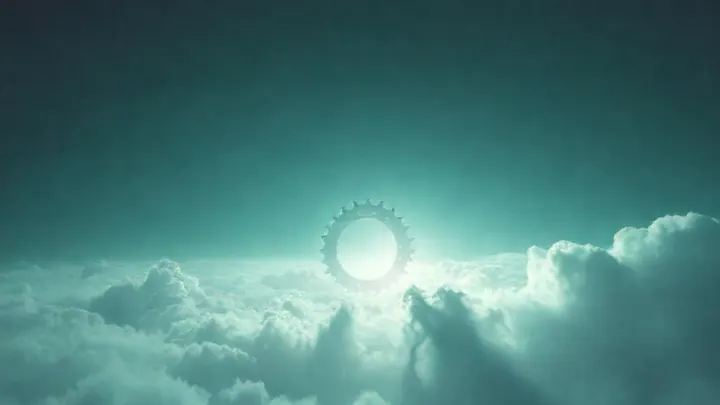
A wormhole is a tunnel through space, connecting distant regions of the Universe. Its shadow against a bright gas background was long thought to be as round as that of a black hole. But for a rotating wormhole (one you could actually traverse), the shape of the shadow might be surprising: the edge becomes jagged, like a gear.
An ordinary black hole is a bottomless pit from which not even light can escape. However, physicists have found a way to turn this pit into a through-tunnel — a wormhole.
A black hole that has almost stopped consuming matter is like a kettle coming to a boil: calm on the outside, but seething with invisible processes within. Physicists have peered into this boundary world, where space and time no longer follow the familiar rules.
They have described everything that happens right at the horizon: that invisible boundary beyond which even light cannot return.
Sound in a thin plate behaves like ripples on water: it travels, reflects off edges, and changes shape. But sound has a peculiar trait: it can pass through places where waves are forbidden to exist. It's as if ripples on a pond suddenly vanished before a stone barrier and reappeared on the other side, without going around it.
In disordered materials, such as organic semiconductors or inks made from two-dimensional materials, electrons don't move smoothly like water through a pipe. Instead, they hop from one spot to another, like a ball bouncing across a rough surface. This kind of motion is called hopping transport.
Time is a one-way road: events race forward with no U-turn allowed. The arrow of direction is governed by entropy — a measure of disorder, which only grows in the Universe, like a traffic jam at rush hour. You can clear one intersection, but the overall congestion only gets worse.
Two seemingly incompatible mathematical languages describe a single quantum reality. The first is the language of quantum walks: here, a particle (such as an electron or even a quasiparticle in a condensed medium) takes a stroll on a graph, simultaneously exploring all possible paths — much like a pedestrian in an unfamiliar city instantly finding…
Two water droplets tremble in sync — because they're connected by a straw. So it is with entangled particles: their unity may be held together by a microscopic wormhole.
In the familiar world, we have three spatial dimensions. However, theoretical physics allows for additional, hidden directions — compactified, that is, curled up to microscopic sizes.
A wormhole is a tunnel that pierces through curved space and connects distant regions of the Universe. Recently, Juan Maldacena and his colleagues proposed a working model of such a hole based on a special combination of spatial curvature and quantum particles.
A waterfall doesn't ask if you're ready to jump. Its flow accelerates, and at some point even light can't escape back. A McVittie black hole is such a waterfall, but not in an ordinary river; it's in an expanding universe: the water here is space itself, which continuously stretches, carrying galaxies apart from each other.
A black hole is not just the universe's trash can; it is more like a safe with a secret code. For decades, it was thought that any signal sent toward the event horizon would be partially reflected back: curved spacetime acts like a funhouse mirror, and some energy always escapes.